

In short
- In the connection and meaning section: in a lab test on bite splint materials, toothpaste changed the surface roughness of all three materials, and a 3D-printed resin brushed with toothpaste became clearly softer.1
- Of the four cleaning products tested, a neutral cleaner was the mildest. The test was not done on bite splints people wore, but on small pieces of material.1
- Milled bite splint material was the hardest in every situation, in line with earlier lab research in which milled materials and PMMA-based materials were the harder ones.2
- In 2018, 80 per cent of adults had contact with a dentist (CBS, 2019), so the person who can tell you what your bite splint is made of is usually within range.3
Contents
- Connection and meaning: what happens to your bite splint when you brush it
- A visit most adults already make
- Why bite splints wear, and what was known until now
- Who measured it, and where it was published
- Hardness and roughness: what the cleaning product does to the surface
- What brushing did, material by material
- What this lab test did not show
- In short, and what you can do now
- Frequently asked questions
Connection and meaning: what happens to your bite splint when you brush it
In this piece from the connection and meaning section, you read what brushing does to your bite splint: what happens to the surface of bite splint materials, the mouthguards people wear for teeth grinding and clenching, when those materials are brushed every day with different cleaning products. That matters, because toothpaste, the product most people reach for, changed the surface of every material in the lab, while a mild, neutral cleaner affected the surface the least. It also matters because the material your bite splint is made of determines how much the surface gives way.
You wake up, take the bite splint out of your mouth and hold it under the tap. Then you do what feels responsible: a little toothpaste on the brush, a good scrub, a rinse and back into its case until bedtime. You rely on that piece of plastic every night, and you want it to last. Somewhere at the back of your mind is the question of whether all that scrubbing keeps the bite splint clean or slowly wears it down, and nobody has ever told you which product to use.
A visit most adults already make

If you wear a bite splint, you probably see the person who made it anyway. According to Statistics Netherlands (CBS), in 2018, 80 per cent of adults said they had been in contact with a dentist in the past year, more than the 71 per cent who had been in contact with their GP (CBS, 2019).3 And in 2019, 72 per cent of adults said they felt their own oral health was good (CBS, 2020).4
So a visit to the dentist is one of the most ordinary appointments there is, and a question about cleaning a bite splint fits easily into it. These figures do not count how many people wear a bite splint. They show that you are one of many who sit in that chair. If you would like a picture of where your wider lifestyle stands today, the BioProfile lifestyle scan gives you that. The scan is not a diagnosis.
Why bite splints wear, and what was known until now
Many bite splints exist because of what the jaw does when you are not paying attention. An international group of experts describes grinding and clenching as activity of the jaw muscles during sleep or during the day. In people who are otherwise healthy, the experts see it not as a condition but as a behaviour. It can be assessed by asking people themselves and also with measuring equipment, and there is no fixed line between present and absent.5 A bite splint sits between the teeth, so it is the plastic that takes the contact.
Bite splints are made in different ways. Some are milled from a solid block of PMMA, a hard acrylic plastic. Some are 3D-printed from resin. Some are made from acrylic resin that is hardened in a microwave. Those methods do not produce the same material. Earlier lab research found that milled bite splint material was stronger and harder than cold-setting or 3D-printed bite splint materials, and that 3D-printed materials generally fall behind milled ones in surface hardness.2 Another lab comparison of nine bite splint materials found that PMMA-based materials had the most even surface hardness and wear across all production methods, while flexible 3D-printed materials and polycarbonate-based materials wore more and were softer.6
That is where the knowledge in these sources stopped. The earlier research measured the strength, hardness and wear of the material itself. It did not look at the part of a bite splint's life that happens at your bathroom sink: the brush and the cleaning product, day after day. A bite splint is one part of how your mouth gets through the day, alongside eating and drinking; what a day's food adds up to is another subject, explained in how many calories you need per day.
Who measured it, and where it was published
The new research comes from the Department of Dentistry at the Universiteit van Brasilia (UnB) in Brazil. The authors are de Aragao Junior EX (postgraduate student), Silva DT (predoctoral student), Farias SJS and Guedes BS (postgraduate students), and Kogawa EM and de Medeiros RA (professors), all from that department. Their article, "Surface alterations in materials for occlusal devices subjected to simulated brushing with different solutions", was published online in The Journal of prosthetic dentistry on 9 October 2026. It is not a preprint but an article in a professional journal.1
Why this matters to you: it takes the question out of the dental lab and puts it next to your bathroom sink. The earlier comparisons told you which bite splint material is harder from the start. This study asks what an ordinary daily routine does to it, using everyday products such as toothpaste and a neutral cleaning agent, alongside distilled water and a gel for cleaning acrylic parts. Healthy ageing is usually about how long people stay healthy. Here it is about the lifespan of the thing you put in your mouth every night, and the authors say exactly that: daily brushing can affect how well the material works and how long it lasts.1 If you want the human side of that, read about the difference between your age on paper and how your body ages in biological age versus calendar age.
Hardness and roughness: what the cleaning product does to the surface
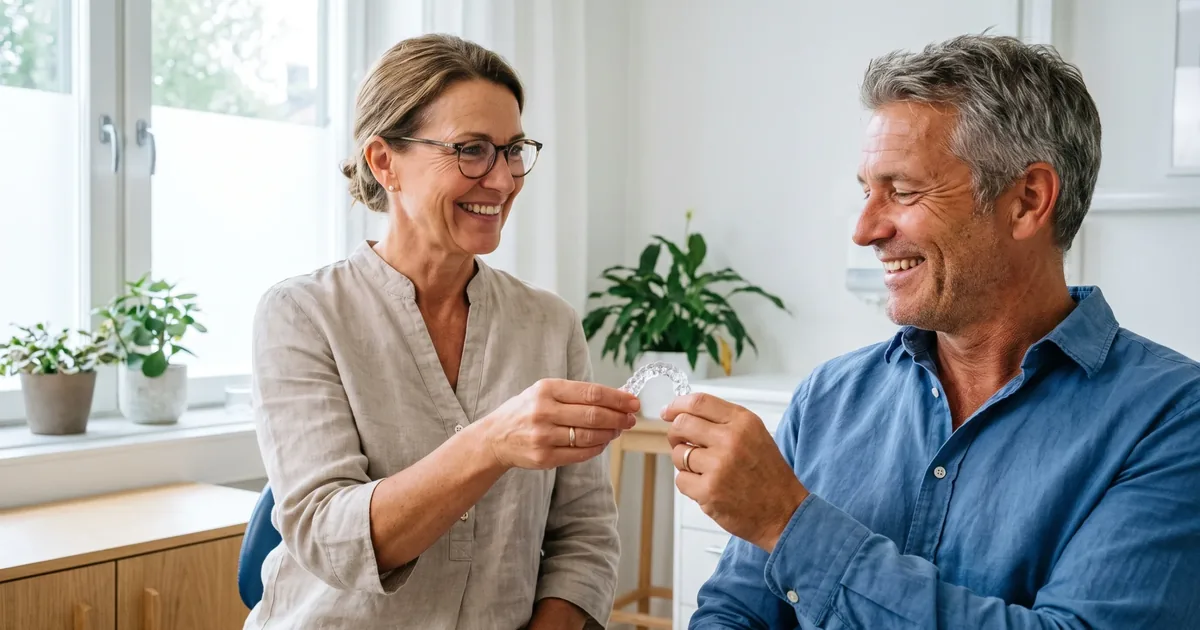
The one idea you need to grasp here is that a bite splint has a surface, and that surface does the work. Every night your teeth press and slide against it. Every morning a brush and a cleaning product go over it. The team in Brasilia measured two properties of that surface.
The first is hardness: how well the surface resists being pressed in. The team used Vickers microhardness, a standard lab measurement in which a very small tip is pressed into the material and the size of the mark is read. A harder surface leaves a smaller mark. The second is roughness: how even the surface is on a very small scale. A surface can become rougher if brushing scratches it, or less rough if brushing makes it smoother. Either way, brushing has changed not only what sits on the surface, but the surface itself.
Why would either of them matter? The authors start from the problem that daily brushing with different cleaning products can change the roughness and hardness of bite splint materials, and with that how well the splint works and how long it lasts.1 A bite splint is meant to be used night after night, so a product that changes the surface a little does so again every day.
Why people wear a bite splint in the first place usually has to do with the jaw. Sheila Stille, a dentist and lecturer at the University of Colorado Anschutz School of Dental Medicine, writes about night-time bite splints in connection with stress:7
If you still feel stressed, talk to your dentist about trying a flat bite splint at night. You can protect your teeth, and sometimes you may even stop grinding, because it removes the feedback that comes from the cusps of your molars working against each other.
Sheila Stille, DMD, faculty, University of Colorado Anschutz School of Dental Medicine
The word to watch in this piece is flat. A flat bite splint works through its surface: the teeth meet an even, level plane. What a cleaning product does to that plane, whether it makes it harder or softer, rougher or smoother, is exactly what the new lab test measured.
The bite splint is also only part of what the jaw goes through in a day. Frank Lobbezoo, a dentist-gnathologist (a dentist who specialises in the jaw and how it works) at ACTA, the Academisch Centrum Tandheelkunde Amsterdam, said the following about chewing gum to the consumer programme Radar:8
Giving up chewing gum is one of the first and most unambiguous pieces of advice we give our patients.
Frank Lobbezoo, dentist-gnathologist, ACTA (Academisch Centrum Tandheelkunde Amsterdam)
In other words: at ACTA, giving up chewing gum is one of the first and clearest pieces of advice patients get. The bite splint and the habits around it belong together.
What brushing did, material by material
The test itself is simple to describe. The team made 180 small cylinders, 6 mm across and 3 mm high, from three materials used for bite splints: milled PMMA blocks, 3D-printed resin and acrylic resin hardened in a microwave. The pieces went through simulated brushing with four solutions: distilled water, a neutral cleaning agent, toothpaste and a cleaning gel made for acrylic resin parts. Hardness and roughness were measured once on each piece before the brushing began and once more when the brushing was finished.1
What came out of it, in plain words:1
- The milled material was the hardest of the three in every situation tested.
- Brushing left the hardness of every material unchanged, with one exception: the 3D-printed resin brushed with toothpaste became clearly softer.
- Toothpaste clearly changed the roughness of all three materials; according to the abstract, all three became less rough.
- The 3D-printed resin also changed in roughness with the gel, and the microwave resin changed in roughness with the neutral cleaning product.
Less rough can sound like good news. The authors don't present it that way. They count it among the surface changes that daily brushing brings with it, and for the 3D-printed resin with toothpaste they also describe more surface wear. Their conclusion is that, of the solutions tested, the neutral cleaning agent was the least aggressive and did not clearly change the properties of the resins, although it did make the microwave resin less rough.1
Two examples make the difference concrete.
Take a 3D-printed bite splint that is brushed with toothpaste every morning. In this test, that was the only combination in which a material lost hardness, and it is the combination for which the authors describe more surface wear. It fits what earlier lab research found: 3D-printed bite splint materials generally lag behind milled ones in surface hardness from the start.2 A material that starts out softer and is then brushed with the most aggressive product in the test is the combination that changed the most.
Now take a milled bite splint that is cleaned with a neutral cleaning agent. Milled PMMA was the hardest material under every condition, and the neutral cleaning agent did not clearly change its roughness; the only material this agent changed was the microwave resin. Of the combinations in this test, this is the calmest. That also fits earlier lab research, in which PMMA-based materials kept the most even surface hardness and wear across all production methods.6
So the same bite splint can have a very different morning depending on the product next to the sink, and the same product can mean something different depending on what the bite splint is made of.
What this lab test did not show
This was a lab test, done in vitro, not on bite splints that people wore but on small cylinders of material. Nobody wore anything, so saliva, grinding and a night in a mouth never came into it at any point. In other words, the group studied is not made up of people but of 180 test pieces.1
The summary leaves a lot unsaid. It does not say how long the simulated brushing lasted or what that stands for in weeks or months of real use, how hard the brush pressed, which toothpaste, cleaning product or gel was used, or how many pieces there were in each combination of material and solution. The summary does not give the size of the changes in everyday terms, but it does give the direction they go in. It does not say whether any of the changes would be noticeable in the mouth or would shorten the working life of a real bite splint. And the test did not look at how clean each solution gets a bite splint, even though that is exactly why people brush one.
So the finding is narrow: in this lab, toothpaste acted on the surface of every material, the 3D-printed resin was the most sensitive and the neutral cleaning product was the mildest. Whether that also applies to your own bite splint is a question for the person who made it.
In short, and what you can do now

In short: the surface of bite splint materials changes with the product used to brush them. In a lab test at the University of Brasilia, toothpaste changed the roughness of all three materials tested, a 3D-printed resin brushed with toothpaste became clearly softer, milled PMMA stayed the hardest throughout, and a neutral cleaner was the mildest.1 That fits earlier lab research in which milled materials and PMMA-based materials were the harder ones.2,6 The test was done on small pieces of material, not on bite splints people wore, and it does not say how large the changes were in daily use or how long a real bite splint lasts. And in 2018, 80 per cent of adults had contact with a dentist (CBS, 2019), so the person to ask is usually within range.3
Three directions follow from this, and none of them is a prescription.
Find out what your bite splint is made of. Milled, 3D-printed and microwave-hardened resins did not behave the same way in this test, so the material is the first thing you want to know. Your dentist or the lab that made your bite splint can tell you.
Ask which cleaning product suits that material. You are welcome to bring the lab finding that a neutral cleaner was the mildest into that conversation; it is not a rule for every bite splint.
Look at what lies behind the bite splint. In people who are otherwise healthy, grinding and clenching are more a behaviour than a condition,5 and behaviour is part of how your days and nights unfold. How those days fit together is the open question this piece cannot answer for you. The scan below is a place to start looking at your own lifestyle and where you stand today. The scan is not a diagnosis.
Frequently asked questions
Can I clean my bite splint with toothpaste?
In this lab test, toothpaste changed the surface roughness of all three bite splint materials, and the 3D-printed resin brushed with toothpaste became clearly softer.1 The test was done on pieces of material, not on bite splints in use, so ask your dentist which cleaning product suits the material of your own bite splint.
In this test, what was the gentlest way to clean a bite splint?
The authors conclude that of the four solutions tested, the neutral cleaning product was the least aggressive and did not clearly change the properties of the resins, although it did make the microwave resin less rough.1
Is a 3D-printed bite splint softer than a milled one?
In the lab, usually yes. Earlier research found milled bite splint material stronger and harder than cold-setting or 3D-printed material,2 another comparison found flexible 3D-printed materials softer and less resistant to wear,6 and in the new test the milled material was the hardest in every situation.1
Is teeth grinding a condition?
International experts describe grinding and clenching as activity of the jaw muscles during sleep or during the day, and in people who are otherwise healthy, they see it not as a condition but as a behaviour.5
Does this tell me how long my bite splint will last?
No. The abstract does not say what the simulated brushing stands for in months of real use, how large the changes were in everyday terms, or whether they shorten the working life of a real bite splint.1
Sources
Every source below was checked on the day this article was published. The numbering follows the text.
- de Aragao Junior EX, Silva DT, Farias SJS, Guedes BS, Kogawa EM, de Medeiros RA. Surface alterations in materials for occlusal devices subjected to simulated brushing with different solutions. The Journal of Prosthetic Dentistry, 2026. In vitro; Vickers microhardness and surface roughness; 3-way repeated-measures ANOVA with Tukey HSD test (α=.05); the changes the text calls clear were reported at P<.001. pubmed.ncbi.nlm.nih.gov
- Prpic V, Spehar F, Stajdohar D, Bjelica R, Cimic S, Par M. Mechanical Properties of 3D-Printed Occlusal Splint Materials. Dentistry Journal, 2023. pmc.ncbi.nlm.nih.gov
- CBS. Waardering voor zorgverleners. Statistische Trends, 2019. cbs.nl
- CBS. Meerderheid volwassenen tevreden met mondgezondheid. 2020. cbs.nl
- Lobbezoo F, Ahlberg J, Raphael KG, Wetselaar P, Glaros AG, Kato T, Santiago V, Winocur E, De Laat A, De Leeuw R, Koyano K, Lavigne GJ, Svensson P, Manfredini D. International consensus on the assessment of bruxism: Report of a work in progress. Journal of Oral Rehabilitation, 2018. doi.org/10.1111/joor.12663
- Gibreel M, Perea-Lowery L, Vallittu PK, Garoushi S, Lassila L. Two-body wear and surface hardness of occlusal splint materials. Dental Materials Journal, 2022. jstage.jst.go.jp
- Sheila Stille, DMD, faculty, University of Colorado Anschutz School of Dental Medicine. The impact of stress and mental health on oral health. CU Anschutz News, 2025. news.cuanschutz.edu
- Frank Lobbezoo, dentist-gnathologist, ACTA (Academisch Centrum Tandheelkunde Amsterdam). Een strakkere kaaklijn door fitnesskauwgom? 'Dit product is een no-go'. Radar (AVROTROS), 2026. radar.avrotros.nl
Quotations from English have been translated by BioProfile.
Also read
See where you stand today
A short series of questions about how you live, and your result appears in your dashboard. The scan gives you insight into where you stand today. The scan is not a diagnosis.
Free, about 3 minutes. An analysis of your answers, never a diagnosis.
BioProfile analyses your health status to guide you and your coach. It does not make a diagnosis, only a doctor can do that. Built on validated health questionnaires; the combined BioProfile score is not itself a validated clinical instrument yet. Your answers stay private (GDPR).