
BioProfile analysis · stress scan
Your result in 3 minutes
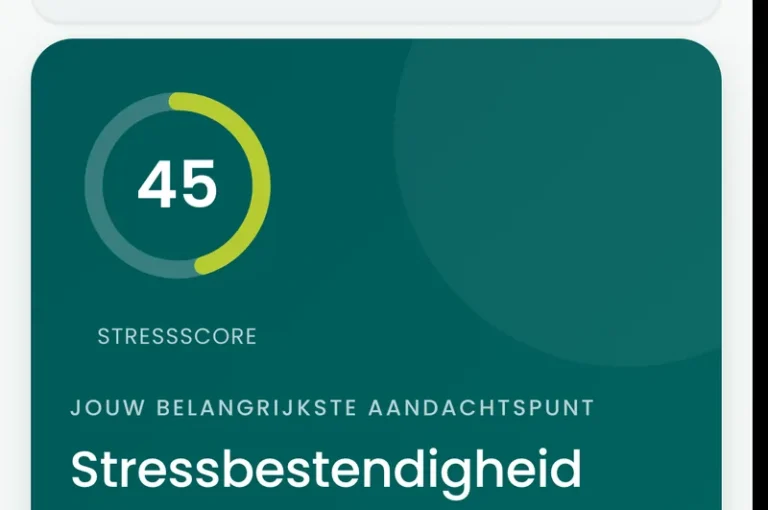
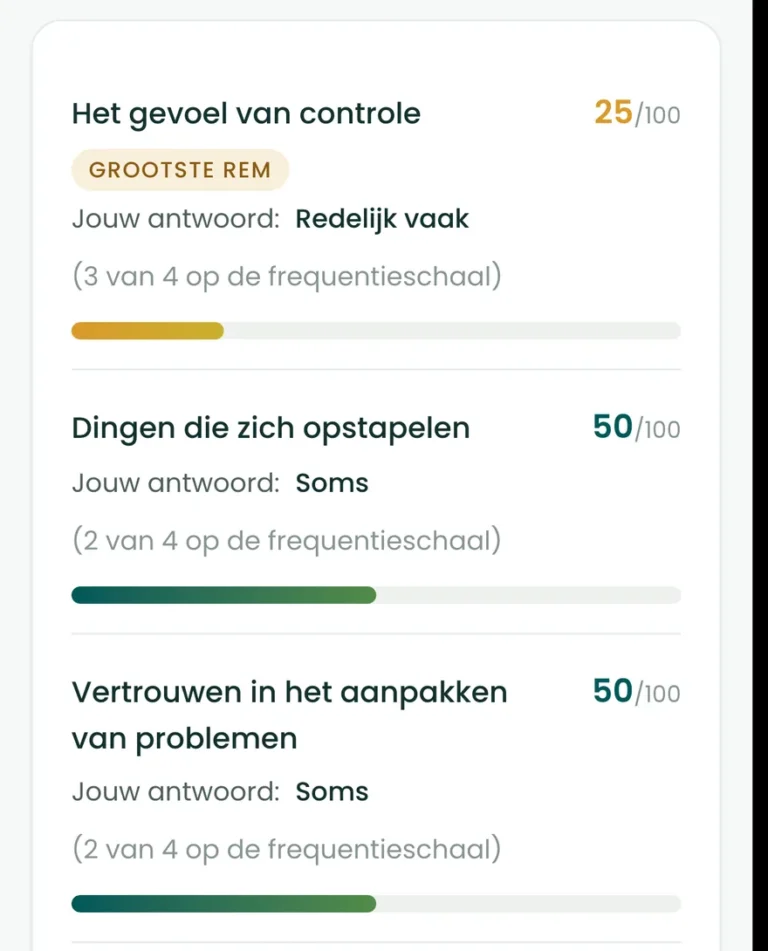
Your stress score over the past two weeks, with the reading band it falls in and, for each question, the number that pulled your score down or up. All of it on your own screen, in your dashboard, and again in two weeks.
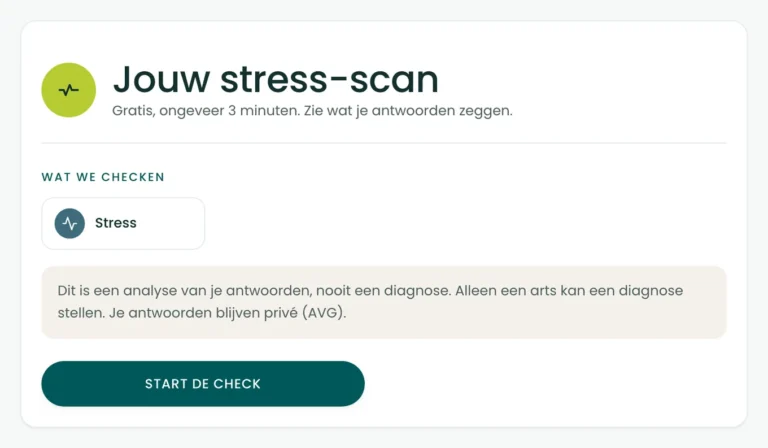
Five questions about the past two weeks, modelled on the most widely used scale for perceived stress. You get a stress score from 0 to 100 with the reading band alongside it. An analysis of your answers, never a diagnosis.
Free
5 questions
About 3 minutes
Score from 0 to 100
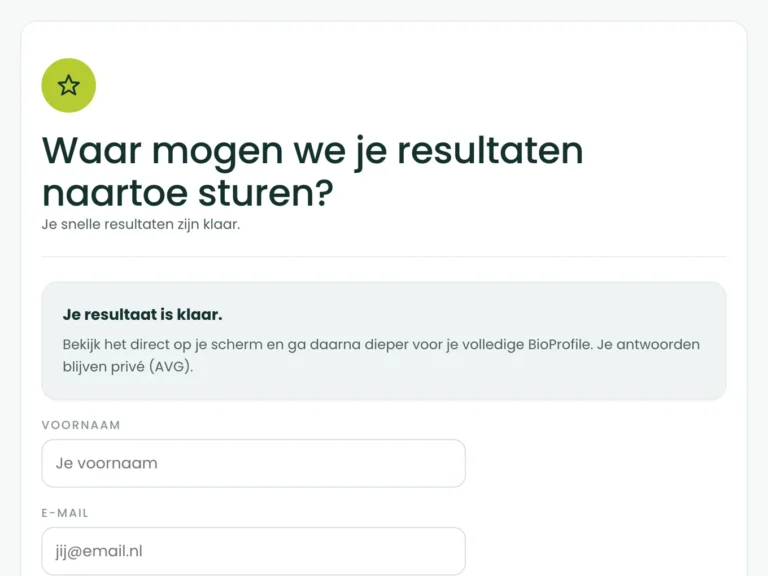
Fill in your first name and email address, and your stress score is in your dashboard.
(and the scientifically supported reason why it is precisely these five)
You get it done. That is the problem. The emails, the deadlines, the children, the parents, the house: it all runs, and nobody sees that it runs because you are lying awake at six with a list in your head. In the evening you cannot switch it off, at the weekend you do not come loose, and the question you are not asking yourself is the only one that counts: is this still ordinary busyness, or am I crossing a line somewhere?
The hard thing about stress is that you are in the middle of it. From the outside it is invisible, on the inside it has become normal, and the only reference point you have is yesterday, when things were busy too. There is no blood value for how unpredictable your life feels, and burnout is not a moment but a slope: you only notice it once you are already some way down.
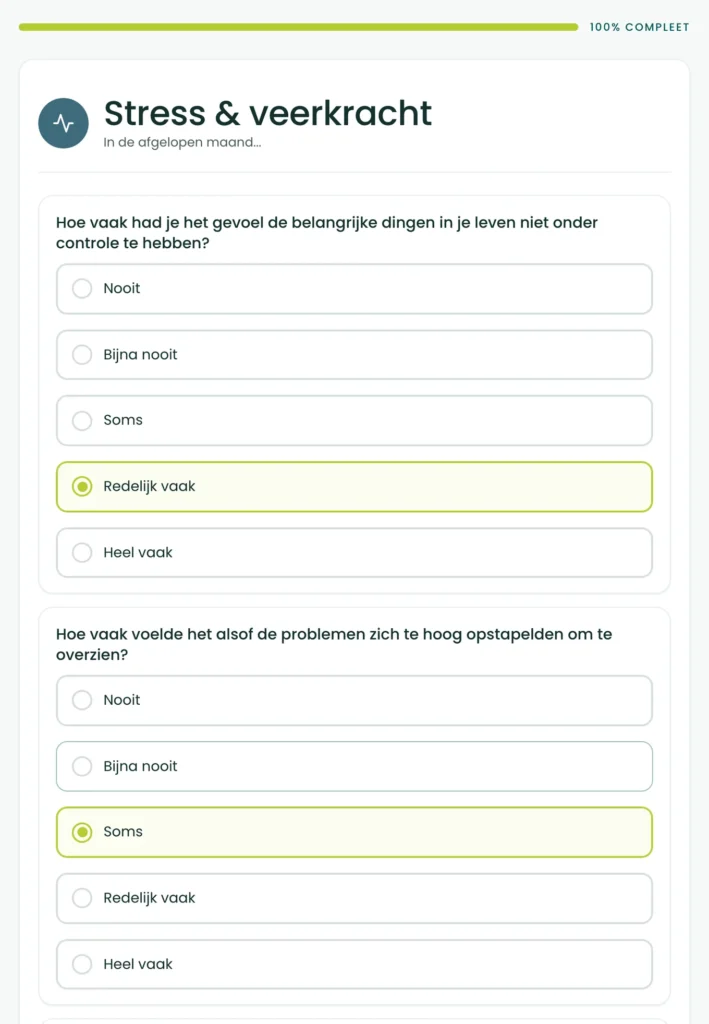
So researchers who wanted to measure stress did not go for the number of things you have to do, but for how it feels: how often you feel you have lost control, how often things pile up, how much confidence you have in tackling problems, how often things go the way you want, and whether you manage to switch off at the end of the day. Five questions about two weeks, added up into a score from 0 to 100. Not a diagnosis. But a number. And a number is something you can follow.
A meditation app. A mindfulness course, a weekend away, a book about boundaries, stopping work earlier on Friday. All sensible, and all of them start in the same place: with what you are going to do about it.
So a month later you still do not know whether it did anything. You never recorded how heavy it was when you started, and stress is exactly the feeling that keeps making itself normal again. Without a starting value, every change is a feeling about a feeling.
We analyse the real cause first
At BioProfile we turn the order around. First measure what is there now, with questions modelled on a scale someone else has validated, and only then talk about what you do with it. Analyse first, advise after.
The stress scan is the first step of that analysis, and one of the shortest.
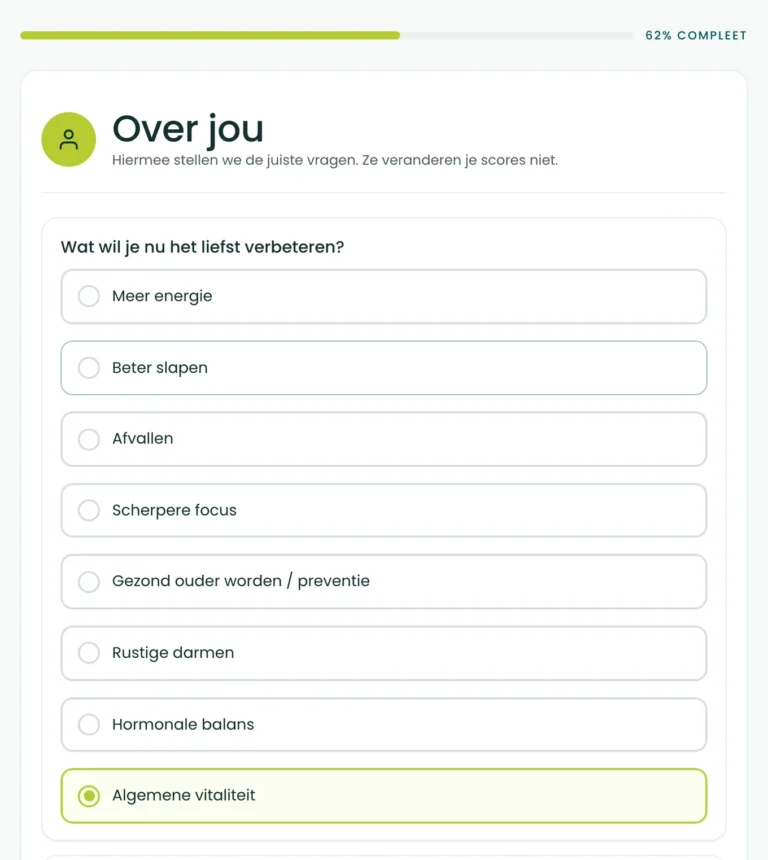
You start with eight short questions about yourself. They do not count towards your score; they make sure we can read the rest properly. One of them you may skip.
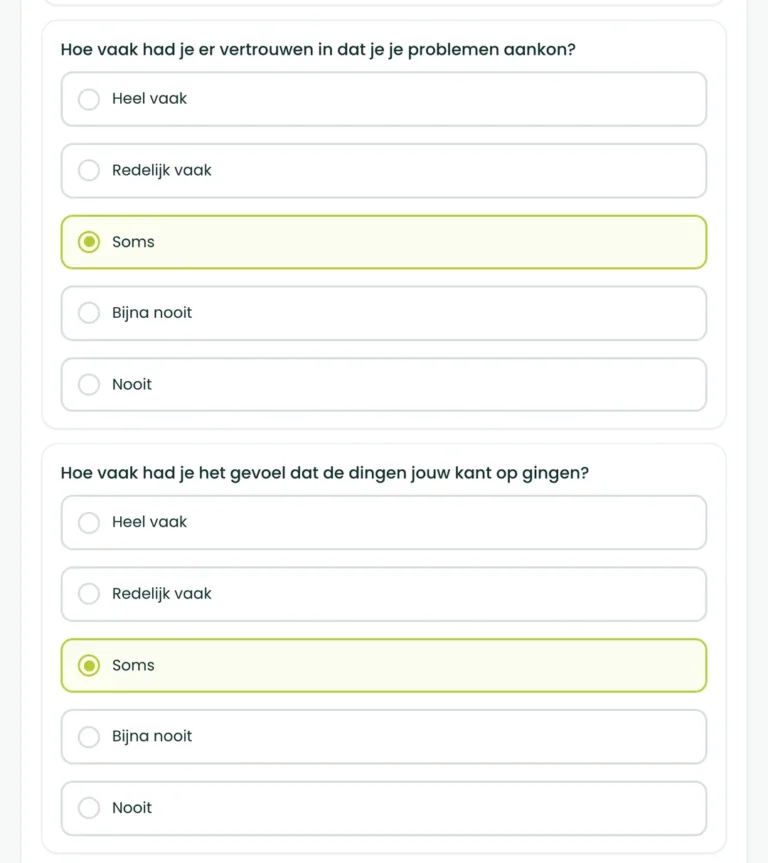
Then come the five stress questions, about the past two weeks: the feeling of control, things piling up, your confidence in dealing with problems, things going the way you want, and switching off at the end of the day. Each question has five answers.
You fill in your first name and email address. You see a first picture straight away, and with one tap on your dashboard your stress score is on your screen, with the reading band alongside it. Your email holds a login link, so you can find your result again later and extend your scan into your full BioProfile.
This is what is on your screen after about three minutes:
Take the scan again in two weeks and you no longer have a feeling about your load, you have two numbers.
Fill in your first name and email address, and your stress score is in your dashboard.
This scan is about the past two weeks. You get five questions about how your life feels and for each question you choose the answer that comes closest to your days.
Every question counts equally. The software then reads your answers back to you question by question, from low to high, so you can see which of the five pulled your score down the most.
modelled on
Ten questions, scored from 0 to 40, with an internal consistency between 0.85 and 0.91. It measures how unpredictable and overloading life feels, set against norms from the general population. The person who built it deliberately published no clinical cut-off value, and that is why we give you a position on the scale and not a label.
Modelled on, not validated as, this instrument.
Validated for: perceived stress against norms from the general population.
Cohen and colleagues, 1983, Stress Immunity Disease Lab, Carnegie Mellon University.
Self-report is the right and validated way to measure perceived stress, because the experience is the construct. What it cannot do is measure your physiological stress response, establish anxiety or point to the cause. Our questions are worded by us and modelled on the published scale rather than a licensed copy of it, so we give you a position and never a clinical label. Heart rate variability from a wearable is the layer that lifts this beyond questionnaire data.
BioProfile scoring rules, measurement class A, reliability capped at medium on the basis of questionnaire data alone.
Each of the five questions gets 0 to 4 points, from little load to a lot of load. The points are added up and converted into a stress score from 0 to 100. Higher is better.
0 to 39
high strain
40 to 59
noticeable
60 to 79
manageable
80 to 100
low strain
Reading bands, not clinical cut-off values. Your questions about stress resilience are worded by us and modelled on validated instruments, so there is no published cut-off value for precisely this score. Higher is always healthier.
This scan falls into measurement class A: a questionnaire is the usual way of measuring here, because perceived stress is exactly what is measured, and even so the reliability of your score stays capped at average as long as only your answers count. What lifts that ceiling is heart rate variability from a wearable, and you can add a wearable in your full BioProfile.
On your results screen that reliability appears as a label next to your score: medium reliability, symptom based. That label is not an aside; it tells you exactly how much weight you may put on the number.
This page describes a measuring instrument, so below you can read where that instrument comes from and what has been studied about it. Every claim points to the source it appears in.
Cohen, Kamarck and Mermelstein published the Perceived Stress Scale in 1983, a scale that does not count what happens to you, but how unpredictable, uncontrollable and overloaded your life feels.1,2 In 2012 Lee lined up nineteen studies of the scale: the version with ten questions came out best, better than the one with fourteen and much better than the one with four.3
In the Netherlands and Flanders a tradition of its own grew up alongside. Terluin and colleagues developed the Vierdimensionale Klachtenlijst in general practice and tested it in ten studies: the distress scale, the most general expression of psychological strain, picked out with an accuracy of 0.79 who came to the GP with a psychosocial problem, and was linked to sickness absence.4 In 2020 Schaufeli and colleagues built the Burnout Assessment Tool on interviews with 49 practitioners and tested it in 1,500 Flemish employees: exhaustion, mental distance, and reduced emotional and cognitive control as the core.5
Four scales, one thought: stress is what you experience, and that can be measured. That is the reason this scan exists.
In 2001 Maslach, Schaufeli and Leiter summed up twenty-five years of research: burnout is a prolonged response to chronic emotional and interpersonal strain at work, with exhaustion, cynicism and the feeling of no longer getting anything done as the three features.6 Prolonged, then: it is not a bad week, it is a pattern that builds up week after week while you are in the middle of it.
In 2019 Russell and Lightman described what is going on inside your body in the meantime: cortisol is released in pulses, rises with acute stress, and with prolonged strain the pattern shifts.7 That is not something you measure with a feeling about yesterday. So the questions in this scan follow the same thinking as the scale they are modelled on: a pattern across two weeks, broken down into the parts that matter.
The Perceived Stress Scale measures the feeling of control, things piling up, confidence in dealing with problems and whether things go the way you want; that is four of our five.2 The fifth, switching off at the end of the day, comes from recovery research: in 2007 Sonnentag and Fritz showed in 930 people that recovery from work consists of four experiences, and that mentally detaching from work is the first.8 In 2015 they worked that out into a model with that detachment as the pivot.9
Our five questions follow the construct and the look-back period of that scale, in our own words. They are not a copy of it, and the card above says so in as many words. The maker of the scale deliberately published no clinical cut-off value, and that is why we give you a position on the reading bands and not a label.
A low stress score is a picture of perceived load. It is not a diagnosis of an anxiety disorder, it does not measure cortisol, and it says nothing about the cause. Terluin’s work shows why that distinction matters: general distress, low mood and anxiety are related but different things, and the GP is the one who tells them apart.4
A low score means that looking further makes sense, and nothing more. If worrying or a low mood affects your daily life, that is a conversation with a doctor and not a number to optimise, and only a doctor can make a diagnosis.
Kivimäki and colleagues followed 197,473 working people without heart complaints across thirteen European cohorts, for an average of seven and a half years; 15 per cent reported stress at work, and that group was 1.23 times as likely to have a first myocardial infarction, an effect that is smaller than the effect of smoking and that comes on top of it.10 Keller and colleagues followed 28,753 Americans for eight years: people who had a lot of stress and believed that this stress was harming their health were 43 per cent more likely to die early.11
Prior and colleagues followed 118,410 Danes for four years: mortality rose step by step with the level of perceived stress, up to 1.51 times for the highest quintile against the lowest.12 In Copenhagen, Nielsen and colleagues saw 1.32 times as much mortality in men with high stress, among 12,128 people over more than twenty years.13 In 2012 Cohen and colleagues showed in 276 healthy volunteers how that works: people who had been through prolonged stress responded less to their own stress hormone, and caught a cold more often after exposure to a virus.14
In 2013 Van Laethem and colleagues found across twenty studies that a high workload and little room to decide for yourself predict poorer sleep.15 In 2018 Hassard and colleagues added up fifteen cost studies: work stress costs societies between 221 million and 187 billion dollars a year, and 70 to 90 per cent of that is lost productivity.16 That is a connection, not a cause, and that is how those studies put it too. What it does say: stress is not the soft part of health that you get round to looking at later.
This is what the scan stands on. Now your stress score.
Fill in your first name and email address, and your stress score is in your dashboard.

This page was written by BioProfile. BioProfile sells health products and this scan is free: no purchase comes with it. The Perceived Stress Scale is not ours and not free to use. That is why we ask our own five questions, modelled on that instrument, and nowhere do we call them a validated copy of it.
Every source below was checked on the day this page was published. The numbering follows the text: source 1 is the first one the text refers to, and the instrument the scan is built on sits among them at the point where it comes up.
Five questions, about three minutes, and your stress score is in your dashboard. Your answers stay private (GDPR).
Fill in your first name and email address, and your stress score is in your dashboard.
What this does not say. This is a picture of perceived stress, not a diagnosis of an anxiety disorder, and it does not measure cortisol or any other stress hormone. A low score here is not a judgement about your mental health. If worrying or a low mood affects your daily life, that is a conversation with a doctor and not a number to optimise.
BioProfile analyses your health status to guide you and your coach. It does not make a diagnosis, only a doctor can do that. Built on validated health questionnaires; the combined BioProfile score is not itself a validated clinical instrument yet. Your answers stay private (GDPR).