
BioProfile analysis · brain scan
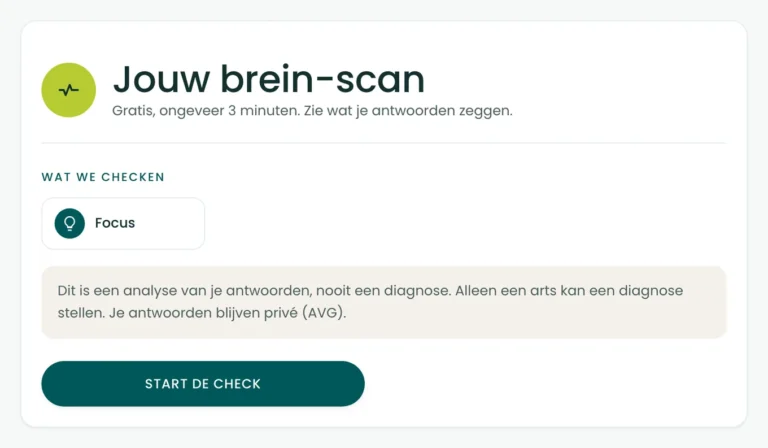
Your result in 3 minutes
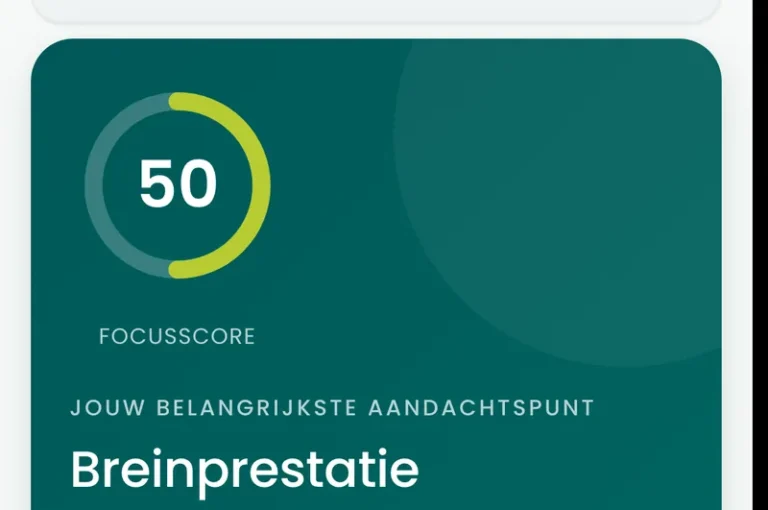
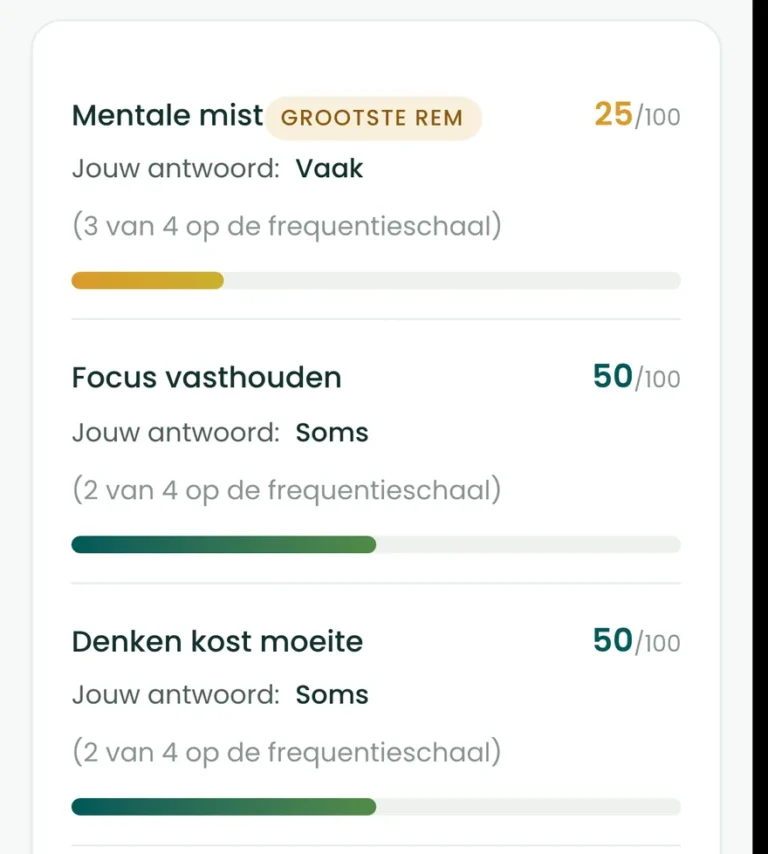
Your focus score over the past two weeks, with the reading band it falls into and, for each question, the number that pulled your score down or up. All on your own screen, in your dashboard.
Four questions about the past two weeks: fog, focus, forgetting and the effort thinking costs you. You get a focus score from 0 to 100 with the reading band alongside it. An analysis of how you experience your thinking, never a diagnosis.
Free
4 questions
About 3 minutes
Score from 0 to 100
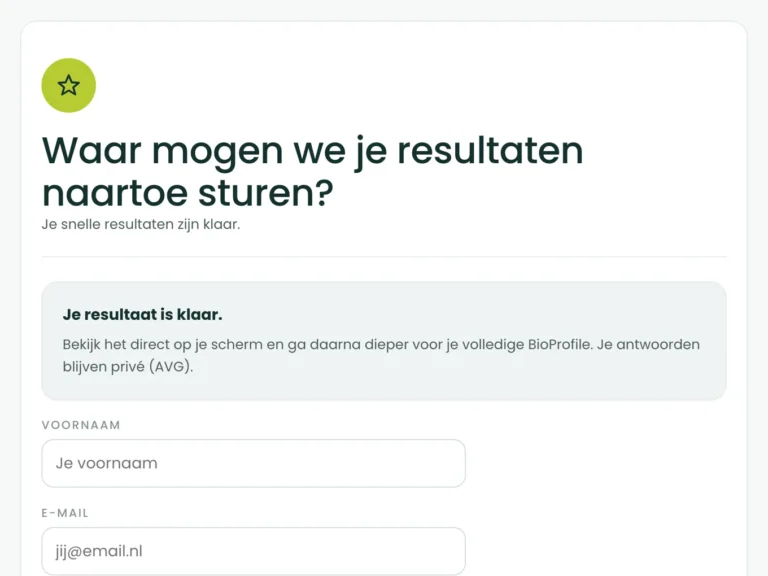
Fill in your first name and email address, and your focus score is in your dashboard.
(and the scientifically grounded reason why it is exactly these four)
You read a paragraph three times and still do not know what it said. You walk into the room and have lost what you came for. Following a conversation takes effort, making a decision takes more, and by three in the afternoon your head is a radio between two stations. You are not ill. Your head is just not joining in.
The awkward thing about brain fog is that no measurement for it exists. There is no thermometer for your head, and usually no test at your GP either, so it stays a word you chose yourself for something you feel yourself. Researchers who did try to capture it kept arriving at the same list: slow thinking, trouble concentrating, confusion, forgetfulness, a haze over your thoughts. Recognisable, and still not a number.
What you can do is measure the pattern instead of the feeling: how often the fog is there, how well you hold your attention, how often you forget everyday things, and how much effort thinking costs you. Four questions about two weeks, added up into a score from 0 to 100. Not a diagnosis. But a number. And in two weeks you can lay that number next to a new one.
A jar of fish oil. An app with brain training. Less coffee, more coffee, a supplement from a podcast, a weekend without a screen. All understandable, and they all begin in the same place: with what you are going to do about it.
So after a month you still do not know whether it did anything. You have not recorded anywhere how foggy it was when you started, and with your own thinking your memory is a poor witness: you remember a clear day, a foggy week fades. Without a baseline, every improvement is a feeling about a feeling.
We analyse the real cause first
At BioProfile we turn the order around. First measure what is there now, with questions that follow the research into perceived thinking, and put that score next to your sleep and your mood, because that is usually where it points. Only then talk about what you do with it. Analyse first, advise after.
The brain scan is the first step of that analysis, and the shortest of them all: four questions.
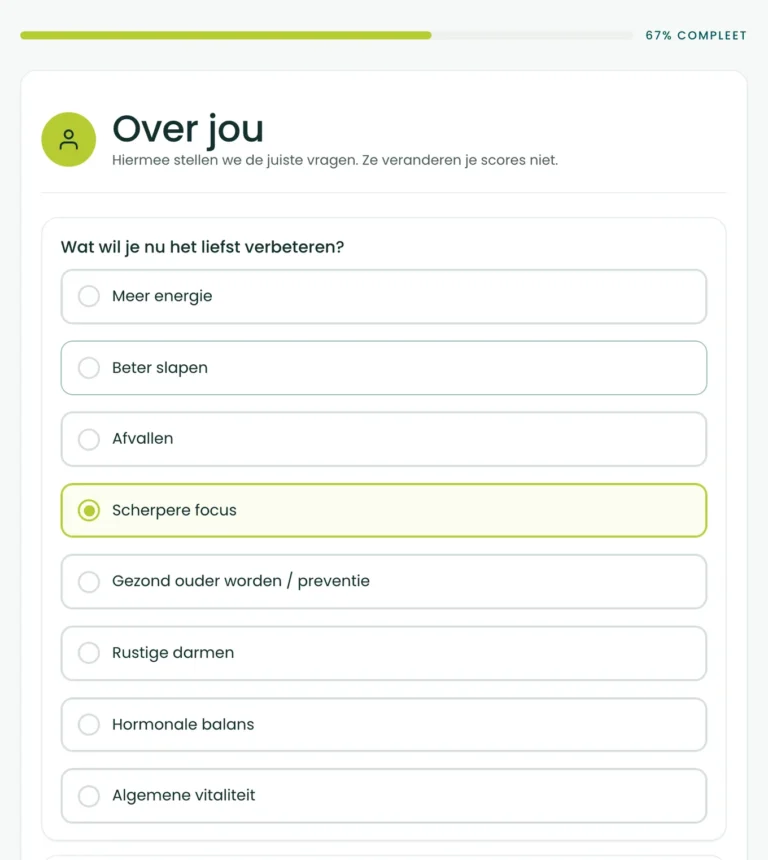
You start with eight short questions about yourself. They do not count towards your score; they make sure we can read the rest properly. One of them you may skip.
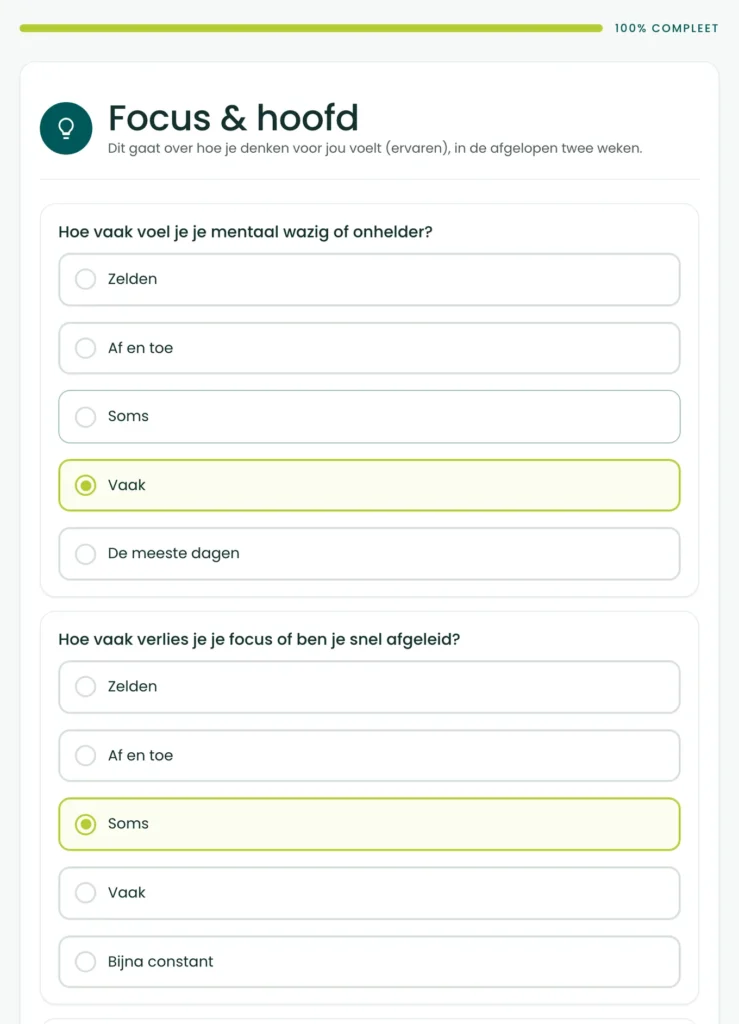
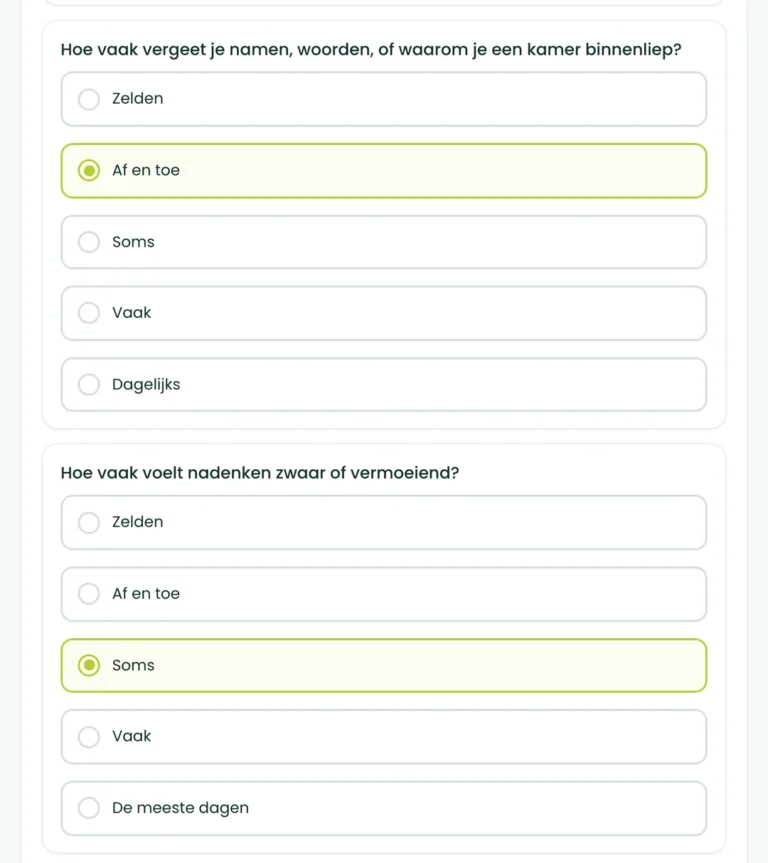
Then come the four brain questions, about the past two weeks: how often your head feels foggy, how well you hold your attention, how often you forget everyday things, and how much effort thinking takes you. Each question has five answers, from rarely to almost always.
You fill in your first name and email address. You see a first picture straight away, and with one tap on your dashboard your focus score is on your screen, with the reading band alongside it. Your email holds a login link, so you can find your result again later and expand your scan into your full BioProfile.
This is what is on your screen after about three minutes:
Repeat the scan in two weeks and you no longer have a feeling about your head, you have two numbers.
Fill in your first name and email address, and your focus score is in your dashboard.
This scan is about the past two weeks. You get four questions about how your thinking feels and for each question you choose the answer that comes closest to your days.
Every question counts equally. The software then reads your answers back question by question, from low to high, so you can see which of the four pulled your score down the most.
used descriptively only
An umbrella review of ten meta-analyses covering roughly 92,600 people found that how people rate their own thinking correlates only around 0.14 with their measured cognitive performance. That is why we call this score experienced, why we never call it a cognitive test, and why we read it alongside your sleep and wellbeing instead of on its own.
Used only descriptively. We do not apply the diagnostic rule behind it here.
Validated for: the relationship between self-rated and measured cognition.
used descriptively only
Self-reported complaints about memory and concentration go together more strongly with mood and fatigue than with measured ability. Read the other way round, that is exactly what makes them useful: if this score is low, it usually points to sleep, stress or mood, and those are things you can do something about.
Used only descriptively. We do not apply the diagnostic rule behind it here.
Validated for: the link between self-reported cognition and mood.
There is no honest way to measure cognitive performance with a questionnaire. What self-report captures is experienced daily cognition, which correlates around 0.14 with measured performance and correlates far more strongly with mood and fatigue. That is why we call this score experienced, why we never call it a cognitive test, and why we read it alongside your sleep and wellbeing instead of on its own. It is also why this area is capped at average reliability and can never become high on answers alone.
BioProfile scoring rules, measurement class C, labelled as perceived, reliability capped at average.
Each of the four questions gets 0 to 4 points, from rarely to almost always. The points are added up and converted into a focus score from 0 to 100. Higher is better.
0 to 39
a lot of fog
40 to 59
noticeable
60 to 79
mild
80 to 100
clear
Reading bands, not clinical cut-off values. Your questions about brain performance are written in house and modelled on validated instruments, so no published cut-off value applies to precisely this score. Higher is always healthier.
This scan falls into measurement class C: what a questionnaire measures here is experienced thinking, so the reliability of your score stays capped at average, even if you add blood values or a wearable later. What does sharpen the score is reading it alongside your sleep and your wellbeing, and that is exactly what your full BioProfile does.
On your result screen that reliability stands as a label beside your score: average reliability, experienced. That label is not an aside; it says exactly how much weight you may hang on the number.
This page describes a measuring instrument, so below you can read where that instrument comes from and what has been studied about it. Every claim points to the source it appears in.
In 2013 Ocon described what people mean when they use the word: slow thinking, trouble focusing, confusion, a lack of concentration, forgetfulness, a haze over your thoughts.1 In 2013 Ross and colleagues put the question to 138 young adults with a condition in which the heart rate rises too steeply on standing up: 132 of them recognised the fog, and the more often and the more heavily it came, the higher they scored on a validated scale for mental fatigue.2
In 2022 Callan and colleagues had fifty people with fog after COVID-19 describe in their own words what it is; the title of their study is a quote from one of them: I can’t cope with multiple inputs.3 In 2015 Theoharides summed it up as reduced thinking ability, not being able to concentrate or multitask, and loss of short-term and long-term memory, and listed the conditions in which it occurs.4
Four descriptions, the same list, and nowhere a number. That is why this scan exists: not to say what it is, but to measure how much of it there is.
In 2014 Crumley and colleagues pooled fifty-three studies on the question of whether what older adults think about their memory matches what a memory test measures. The link was small: a correlation of 0.06.5 The umbrella review that the BioProfile analysis cites arrives at around 0.14 across ten meta-analyses and about 92,600 people.6 Perceived thinking and measured thinking are two different things.
That does not make the score worthless, it makes it something else. Self-reported complaints about memory and concentration are linked more strongly to mood and fatigue than to ability, and read the other way round that is exactly what makes it useful: a low score usually points to sleep, stress or mood, and those you can do something about.7 That is why this number is called a focus score, and not a test.
In 2008 Mitchell lined up the studies in which people were asked about their memory: among people in whom cognitive decline had been established, 39.8 per cent reported complaints, against 17.4 per cent of healthy older people, more than twice as often.8 In 2014 Jessen and an international working group set down how research into self-experienced decline ought to be carried out, precisely because that experience is sometimes there before a test sees anything.9
Our four questions follow what that research asks about: the fog itself, your attention, your everyday memory and the effort thinking costs you. We worded them ourselves, after no licensed instrument, and the cards above say so in so many words.
In 2010 Lim and Dinges pooled seventy studies with 147 cognitive tests on what one night without sleep does: the largest effect was in attention slipping away, with an effect size of 0.78, the smallest in reasoning.10 Van Dongen and colleagues had 48 healthy adults sleep 4, 6 or 8 hours for two weeks: at 6 hours or less the deficits in thinking performance stacked up day after day, to the level of two nights of no sleep at all, while the participants themselves said they were barely any sleepier.11
Lo and colleagues found in 2016, across 35 samples and more than 97,000 older people, that both short and long sleep raised the chance of poorer thinking, by 1.40 and 1.58 times.12 Rock and colleagues found in 2014, in people with symptoms of low mood, moderate shortfalls in executive functions, memory and attention, with effect sizes of 0.34 to 0.65, and part of that remained after the mood recovered.13 Shields and colleagues showed in a meta-analysis in 2016 that acute stress too harms working memory and mental flexibility.14
That is why this score is never read on its own: a low focus score is usually a sleep, stress or mood score in disguise. And a sudden, clear change in memory or language is not a score to follow, but a reason to see a doctor. Only a doctor can make a diagnosis.
In 2010 Killingsworth and Gilbert had people report through the day, via a smartphone app, where their thoughts were: almost as often on something other than what they were doing, and that wandering generally left them less happy.15
In 2018 Northey and colleagues pooled 39 randomised studies in people over fifty: exercise improved thinking ability with an effect size of 0.29, whatever cognitive level someone started from, and sessions of 45 to 60 minutes at moderate intensity or above went together with the greatest benefit.16
That is correlation and effect from research and it promises nothing about your head. What it does say: perceived thinking moves along with sleep, stress and exercise, and what moves along can be followed.
This is what the scan rests on. Now your focus score.
Fill in your first name and email address, and your focus score is in your dashboard.

This page is written by BioProfile. BioProfile sells health products and this scan is free: no purchase comes with it. There is no validated questionnaire that measures thinking ability, and we say that out loud. Our four questions follow the research into perceived thinking and measure what you experience, never what a test would measure.
Every source below was checked on the day this page was published. The numbering follows the text: source 1 is the first one the text refers to, and the two studies the analysis reads this score against sit among them at the point where they come up.
Four questions, about three minutes, and your focus score is in your dashboard. Your answers stay private (GDPR).
Fill in your first name and email address, and your focus score is in your dashboard.
What this does not say. This is not a cognitive test and not a screening for progressive memory loss or attention disorders. How people judge their own thinking lines up only around 0.14 with measured performance, and self-reported complaints line up more strongly with mood than with ability. A sudden, clear change in memory or language, or fog that gets worse instead of coming and going, belongs with a doctor and not in a score.
BioProfile analyses your health status to guide you and your coach. It does not make a diagnosis, only a doctor can do that. Built on validated health questionnaires; the combined BioProfile score is not itself a validated clinical instrument yet. Your answers stay private (GDPR).