
In short
- In mice with wasted muscles, strength training brought the muscle structure back to normal, and the muscles tired less quickly.1
- Cannabigerol, a plant compound that doesn’t give the high of THC, mainly added strength: on top of training, the mice produced clearly more strength than with training alone, while their muscle fibres grew only a little.1,2
- The finding does not come from people but from mice with muscle loss that had been brought on by a medicine. It is no reason to take cannabigerol.1
- In 2022, 44 per cent of Dutch adults met the national Beweegrichtlijnen (physical activity guidelines), Statistics Netherlands (CBS) reported in 2023.3
Contents
- Strength training: strength is more than muscle size
- You are not the only one
- Why muscles lose strength, and what was already known
- A new finding from a Brazilian exercise lab
- Strength is not the same as size
- What the mice showed, and what they did not
- In short, and what you can do now
- Frequently asked questions
Strength training: strength is more than muscle size
In this piece you will read what strength training does to your muscles, why muscle strength is not the same as muscle size, and what cannabigerol, a substance from the cannabis plant that does not get you high, added to strength training in a study in mice. That matters, because the strength in your muscles, more than their size, decides how easily you get up, carry something and climb the stairs as the years go by. And it matters because in mice with wasted muscles, the training did the work of bringing the muscle back, while the plant substance mainly made that muscle stronger.

Verified by Carlos Mendoza Montano
Doctorate in nutritional biochemistry from the University of Arizona
Checked on 10 November 2026
In the evening you pick up the shopping bags, and they feel heavier than they did a few years ago. At work you take the stairs, and halfway up you stop for a moment, very briefly, as if you’re checking your phone. Getting up from a low sofa now takes a push with your hands that you never used to need. None of this hurts, and none of it feels like a real problem yet. But you notice it, and you wonder whether this is simply what getting older feels like, or something you can still change.
You are not the only one
Most Dutch adults move less than the national guidelines recommend. In 2022, 44 per cent of adults met the Beweegrichtlijnen (physical activity guidelines) of the Gezondheidsraad, CBS reported in 2023.3 So more than half did not. Of all adults, people aged 75 and over met the guidelines least often, at 29 per cent (CBS, 2023).4 Bone and muscle strengthening exercises score better in the same CBS figures: 78 per cent did enough of them, with running or football given as examples (CBS, 2023).5
So if the stairs feel steeper than they used to, you share that with a large group of people. If you want to know where you stand today, the free heart and blood vessel test gives you a first picture. The scan is not a diagnosis.
Why muscles lose strength, and what was already known

Muscle is never a fixed amount. Your body is constantly building up muscle protein and breaking it down, and when the breakdown wins, the muscle shrinks. Some medicines tip that balance. Glucocorticoids, a group of steroid medicines that includes dexamethasone, mainly shrink the fast muscle fibres, the fibres you use for quick, powerful movements. The fibres become thinner and contain less protein, because breakdown increases and build-up decreases.6 Moving too little pushes in the same direction; you can read more about that in what moving too little does to your body.
As they get older, many people lose muscle mass and strength. The European consensus on this age-related loss puts low muscle strength at the centre, and not just the size of the muscle.7 That is a telling choice: what counts most is what the muscle can do.
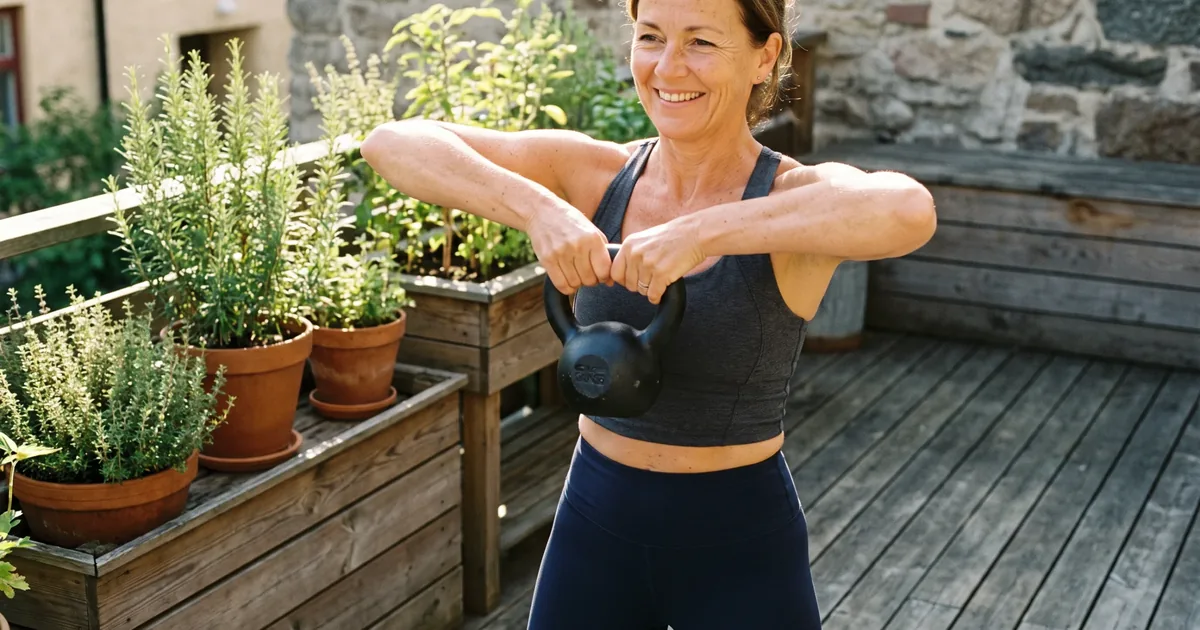
What is strength training? It is training in which your muscles work against resistance, so that they get stronger. What was known until now is clear and encouraging: pooled studies in older people show that older people get stronger from strength training, especially when the training asks more of the muscle.8 Thuisarts advises older people to strengthen their bones and muscles twice a week, for example with exercises, strength training, climbing stairs and gym workouts.9 Want to do strength training at home? The advice does not say where you train. Besides gym workouts, it also mentions exercises and climbing stairs.
Where that knowledge stopped: training is a proven way to counter muscle loss, but ways to add something specifically to what a muscle can deliver, its strength and performance, remained limited.1 That is exactly the gap the new research steps into.
A new finding from a Brazilian exercise lab
The new study comes from Brazil. Fabro IF, Nery T, Pinto de Araújo AP, Bastos Pereira AL and Aguiar AS work at the Biology of Exercise Lab (Labioex) in the Department of Physiotherapy at the Federal University of Santa Catarina in Araranguá. Felipetti FA works at the Laboratory of Intrauterine and Fetoplacental Analysis (Laif) in the Department of Medical Sciences at the same university. Aguiar AS is also affiliated with the Institute for Education and Research (IEP) Remederi in São Paulo. Their article appeared online on 30 September 2026 in the journal ACS Pharmacology & Translational Science, as a journal article and not as a preprint, with 9 October 2026 given as the publication date in the registration details.1 The article reports a financial conflict of interest: Aguiar AS is a partner in Remederi Cannabis Medicinal.1
The team asked a simple question: what happens when you combine strength training with cannabigerol in mice whose muscles have wasted, and what does each of the two do on its own? Cannabigerol is one of the substances found in the cannabis plant. Unlike THC, the best known of them, cannabigerol does not make you intoxicated.2 Cannabigerol does not activate the CB1 receptor, so it does not give you the high of cannabis.1 Before this study, little was known about the role cannabigerol plays in how muscles adapt to training.
The answer, in plain words: training and cannabigerol each did something different. Training brought the muscle’s structure back to normal and made the muscle tire less quickly. Cannabigerol mainly made the muscle stronger, while the muscle fibres grew only a little. The authors describe the two effects as complementary.1
Why would this matter to you, if you are not a mouse and have never used dexamethasone? Because it pulls apart two things you probably see as one: muscle that is there, and muscle that performs. In this study, the training itself did the groundwork, and that is the part you can start on today. The extra strength from cannabigerol is not a product to buy, but a pointer for further research.
Strength is not the same as size

If you remember one thing from this piece, make it the difference between how big a muscle is and how much strength it delivers. Size is structure: how thick the muscle fibres are, which scientists measure as the cross-section of a fibre. Strength is performance: how hard the muscle can pull, and how fast. For that, a muscle needs a nerve. A nerve signal decides when the fibres contract and how many of them take part. That is why scientists speak of neuromuscular performance: nerve and muscle working together.
In daily life, you use strength to get up from a low chair, to push yourself up onto a high step, or to regain your balance when you trip. You use grip strength to twist a stuck lid off a jar or to hold on to a heavy bag. Size and strength often grow together, but they are not the same thing, and the mice in this study show how the two can come apart.
First, look at the mice that only trained. After their muscles had wasted under dexamethasone, four weeks of climbing a ladder brought the muscle structure back to normal, and their muscles tired less quickly.1 The training did the structural work, as you would expect from what was already known.
Now look at the mice that were given cannabigerol on top of the same training. Their muscle fibres grew only a little more. Yet after the first week, the power they produced was about 55 per cent higher than with training alone, and after four weeks up to about 87 per cent higher.1 That power was measured during the training sessions themselves, on the days the mice were given cannabigerol. The article’s other tests began 48 hours after the last dose.1 In plain words: after a month, almost twice as much strength as with training alone, from a muscle that was barely any bigger. So this is not about size, but about performance.
Two other results point the same way. Cannabigerol increased maximum grip strength by about 10 per cent. And in mice that did not train, cannabigerol lowered the amount of lactate in the blood after exertion by about 48 per cent.1 Lactate is a substance that builds up in the blood during heavy exertion.
How cannabigerol does this in the muscle is not stated in the abstract. A review article on the substance names several signalling pathways that cannabigerol acts on, including the cannabinoid receptors CB1 and CB2, TRP channels and the alpha-2 adrenergic receptor.2 The abstract does not link any of these pathways to the result in the mice.
Why does performance matter so much? A Maastricht researcher in the field of healthy ageing puts it like this:
When muscle strength declines, moving becomes harder, which directly affects independence and quality of life.
Milan Betz, PhD candidate, Department of Human Biology, research group M3, Universiteit Maastricht10
In plain words: when muscle strength declines, moving becomes harder, and that directly affects how independently you live and how good your life is. A professor at the same university draws a link between movement and the future:
We now know from all kinds of research that when people become immobile or no longer move enough, that is a bad sign for their future health.
Annemie Schols, professor of Nutrition and Metabolism in Chronic Disease, Universiteit Maastricht11
In plain words: when people stop moving, or no longer move enough, that is a bad sign for their health in the years to come.
What the mice showed, and what they did not
Who was studied: not people, but mice. The team induced muscle loss by giving the mice dexamethasone for 12 days. The mice then followed a four-week strength training programme in which the animals climbed a ladder. On training days, cannabigerol was given by injection into the abdominal cavity.1 The summary does not say how many mice took part, or what their sex and age were.
What it showed: training alone brought the muscle structure back to normal and made the muscles tire less quickly. Cannabigerol mainly added strength, with only a small extra growth of the fibres, and the substance increased grip strength and lowered lactate after exertion in mice that did not train.1
What it did not show is just as important. The muscle loss was caused by a medicine, and the abstract reports no test in muscle loss that comes with age. The cannabigerol was not taken by mouth but injected. The abstract does not say in which group, or compared with what, grip strength rose. Side effects and long-term effects are not reported. BioProfile read the abstract, and read the full article only for the timing of the tests and the reported conflict of interest. The authors themselves call for further research into cannabigerol as an addition to exercise in muscle loss caused by glucocorticoids.1
In short, and what you can do now
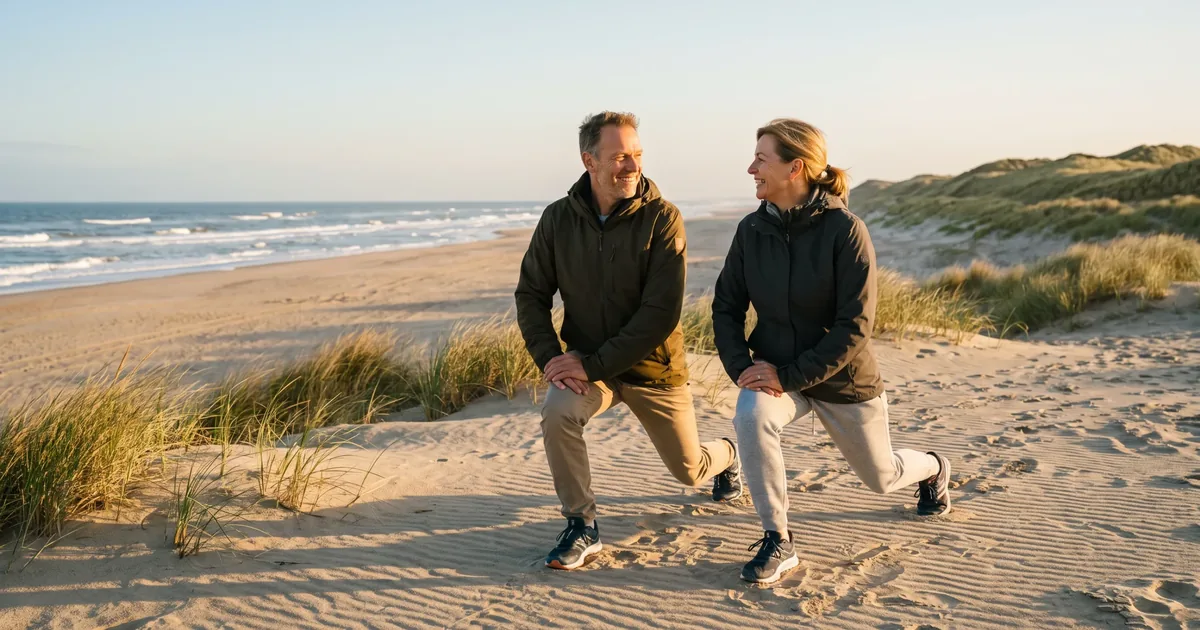
In short: the size of a muscle and the strength it delivers are two different things, and as you get older, strength matters most.7 Strength training makes older people stronger.8 In mice whose muscles had shrunk under a medicine, training restored the muscle structure and the muscle tired less quickly, while cannabigerol on top of training mainly added strength, with little extra muscle size.1 That finding comes from mice that were given injections, not from people, and the abstract does not say how large the study was or what side effects there were.1 Meanwhile, fewer than half of Dutch adults met the Beweegrichtlijnen in 2022.3
Three directions follow from this. First: keep putting your muscles to work against resistance, in a form that suits you. That is the part of this research that already applies to people.8 Second: do not see this finding as a reason to go looking for cannabigerol. It is not a shortcut, but a lead for science. Third: know the signs that mean you stop and call your GP: becoming short of breath, a wheezing sound when you breathe, chest pain or trouble with your joints while you exercise.9 If you want to understand what your heart does at rest, read what a normal heart rate is.
How you start depends on where you stand today. The free scan gives you that insight as a starting point, so you can see what you can change and measure again later. The scan is not a diagnosis.
Frequently asked questions
What is strength training?
Training in which your muscles work against resistance, so that they get stronger. Pooled studies in older people show that it makes older people stronger, especially at a higher training intensity.8 Thuisarts names exercises, strength training, climbing stairs and fitness as ways to make your bones and muscles stronger.9
Is strength training still worth it as you get older?
Yes. Older people who do strength training get stronger, and more so the more the training demands of the muscle.8 Thuisarts advises older people to make their bones and muscles stronger as part of healthy movement.9 A doctor or a physiotherapist can help you judge which form suits you.
Should I take cannabigerol to get stronger?
This finding doesn’t point that way. It comes from mice with muscle loss caused by a glucocorticoid, which were given cannabigerol by injection into the abdominal cavity. The abstract reports no results in people and no side effects or long-term effects.1
Is cannabigerol the same as cannabis?
No. Cannabigerol is one of the substances in the cannabis plant. Unlike THC, cannabigerol does not make you intoxicated.2 Cannabigerol does not activate the CB1 receptor, so it does not give you the high of cannabis.1
When should I call my GP while exercising?
Thuisarts advises calling your GP if you get one or more of these symptoms while exercising or playing sport: you become short of breath or find it hard to breathe, you hear a wheezing sound when you breathe, you get chest pain, or you get trouble with your joints.9
Is the scan a diagnosis?
No. The scan is not a diagnosis. The scan gives you insight into where you stand today; what lies behind a complaint is for a doctor to assess.
Sources
Every source below was checked on the day this article was published. The numbering follows the text.
- Fabro IF, Nery T, Pinto de Araújo AP, Bastos Pereira AL, Felipetti FA, Aguiar AS Jr. Cannabigerol Enhances Muscle Strength and Performance in Dexamethasone-Treated Mice. ACS Pharmacology and Translational Science, 2026. doi.org/10.1021/acsptsci.6c00187
- Li S, Li W, Malhi NK, Huang J, Li Q, Zhou Z, Wang R, Peng J, Yin T, Wang H. Cannabigerol (CBG): A Comprehensive Review of Its Molecular Mechanisms and Therapeutic Potential. Molecules, 2024. pmc.ncbi.nlm.nih.gov
- CBS. Just over 4 in 10 adults get enough exercise. 2023. cbs.nl
- CBS. Just over 4 in 10 adults get enough exercise. 2023. cbs.nl
- CBS. Just over 4 in 10 adults get enough exercise. 2023. cbs.nl
- Schakman O, Kalista S, Barbé C, Loumaye A, Thissen JP. Glucocorticoid-induced skeletal muscle atrophy. The International Journal of Biochemistry & Cell Biology, 2013. doi.org/10.1016/j.biocel.2013.05.036
- Cruz-Jentoft AJ, Bahat G, Bauer J, et al. Sarcopenia: revised European consensus on definition and diagnosis. Age and Ageing, 2019. pmc.ncbi.nlm.nih.gov
- Peterson MD, Rhea MR, Sen A, Gordon PM. Resistance Exercise for Muscular Strength in Older Adults: A Meta-Analysis. Ageing Research Reviews, 2010. pmc.ncbi.nlm.nih.gov
- Thuisarts.nl (NHG). I am an older person and want to move in a healthy way. thuisarts.nl
- Milan Betz, PhD candidate in Human Biology (research group M3), Universiteit Maastricht. The role of muscle blood vessels in healthy ageing. Maastricht University, 2026. maastrichtuniversity.nl
- Annemie Schols, professor of Nutrition and Metabolism in Chronic Disease, Universiteit Maastricht. Ouderen gezocht met slappe spieren. Maastricht University, 2017. maastrichtuniversity.nl
Quotes from Dutch sources appear in Dutch and have been translated into the other languages by BioProfile.
Also read
See where you stand today
A free scan gives you insight into where you stand today. The scan is not a diagnosis.
Free, about 3 minutes. An analysis of your answers, never a diagnosis.
BioProfile analyses your health status to guide you and your coach. It does not make a diagnosis, only a doctor can do that. Built on validated health questionnaires; the combined BioProfile score is not itself a validated clinical instrument yet. Your answers stay private (GDPR).