

In short
- Older Thai women with a slight dip in memory and thinking took clearly longer on a chair and walking test for mobility and balance, had a weaker grip, and had less muscle mass and a higher body fat percentage than women without that dip.1
- The differences remained after taking age and physical activity into account, but a single measurement cannot show what comes first.1
- Earlier long-term studies had already linked weaker hand grip strength to thinking skills that declined more often over the years.2
Contents
- Mobility and balance, muscle strength and memory: one picture
- You are far from the only one
- What was already known, and where it stopped
- New findings from three universities
- Functional mobility: the body in everyday movement
- What the findings do not show
- In short, and what you can do now
- Frequently asked questions
Mobility and balance, muscle strength and memory: one picture
In this piece, you will read what your mobility and balance and your muscle strength can say about memory and thinking: older women whose memory and thinking had declined slightly took longer to stand up and walk in a chair test, had a less firm grip, and had less muscle mass and more body fat than women whose memory and thinking had not declined. That matters, because standing up, walking and holding something are things you do every day, so they are signals you can notice in your own body. It also matters because a difference between two groups is not yet a cause, and if you know where that line lies, you won’t read too much into one slow morning.
You wake up and sit on the edge of the bed for a moment before you get up. At breakfast, the lid of a jar won’t turn, and you hand the jar to someone else. On the way to the shop, people pass you on the pavement who never used to. In the afternoon, you walk into the kitchen and can’t remember what you came in for. Each moment is small, and you wave each one away. Still, the question lingers: are your body and your mind telling the same story, and is there something in it you can keep an eye on?
You are far from alone

Moving less as the years go by is common. In 2023, CBS, Statistics Netherlands, reported, with figures for 2022, that just over 4 in 10 adults get enough exercise.3 So a large share of adults do not. The gap widens with age: of all adults, people aged 75 and over were the least likely to meet the Dutch physical activity guidelines, at 29 per cent, according to the same CBS report.3 In that report, CBS also stated that 78 per cent did enough bone and muscle strengthening exercise, such as running or playing football.4
So if you move less than you used to, you are in large company. Movement matters for more than your legs. How your resting heart rate compares with typical values is explained on the BioProfile page on a normal heart rate. If you want a starting point for your own heart and blood vessels, the heart and blood vessel scan gives you one. The scan is not a diagnosis; the scan shows where you stand today.
What was already known, and where it stopped
For many people, forgetting things more often is simply part of getting older. Thuisarts, the patient website of the Dutch College of General Practitioners (NHG), puts it simply: as you get older, you forget things more quickly and your memory works less well, and that is true for many people.5
At the same time, scientists have seen for years that body and memory often change side by side. A review of long-running studies that followed people for years found that people with weaker hand grip strength more often saw their thinking skills decline over time, and were more likely to later develop a memory condition diagnosed by a doctor.2 The authors of that review recommend paying attention to people with a weak grip, so that problems with thinking are picked up early.2
Walking tells a similar story. In earlier studies, people with mild cognitive impairment, a mild dip in memory and thinking, walked more slowly than people their age, especially when a second task was added while walking.6 Variation in walking pattern may even be a sign that such a dip is on its way. The same review found indications that some exercise programmes may improve walking speed, variation in walking and balance, but called for more research because of limitations in the existing studies.6
Why body and mind so often change together is not established in the sources this piece relies on. What the sources do show is that the two often go hand in hand. And there were gaps in what was known. The authors of the new article point to one gap in particular: the evidence in older women in Southeast Asia was limited.1 To learn what too little exercise does to the rest of your body, read what too little exercise does to your body.
New findings from three universities
The new findings come from four authors at three universities. P. Poncumhak works in the physiotherapy department at the University of Phayao, and W. Duangsanjun also works at the University of Phayao. W. Namwong is affiliated with the School of Physical Therapy at Khon Kaen University. R. Intaruk works in the physiotherapy department and the Movement Sciences and Exercise Research Center at Walailak University. Their article appeared on 27 October 2026 in the Korean Journal of Family Medicine. According to the record in the literature database, it is a journal article, not a preprint.1
The team wanted to compare three things between older Thai women with and without mild cognitive impairment: how well the women move, how strong their muscles are and what their bodies are made of. Whether a woman belonged to one group or the other was decided with a standard test of memory and thinking, the Thai version of the Mini-Mental State Examination. In total, 54 women took part, all living independently at home: 29 with mild cognitive impairment and 25 without.1
Why would this matter to you if you are not an older Thai woman? Because what was measured is something you recognise from your own day: getting up from a chair, walking, sitting back down and gripping something firmly. These are not lab tricks. They are the movements a day is made of. The authors conclude that testing physical performance can help to spot people at risk earlier in the community.1 That is a modest claim. A chair does not turn into a memory test. But it does give you a reason to take the way you move seriously as one signal among many, and to see your legs and hands as part of the same body as your memory.
Functional mobility: the body in everyday movement
The one idea at the heart of this article is functional mobility. It is a simple idea with a technical name: how well you move your own body through the ordinary tasks of a day. Standing up from a chair, walking a few steps, sitting back down. How fast you can run or how much you can lift at the gym plays no part here. It is about the movements you cannot avoid, and that is exactly what makes them useful to look at: everyone makes these movements, every day, without thinking about them.
The team measured functional mobility with two tests. In the Timed Up-and-Go test, a person stands up from a chair, walks and sits back down, and the time is recorded. In the Five Times Sit-to-Stand test, a person stands up from a chair five times, sitting back down each time, again against the clock.1 The summary does not say how long the walking route was or what the exact instructions were.
Think back to the moment on the edge of the bed from the start of this piece. Standing up from sitting is the movement both chair tests are built around. For the women with mild cognitive impairment, that movement took clearly longer, on both tests, than for the women without it.1 Something you do dozens of times a day, without giving it a thought, turned out to differ between the two groups.
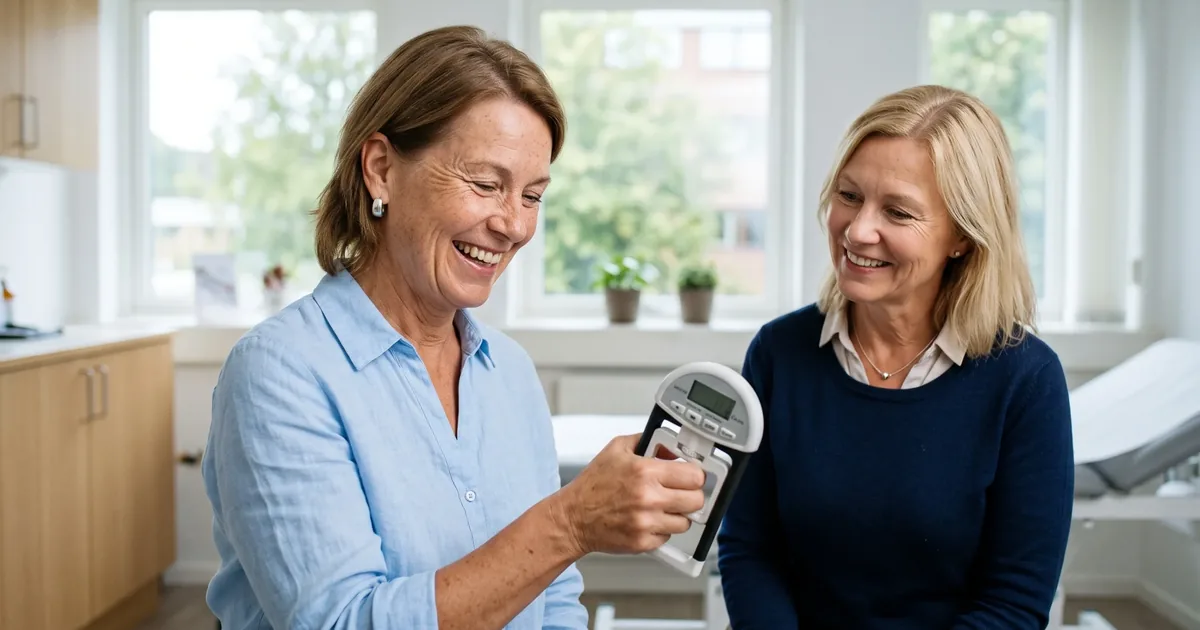
Think of the lid on the jar. The team measured grip strength with a dynamometer, a small device you hold in your hand and squeeze. Here too, the women with mild cognitive impairment came out clearly weaker than the women without it.1 A hand that struggles with a lid and a leg that needs a push to stand up are, in this picture, two sides of the same story.
Beneath the skin, the picture matched. The team measured body composition with bioelectrical impedance analysis, a method that estimates how much of the body is muscle and how much is fat. The women with mild cognitive impairment had less muscle mass and a higher body fat percentage than the women without the impairment. The authors describe all of these differences, in movement and in body composition, as large.1
An obvious objection is that the women in one group were perhaps simply older or less active, and that this alone explains everything. The team checked both. The team recorded age and measured physical activity with the International Physical Activity Questionnaire-Short Form, scored according to the recommendations of the World Health Organization. The differences remained after both were taken into account.1 So the difference was not just a matter of age or of how much the women moved.
The idea that a grip can say something about the brain is not new to doctors who work with memory. Zaldy S. Tan, who leads the Memory and Healthy Aging Program at Cedars-Sinai, sees grip strength as a measurement worth taking early.7
Measuring grip strength, even in early to middle age, allows us to recognise people who may be at risk of cognitive decline later in life.
Zaldy S. Tan, Director, Memory and Healthy Aging Program, Cedars-Sinai
David C. Hay, a hand surgeon at Cedars-Sinai Orthopaedics, puts the emphasis on maintaining strength.8
Keeping to a regular strength training routine can help slow that decline and help maintain health and function.
David C. Hay, hand surgeon, Cedars-Sinai Orthopaedics
Neither quote comes from the new article. Both come from a Cedars-Sinai article about grip strength and brain health, and they show how doctors in that field already look at strength as a signal worth keeping an eye on.
What the findings do not show
The design is cross-sectional: each woman was measured at one moment. That shows a difference between two groups. What the study does not show is what came first: whether weaker legs and a weaker grip come before a dip in memory and thinking, or the other way round, or whether something else lies behind both.1 So the findings do not say that building muscle changes your memory, nor that a slow morning means your memory is declining. No training or programme was tested.
The group was small: 54 women, 29 with mild cognitive impairment and 25 without. All participants were older Thai women living independently at home.1 The findings do not yet say anything about men, younger people or other groups. The editors have not read the full article, only the abstract. The abstract does not report the average times, grip strength values, muscle mass or fat percentages per group, how the women were recruited, or whether the participants had other health problems.
What the findings do show is more limited, yet still useful: in this group, the way of moving and body composition clearly differed between women with and without a slight dip in memory and thinking, even after age and activity were taken into account.1
In short, and what you can do now

In short: older Thai women with mild cognitive impairment took clearly longer on a chair and walking test, had a weaker grip, and had less muscle mass and a higher body fat percentage than women without the impairment, and those differences remained after age and physical activity were taken into account.1 That fits with earlier research that linked a weaker grip and slower walking to thinking skills that more often decline over time.2,6 The group was small, made up only of women and measured at a single point in time, so the findings show a difference, not a cause.1 Meanwhile, only 29 per cent of Dutch adults aged 75 and over meet the Dutch physical activity guidelines.3
None of the three directions that follow from this is a programme. Keep the everyday movements in your day: standing up, walking, carrying, holding on. Keep using your muscles; a regular strength training routine is one way, and a Cedars-Sinai hand surgeon links such a routine to maintaining health and function.8 And if your memory seems to be getting worse quickly, if it gets in the way of your daily life, or if it seems worse than is usual for your age, make an appointment with your GP.5
How you start, and where your heart and blood vessels stand when you start, is the open question. The heart and blood vessel scan gives you a starting point for that part of the picture.
Frequently asked questions
Does a weak grip mean my memory is declining?
No. The findings compare groups, not individuals, and a single measurement cannot show what causes what.1 In long-running studies, people with a weaker grip more often saw their thinking skills decline over the years, but more often does not mean always.2 If you are worried about your memory, it is up to your GP to look into it.
What is the Timed Up-and-Go test?
A simple test of mobility: a person stands up from a chair, walks and sits back down, and the time is recorded. In the Five Times Sit-to-Stand test, a person stands up from a chair five times, sitting back down each time.1 The summary does not say how long the walking route was or what the exact instructions were.
Does strength training help memory?
The new article did not test that; the study compared two groups at a single point in time.1 A Cedars-Sinai hand surgeon says a regular strength training routine can help maintain health and function.8 Whether such a routine changes anything about memory and thinking is not something these findings show.
Is forgetting things more often normal as I get older?
For many people, yes. Thuisarts, the patient website of the Dutch College of General Practitioners (NHG), says that as you get older you forget things more quickly and your memory starts to work less well.5 Make an appointment with your GP if your memory seems to be getting worse quickly, if it gets in the way of your daily life, or if it seems worse than is normal for your age.5
Do these findings also apply to men or to people in the Netherlands?
Not yet. All 54 participants were older Thai women living independently at home.1 Whether the same differences can also be seen in men, in younger people or in other groups is an open question.
Can the heart and blood vessel scan tell me whether my memory is declining?
No. The scan gives you a starting point for your heart and blood vessels and does not look at memory. The scan is not a diagnosis; questions about your memory belong with your GP.5
Sources
Every source below was checked on the day this article was published. The numbering follows the text.
- Poncumhak P, Duangsanjun W, Namwong W, Intaruk R. Differences in functional mobility and body composition between older Thai women with and without mild cognitive impairment: a cross-sectional comparative study. Korean Journal of Family Medicine, 2026 (epub 27 October 2026). PMID 42934840. doi.org/10.4082/kjfm.26.0070
- Cui M, Zhang S, Liu Y, Gang X, Wang G. Grip Strength and the Risk of Cognitive Decline and Dementia: A Systematic Review and Meta-Analysis of Longitudinal Cohort Studies. Frontiers in Aging Neuroscience, 2021. doi.org/10.3389/fnagi.2021.625551
- CBS. More than 4 in 10 adults get enough exercise. Centraal Bureau voor de Statistiek, 12 September 2023 (figures for 2022). cbs.nl
- CBS. More than 4 in 10 adults get enough exercise. Centraal Bureau voor de Statistiek, 12 September 2023 (figures for 2022). cbs.nl
- Thuisarts.nl (NHG). Ik vergeet snel dingen. Thuisarts, accessed 2026. thuisarts.nl
- Fuentes-Abolafio IJ, Stubbs B, Pérez-Belmonte LM, Bernal-López MR, Gómez-Huelgas R, Cuesta-Vargas AI. Functional parameters indicative of mild cognitive impairment: a systematic review using instrumented kinematic assessment. BMC Geriatrics, 2020. doi.org/10.1186/s12877-020-01678-6
- Zaldy S. Tan, MD, MPH, Director, Memory and Healthy Aging Program, Cedars-Sinai. Grip Strength and Brain Health: What the Research Shows. Cedars-Sinai, 2026. cedars-sinai.org
- David C. Hay, MD, hand surgeon, Cedars-Sinai Orthopaedics. Grip Strength and Brain Health: What the Research Shows. Cedars-Sinai, 2026. cedars-sinai.org
Quotations from English have been translated by BioProfile.
Also read
See where your heart and blood vessels stand
Answer the questions in the heart and blood vessel scan and your starting point appears in your dashboard. The scan is not a diagnosis; the scan shows where you stand today.
Free, about 3 minutes. An analysis of your answers, never a diagnosis.
BioProfile analyses your health status to guide you and your coach. It does not make a diagnosis, only a doctor can do that. Built on validated health questionnaires; the combined BioProfile score is not itself a validated clinical instrument yet. Your answers stay private (GDPR).