

In short
- Of 6,690 people in South Tyrol, Italy, those who ate more in line with healthy plant-rich eating patterns had a better sense of smell, and fewer of them had a clearly reduced sense of smell.1
- Plant-based eating is not one thing: with the unhealthy plant-based pattern, the study saw the opposite.1
- The study looked at a single moment in time, so it shows a link but not cause and effect.1
- A free BioProfile health scan gives you insight into where you stand today. The scan is not a diagnosis.
Contents
- The tin of coffee in the morning
- You are far from the only one still working it out
- Why your sense of smell declines, and what was known until now
- A study from South Tyrol puts the plate next to the nose
- Plant-based eating is not one thing
- How a nose gets a score
- What the study showed, in whom, and what it did not
- Where you can start
- Frequently asked questions
The morning can of coffee
The kettle clicks off, you open the tin of coffee and it smells of less than you remember. Or it smells exactly the same and you never give your nose a thought. What you do think about is your plate. Everyone seems to say you should choose more plant-based food, the shelves are full of products with a little green leaf on the label, and you are not quite sure what counts. Do the bread, the oat drink and the veggie burger all mean the same thing? And does any of it make a difference you would ever notice?
Smell is the sense most people forget until it changes. Smell plays a part in how food tastes, whether a meal appeals to you and whether you notice the milk has gone sour. It is also the sense a new study has set beside the way people eat.
This piece is about that link: what plant-based eating is, what was known about diet and sense of smell, what the new study adds and what it cannot tell you yet.
You are far from the only one still working it out

If your plate isn’t mostly plants yet, you’re in good company. In the Netherlands, the national statistics office CBS reported in 2023 that from 2019 to 2021, 18 per cent of people aged 18 to 70 met the standard for healthy eating set out in its report on (un)healthy eating, up from 15 per cent in 2012 to 2016.2 The share is rising slowly, and most people still don’t meet it.
In Germany, the federal statistical office Destatis reported in 2026 that 14 per cent of spending on food went on vegetables, potatoes and the like, and 9 per cent on fruit and nuts.3
None of these figures says anything about anyone’s nose. What the figures do show is that a plate made up mostly of plants is not yet the daily pattern for many people in either country. Being unsure where to start is not the exception. It is the usual starting point.
Why the sense of smell declines, and what was known until now
A weaker sense of smell is more common than many people think. Studies in which people have to name smells put the share of adults with a reduced sense of smell at about 15 per cent, and the share with no sense of smell at about 5 per cent. That estimate comes from the background of an earlier article by researchers who work on the same South Tyrol study as the new one. The same article notes that age, sex, and health and lifestyle circumstances all go together with a weaker sense of smell.4 Several things can play a part at once, so it is rarely one simple story.
Researchers pay attention to smell for a reason that goes beyond enjoying food. In an American study of 3,005 adults aged 57 to 85 living at home, tested in 2005 to 2006 and looked at again in 2010 to 2011, people who were poor at naming smells had a clearly higher chance of dying within five years. The authors call smell one of the strongest predictors of death within five years in that group.5 The authors of the new study start from the same point: a poor sense of smell goes together with higher mortality among older adults and is an early sign of brain ageing.1
Diet had come into view before. In a nationally representative sample of American adults aged 60 and over, from the 2013 to 2014 NHANES survey, people who ate little in line with an eating pattern rich in unsaturated fats had both a poorer sense of smell and poorer thinking skills. The authors conclude that diet may partly play a part in the link between the two.6
That is where the knowledge stopped. Little was known about how the overall quality of what people eat relates to how well people smell, write the authors of the new study.1 Research had looked at single nutrients and at separate groups of older people. Complete eating patterns in a large group of ordinary people had not been studied much yet.
A study from South Tyrol puts the plate next to the nose
The new work comes from Italy and Canada. Five of the six authors, E. Hantikainen, R. Melotti, M. Gögele, P. Pramstaller and C. Fuchsberger, work at the Institute for Biomedicine at Eurac Research in Bolzano, Italy. The sixth, J. Frasnelli, works at the Department of Anatomy of the University of Québec in Trois-Rivières and at the research centres of the Sacré-Coeur Hospital and of the Institut universitaire de gériatrie de Montréal, in Canada. The article appeared on 5 October 2026 in the journal Chemical Senses as a journal article, not as a preprint.1
The team used data from the Cooperative Health Research in South Tyrol study, CHRIS for short, a study of the general population of that Italian region. For 6,690 participants, the team had two things side by side: what people reported eating and how well they could name smells in a standard test.1 Three of the authors, Gögele, Fuchsberger and Frasnelli, were also authors of the earlier CHRIS article on what goes together with the sense of smell, so the new article is a next step in work with the same group of people.4
Why should this matter to you if your nose seems fine? Most conversations about plant-based eating are about energy, the climate or the grocery bill. This study looks at a sense that people rarely connect with what is on their plate, in ordinary people from one region rather than in patients at a clinic. And it does not lump all plant-based ways of eating together. The question the study asks is one you can also ask about your own week: not “do I eat plant-based?”, but “what kind of plant-based?” The answer is worth knowing in detail, including the places where it stops.
Plant-based eating is not one thing

At the heart of this study is the eating pattern: not one food, but the shape of everything you eat over a longer period, turned into a score. It is worth seeing how that works, because it is also the clearest answer to the question of what plant-based eating is.
Eating plant-based means you build your meals mostly from foods that come from plants. That sounds like one choice, but it covers very different weeks. The researchers did not ask people whether their food was plant-based. They asked how often people ate a long list of foods, using a questionnaire called the GA2LEN semi-quantitative Food Frequency questionnaire, and then scored those answers in five recognised ways.1
Take the first example: the same questionnaire answers were scored in five ways. Each participant’s answers became a score on the Alternate Healthy Eating Index 2010, on an index for the Mediterranean eating pattern, on a plant-based index, on a healthy plant-based index and on an unhealthy plant-based index.1 Picture two neighbours who both tick plenty of plant foods. On the ordinary plant-based index, the neighbours may look alike. On the healthy and the unhealthy plant-based index, they can end up far apart, because those two scores weigh different kinds of plant food. Which foods count on each side is not in the abstract, the only part of the article BioProfile has read.
That split is exactly where the result lies. Higher scores on all the healthy patterns went together with a better sense of smell and with fewer people whose sense of smell was clearly reduced. With the unhealthy plant-based pattern, the study saw the opposite.1 So in this study, the word “plant-based” on its own said little; the kind of plant food is what was linked to smell.
The second example is closer to the kitchen: fruit, vegetables, coffee and tea. Alongside the five patterns, the researchers looked at individual food groups. People who ate and drank more fruit, vegetables, coffee and tea had a better sense of smell, and fewer of them had a clearly reduced sense of smell.1 Think of an ordinary day: fruit at breakfast, tea or coffee mid-morning, vegetables with dinner. Those are the food groups this study named: each of them comes from a plant and none of them is a special product.
This is also the most honest answer to the question of what the benefits of plant-based eating are, as far as this study goes. In these 6,690 people, eating patterns rich in healthy plant foods went together with a better sense of smell. The study does not say that the food caused it.
How a nose gets a score
To set an eating pattern beside a nose, the nose needs a score too. Smell was measured with the Sniffin’ Sticks odour identification test, in which people try to recognise smells, and the score is the number of the 16 smells they get right. A score of 12 or lower counted as hyposmia, the term for a reduced sense of smell.1
A single total score hides detail. A study from the University of Copenhagen found that older adults did not lose all smells to the same degree. One of the researchers put it like this:
Our study shows that the decline in the sense of smell in older adults is more complex than was ever thought. While their ability to smell fried meat, onions and mushrooms is clearly weaker, older adults smell orange, raspberry and vanilla just as well as younger adults.
Eva Honnens de Lichtenberg Broge, researcher, Department of Food Science, University of Copenhagen7
In that study, smells from the pan faded, while fruit and vanilla held up. A total score out of 16 does not show which smells someone is missing, and the summary of the South Tyrol study does not show that either.
Why measure smell at all in a study about food? Because of the earlier findings above: a poor sense of smell goes together with higher mortality among older adults.5 Martha K. McClintock, one of the authors of that American study from 2014, said at the time:
This evolutionarily ancient, remarkable sense can be a signal of an important mechanism that influences human lifespan.
Martha K. McClintock, David Lee Shillinglaw Distinguished Service Professor of Psychology, University of Chicago8
Note the word “can”. That quote is about the 2014 study, not about diet. None of those studies shows that a better sense of smell makes someone live longer, or that a plate can change how long you live.
What the study showed, in whom, and what it did not
In whom: 6,690 participants in the CHRIS study, a study of the general population in South Tyrol, Italy. Their age range is not given in the summary.1
What it showed: people who ate more in line with one of the healthy patterns had a better sense of smell, and fewer of them scored 12 or lower on the smell test. People who scored higher on the unhealthy plant-based pattern showed the opposite. More fruit, vegetables, coffee and tea went together with a better sense of smell and with fewer people with a reduced sense of smell.1 The researchers took other factors into account in their analysis; which factors those are is not stated in the summary. How large the differences were is not stated in the summary either, so this article gives no size for them.
What it did not show matters just as much.
- A link, not a cause. The study looked at everyone at a single point in time. It shows that eating pattern and sense of smell go together, and does not show that one causes the other.1 The summary does not say why the two would go together. Diet could play a role. It could also work the other way round: people who smell well may enjoy fruit and vegetables more and choose them more often. Or a third factor, such as age, health or lifestyle, could be behind both.
- Food as people remember it. The participants reported their own diet on a questionnaire, so this is about what people remembered eating, not what was weighed on a plate.1
- One region. All the participants came from South Tyrol. Whether the same holds elsewhere is something this study cannot say.
- No change tested. Nobody was asked to eat differently and nobody was followed over time, so the study cannot say what happens to your sense of smell if you change your plate.
- Nothing about lifespan or the brain. The summary reports no measure of lifespan or brain ageing. Those links come from other studies, and they are links too.
Where you can start
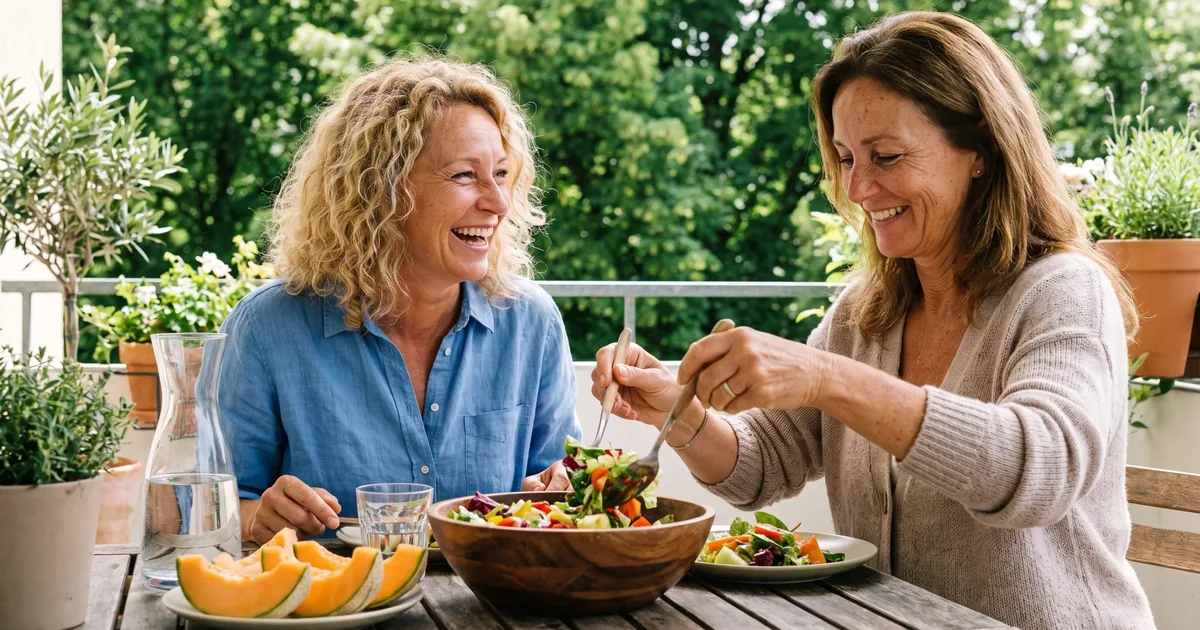
The study does not give you a menu, and neither does this article. It does point to a few directions to think about for your own week, and that makes these the most useful plant-based eating tips the study can support.
First: look at the whole pattern, not at one product. In this study, the healthy plant-rich eating patterns and the unhealthy plant-based pattern went in opposite directions, so a green label tells you less than what ends up on your plate over the week.1
Second: make room for fruit and vegetables at more moments of the day. These are the ordinary plant foods this study named, and you need nothing special to find fruit and vegetables.
Third: pay attention to your own sense of smell. If you are unsure whether your symptoms come from something else, Thuisarts.nl advises calling your GP, and a doctor is the one who judges what lies behind them.9
None of this tells you what your own food looks like today. You only find that out by taking an honest look at it. A free BioProfile scan is made for exactly that question: the scan gives you insight into where you stand right now, as a starting point for your own choices. The scan is not a diagnosis.
See where you stand today
A free BioProfile health scan gives you insight into where you stand today, as a starting point. The scan is not a diagnosis.
Free, about 3 minutes. An analysis of your answers, never a diagnosis. All health scans
Frequently asked questions
What is plant-based eating?
Building your meals mostly from foods that come from plants, such as fruit and vegetables. It is not one single way of eating: the South Tyrol study scored a healthy and an unhealthy plant-based pattern separately, and the two went in opposite directions for the sense of smell.1
What are the benefits of plant-based eating for your sense of smell?
Of 6,690 people, those who ate more in line with healthy plant-rich eating patterns had a better sense of smell, and fewer of them had a clearly reduced sense of smell. More fruit, vegetables, coffee and tea pointed the same way. The study looked at one moment in time, so it shows a link but does not show that the food caused the better sense of smell.1
Will my sense of smell get sharper if I eat more fruit and vegetables?
That was not tested. The study compared people at a single point in time and followed nobody who started eating differently.1 It may be that people who smell well also enjoy fruit and vegetables more, or that age, health or lifestyle is behind both.
How common is a reduced sense of smell?
More often than many people think. Studies in which people have to name smells put the share of adults with a reduced sense of smell at about 15 per cent, and with no sense of smell at about 5 per cent. Age, sex, and health and lifestyle circumstances all go together with a weaker sense of smell.4
When should I contact my GP about my sense of smell?
Thuisarts.nl, from the Nederlands Huisartsen Genootschap (NHG), says that smell training is an option if you have had trouble smelling for longer than four weeks, and that you should call your GP on a working day if you are not sure where your symptoms come from.9 What lies behind a change in your own sense of smell is for a doctor to judge.
Sources
Every source below was checked on the day this article was published. The numbering follows the text.
- Hantikainen E, Melotti R, Gögele M, Pramstaller P, Fuchsberger C, Frasnelli J. Adherence to healthy plant-rich diets is associated with better olfactory function in the general population: Findings from the Cooperative Health Research in South Tyrol (CHRIS) study. Chemical Senses, 2026. PMID 42830263. doi.org/10.1093/chemse/bjag028
- CBS. (On)gezonde leefstijl 2022: opvattingen, motieven en gedragingen. 2. (On)gezond eten. 2023. cbs.nl
- Destatis. Gut ein Fünftel der Nahrungsmittelausgaben entfallen auf Fleisch und Fisch. Pressemitteilung, 2026. destatis.de
- Gögele M, Emmert D, Fuchsberger C, Frasnelli J. Factors influencing olfactory function in an adult general population sample: the CHRIS study. Chemical Senses, 2024; 49. doi.org/10.1093/chemse/bjae011
- Pinto JM, Wroblewski KE, Kern DW, Schumm LP, McClintock MK. Olfactory Dysfunction Predicts 5-Year Mortality in Older Adults. PLOS ONE, 2014. doi.org/10.1371/journal.pone.0107541
- Vohra V, Assi S, Kamath V, Soler ZM, Rowan NR. Potential Role for Diet in Mediating the Association of Olfactory Dysfunction and Cognitive Decline: A Nationally Representative Study. Nutrients, 2023. doi.org/10.3390/nu15183890
- Eva Honnens de Lichtenberg Broge, researcher, Department of Food Science, University of Copenhagen. The sense of smell in older adults declines when it comes to meat, but not vanilla, researchers find. ScienceDaily (press release from the University of Copenhagen, Faculty of Science), 2021. sciencedaily.com
- Martha K. McClintock, David Lee Shillinglaw Distinguished Service Professor of Psychology, University of Chicago. Decreased ability to identify odors can predict death. UChicago News, 2014. news.uchicago.edu
- Thuisarts.nl (NHG). Ik blijf minder ruiken of proeven na corona. thuisarts.nl
Quotations from English have been translated by BioProfile.
BioProfile analyses your health status to guide you and your coach. It does not make a diagnosis, only a doctor can do that. Built on validated health questionnaires; the combined BioProfile score is not itself a validated clinical instrument yet. Your answers stay private (GDPR).