
You sleep your hours, you do not eat badly, and still every day is a climb. At three o’clock it drops away, in the evening you are too spent to do anything, and at the weekend you catch nothing up. Being tired all the time is one of the complaints the GP hears most and one of the least often explained. What the GP usually finds, why your body does not recover and what you can measure yourself is below. The BioProfile energy scan measures how much these complaints bother you, and gives you an indication of where you stand today in this area, as the first of the 11 health areas that the full scan assesses. This is not a diagnosis. It is insight, to see where you stand today. And to help you make better choices in your food and lifestyle. What this scan does not do: point to a cause or make a diagnosis. Only a doctor can do that last one.
Verified by Justinas Šlikas, PhD
PhD in chemistry from the University of Edinburgh
Checked on 5 October 2026
In short
- Among people who come to the GP with fatigue, almost half have something connected to it found within a year, and in 8 per cent that is a clear physical illness.1
- If you sleep six hours a night for two weeks, by the end you perform as though you had not slept for up to two nights, and you barely feel it.2
- An energy scan measures how much fatigue you are carrying and gives you a starting value. It does not point to a cause and it does not make a diagnosis.
Contents
What the GP usually finds
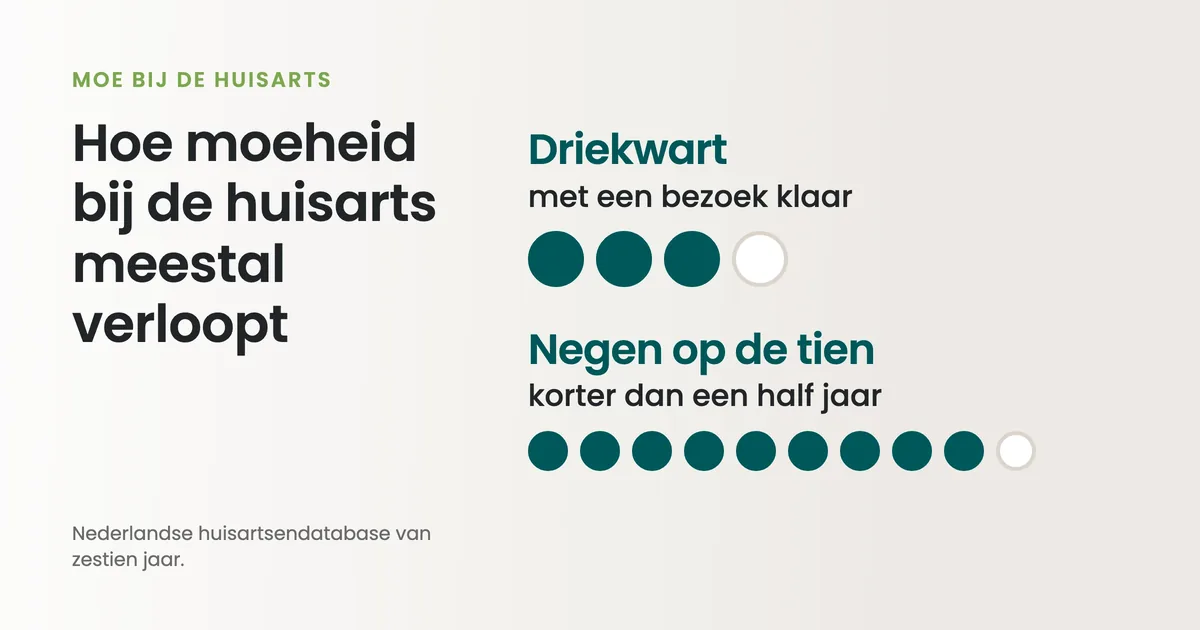
In a Dutch general practice database covering sixteen years, over a four year period 21 per cent of patients came at least once with tiredness as the reason for the visit. Three quarters of those episodes were done with one visit, nine in ten lasted less than six months, and the GP mainly did three things: take blood, do a physical examination and give advice.3
What that brings in was followed for a year in 571 people who came in with a new episode of fatigue. In 47 per cent the GP found something during that year that could be linked to the tiredness, most often muscle and joint complaints (19 per cent) or psychological complaints (17 per cent). A clear physical illness was found in 8 per cent. The other half were given no explanation.1 Thuisarts puts it more briefly: tiredness is almost never caused by a serious illness, and if you have no other symptoms, a blood test almost never turns up a cause.4
What happens next differs. Of 642 people who came to the GP with fatigue, three quarters fell into one of four patterns over the year: 26 per cent stayed just as tired, 17 per cent recovered quickly and 25 per cent slowly, and 32 per cent picked up first and then fell back again.5 That last group is the group that wonders whether anything was ever behind it.
Why your body does not recover
The most measured cause is the night you do not feel as a shortfall. In a laboratory, 48 healthy adults slept four, six or eight hours for fourteen nights in a row. At six hours the performance losses piled up further every day, until by the end they were comparable to up to two nights of no sleep at all. The participants themselves felt hardly any sleepier after the first few days.2 Six hours feels normal after a week, while the shortfall carries on.
Coffee keeps that shortfall going: 400 milligrams of caffeine, six hours before bedtime, still disturbed sleep measurably compared with placebo.6 And exercise works the other way. A summary of research into regular exercise found more energy and less fatigue on average than in control groups; the effect was smaller or absent in the studies with a good placebo group, so it is a modest effect, but one you can measure yourself.7
What an energy scan measures
The energy scan asks five questions about the past two weeks: your energy through the day, energy dips, how much you lean on caffeine, getting physically tired, and being too spent to do things. Each question is given points, the points are added up and converted into an energy score from 0 to 100, with the reading band it falls into. Higher is better.
The questions are modelled on the Fatigue Assessment Scale, a fatigue scale that was written in Dutch and tested in working adults and not only in patients.8 The same tradition produced the Checklist Individual Strength, whose norms were established in 2,288 Dutch people and in which 35 points or more on the severity scale counts as severe fatigue.9 Our questions are worded ourselves, not a copy, so the score is not a validated clinical score. What you get is a picture of how much fatigue you are carrying, and a starting value.
What an energy scan does not measure
A questionnaire cannot attribute fatigue to anything. An underactive thyroid, a shortage of iron, a swinging blood sugar, poor sleep and a low mood all read the same in a questionnaire. So an energy scan does not make a diagnosis. Blood values and sleep data are the layers that take this from a picture of the burden to an explained picture, and those you ask a doctor for.
Four things are a reason to go to the GP: tiredness that lasts a long time, longer than a month for example, sweating more at night, less appetite, feeling tight-chested or short of breath, and a lot of thirst.4
What you do with your score
A score today is your starting value. Repeat the scan in two weeks, over the same questions, and you have two numbers instead of a feeling about a complaint that your memory flattens out.
If you want to change something in those two weeks, pick something whose effect has been measured: cutting out coffee after three in the afternoon,6 or bringing your nights up to seven hours.2 If you already wake up tired, that is where it starts; what a sleep test measures about that is in why you wake up tired.
Measure where you start
Five questions about the past two weeks, about three minutes, and your energy score is in your dashboard. What the energy scan measures and what it is based on is on the scan page.
Free, about 3 minutes. An analysis of your answers, never a diagnosis. All health scans
Frequently asked questions
What illness do you have when you are always tired?
Usually nothing. Tiredness is almost never caused by a serious illness, Thuisarts says,4 and in a Dutch cohort of 571 people who came to the GP with fatigue, a clear physical illness was found in 8 per cent within a year.1 What it is in your case is for a doctor to assess.
What are you short of when you are always tired?
More often sleep than a nutrient. If you have no other symptoms besides the tiredness, a blood test almost never turns up a cause.4 A shortage of iron or a slow thyroid does exist, and that is exactly what the GP takes blood for when there are more symptoms.
When should I go to the GP about tiredness?
If the tiredness lasts a long time, for example longer than a month, and other symptoms come with it: sweating more at night, less appetite, feeling tight of breath or out of breath, or a lot of thirst.4
Is the energy scan a fatigue test?
It measures how much fatigue you are carrying, the way a validated Dutch fatigue scale does, and not where that fatigue comes from.9 Looking for a cause is work for a doctor, and it does not make a diagnosis.
Sources
Every source below was checked on the day this article was published. The numbering follows the text.
- Nijrolder I, van der Windt D, de Vries H, van der Horst H. Diagnoses during follow-up of patients presenting with fatigue in primary care. Canadian Medical Association Journal, 2009. doi.org/10.1503/cmaj.090647
- Van Dongen HPA, Maislin G, Mullington JM, Dinges DF. The cumulative cost of additional wakefulness: dose-response effects on neurobehavioral functions and sleep physiology from chronic sleep restriction and total sleep deprivation. Sleep, 2003. doi.org/10.1093/sleep/26.2.117
- Kenter EGH, Okkes IM, Oskam SK, Lamberts H. Tiredness in Dutch family practice. Data on patients complaining of and/or diagnosed with tiredness. Family Practice, 2003. doi.org/10.1093/fampra/cmg418
- Thuisarts.nl (Nederlands Huisartsen Genootschap). I am tired. What could it be? thuisarts.nl
- Nijrolder I, van der Windt DAWM, van der Horst HE. Prognosis of fatigue and functioning in primary care: a 1-year follow-up study. Annals of Family Medicine, 2008. doi.org/10.1370/afm.908
- Drake C, Roehrs T, Shambroom J, Roth T. Caffeine effects on sleep taken 0, 3, or 6 hours before going to bed. Journal of Clinical Sleep Medicine, 2013. doi.org/10.5664/jcsm.3170
- Puetz TW, O’Connor PJ, Dishman RK. Effects of chronic exercise on feelings of energy and fatigue: a quantitative synthesis. Psychological Bulletin, 2006. doi.org/10.1037/0033-2909.132.6.866
- Michielsen HJ, De Vries J, Van Heck GL. Psychometric qualities of a brief self-rated fatigue measure: the Fatigue Assessment Scale. Journal of Psychosomatic Research, 2003. doi.org/10.1016/S0022-3999(02)00392-6
- Worm-Smeitink M, Gielissen M, Bloot L, et al. The assessment of fatigue: psychometric qualities and norms for the Checklist Individual Strength. Journal of Psychosomatic Research, 2017. doi.org/10.1016/j.jpsychores.2017.05.007
Written by
BioProfile analyses your health status to guide you and your coach. It does not make a diagnosis, only a doctor can do that. Built on validated health questionnaires; the combined BioProfile score is not itself a validated clinical instrument yet. Your answers stay private (GDPR).