
BioProfile analysis · hormone scan
Your result in 3 minutes
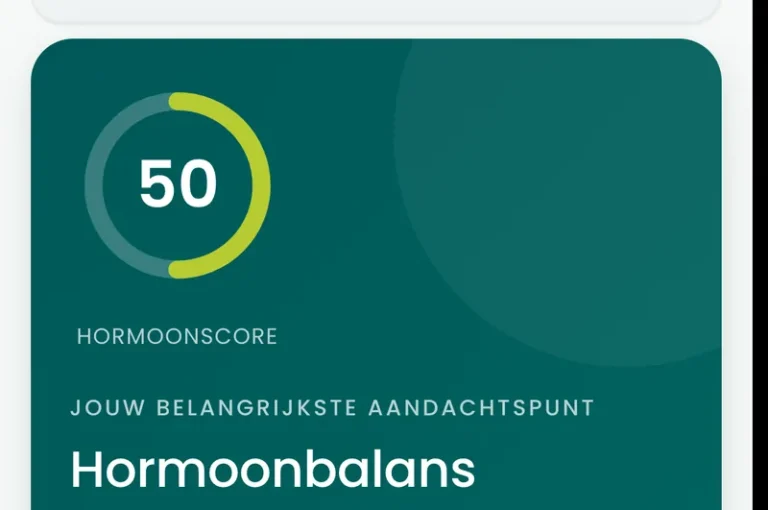
Your hormone score over the past few weeks, read for your life stage, with the reading band it falls in and, per question, the number that pulled your score down or up. All on your own screen, in your dashboard.
Four questions for women in or around the menopause, three for men, based on validated symptom questionnaires. You get a hormone score from 0 to 100 for your stage of life. Symptoms, never hormones; never a diagnosis.
Free
3 or 4 questions
About 3 minutes
0 to 100
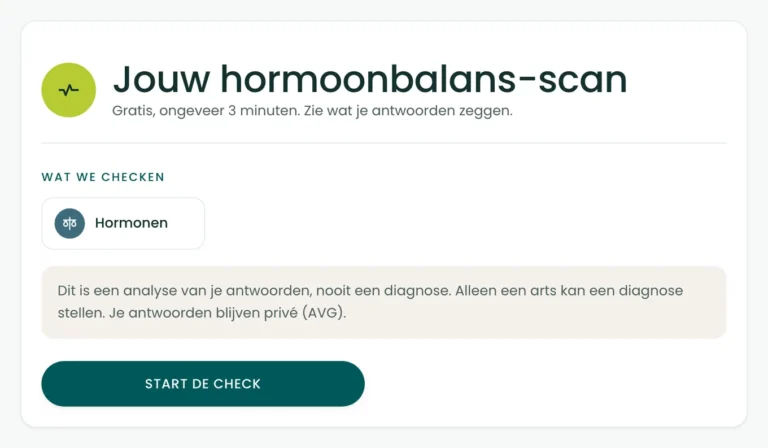
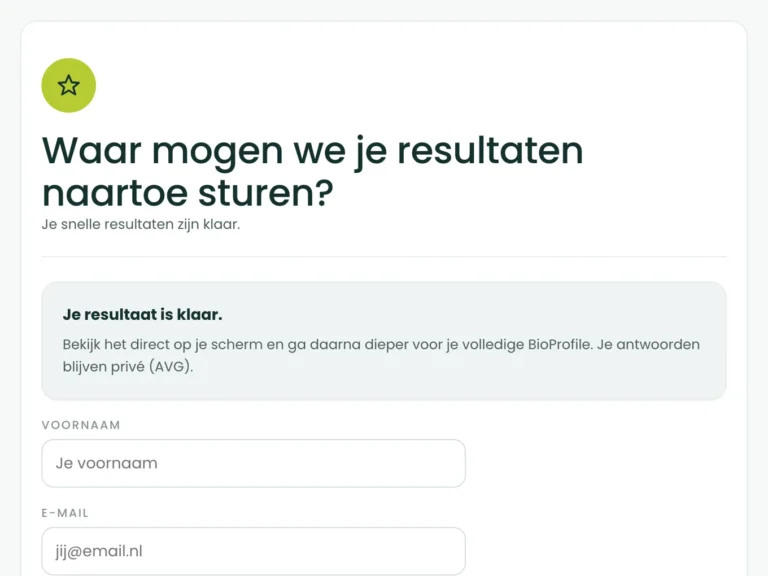
Fill in your first name and email address, and your hormone score is there in your dashboard.
(and the evidence-based reason why these are exactly the questions, for women and for men)
For women: you wake at three in the morning, soaked through, and lie there waiting until five. During the day you are stung more easily than you know yourself to be, and when someone asks how you are, you say you are tired, because that is the word everyone understands. For men: the desire is gone, the strength is less, and the getting on with things that used to come by itself now needs a run-up. You too say you are tired. Neither of you is ill. Neither of you has a number.
The hard part about hormonal symptoms is that they look like everything. Sleeping badly, being irritable, not feeling up for anything: that can be the menopause, or stress, or a winter, and all you have is a feeling about a few weeks. The temptation is to buy a hormone test. But a blood value without a picture of the symptoms says little, and in men the best known symptom questionnaires do not even track the hormone. That is not an opinion of ours; it is in the research, further down this page.
What can be done is to measure the symptoms the way researchers do: how much trouble, over a few weeks, per symptom. For women in or around the menopause: hot flushes or night sweats, dryness, irritability or mood swings, and sleep that hormonal changes disturb. For men: desire, drive and mood. Added up into a score from 0 to 100, read for your stage of life. No hormone measurement. No diagnosis. A number, though. And a number you can follow, and take to a doctor.
A hormone test from a web shop. A supplement for the menopause, a supplement for testosterone, a diet, a detox. All understandable, and all of them start in the same place: with what you are going to do about it.
So after two months you still do not know whether it did anything. You have not recorded anywhere how much trouble you had when you started, and hormonal symptoms are exactly the symptoms you explain away the fastest yourself. Without a baseline, every change is a feeling about a feeling.
We analyse the real cause first
At BioProfile we turn the order around. First measure what is there now, with questions modelled on instruments that someone else has validated, and with an honest limit alongside them: symptoms, never hormones. Only after that, talk about what you do with it. Analyse first, advise second.
The hormone scan is the first step of that analysis, and the step you take to a doctor if the score gives reason to.
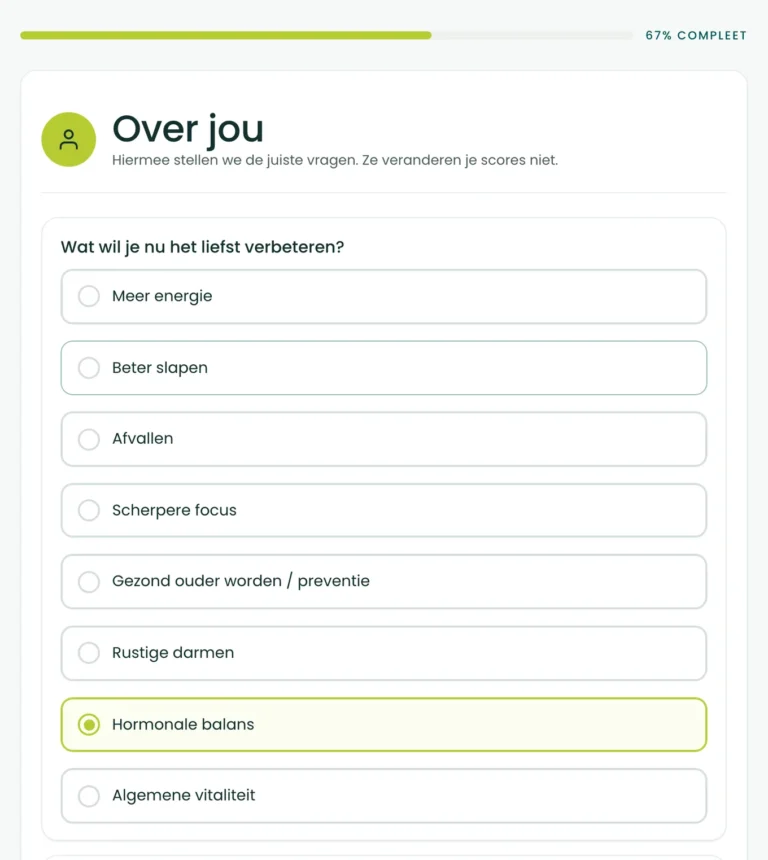
You start with eight short questions about yourself, including your sex and, for women, your life stage: those decide which questions you get. They do not count towards your score.
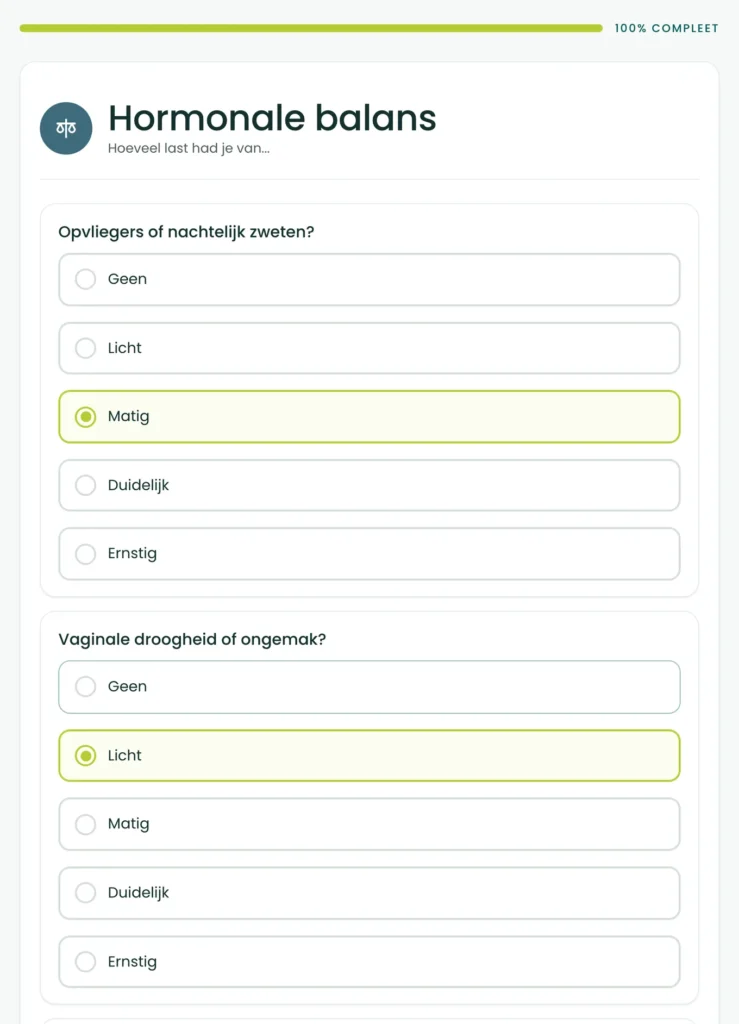
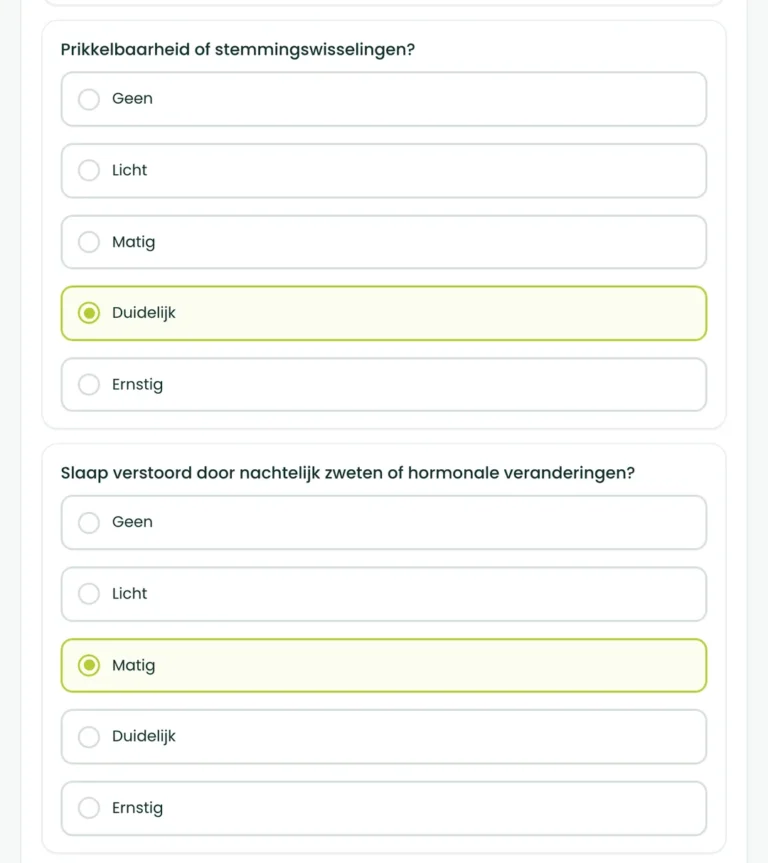
Then come the hormone questions about the past few weeks: for women in or around the menopause, hot flushes or sweating, dryness, irritability or mood, and disturbed sleep; for men, interest in sex, drive and strength, and mood. Each question has five answers.
You fill in your first name and email address. You see a first picture straight away, and with one tap on your dashboard your hormone score is on your screen, with the reading band alongside it. Your email holds a login link so you can find your result again later and extend your scan, with a blood test if you want.
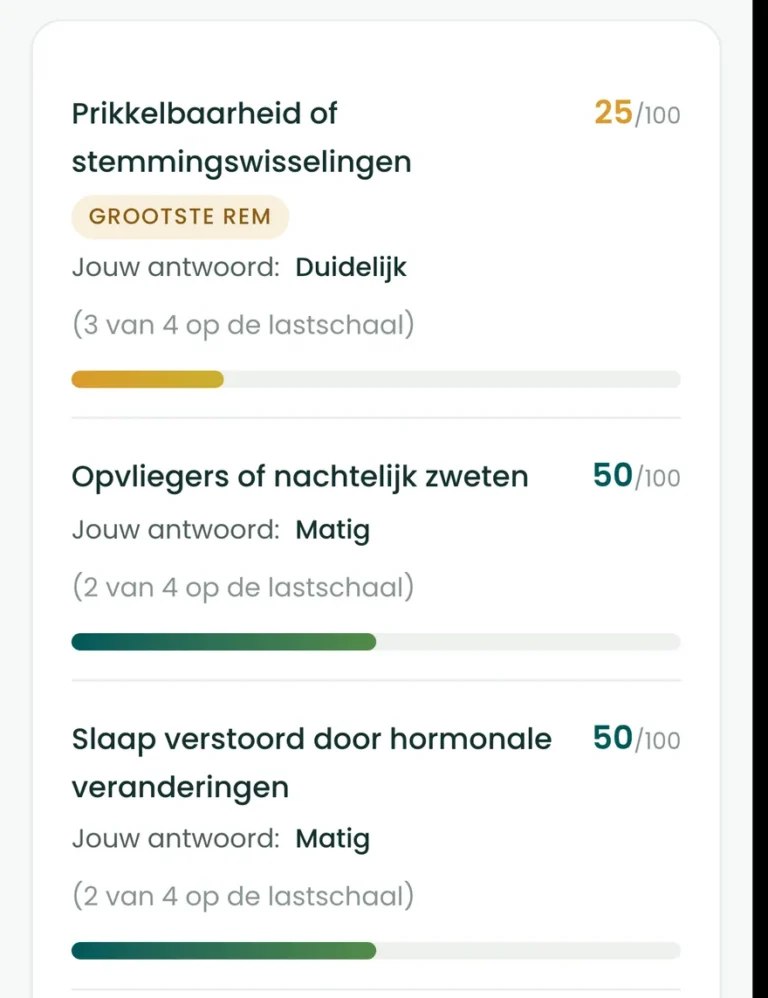
This is what is on your screen after about three minutes:
Repeat the scan in a few weeks and you no longer have a feeling about your symptoms, but two numbers. And if you go to a doctor, you take them with you.
Fill in your first name and email address, and your hormone score is there in your dashboard.
The scan starts with your life stage. Women in or around the menopause get the first four questions below, men the last three; women with regular cycles do not get them, because the scale has not been validated for that.
The first card is the instrument the questions for women are modelled on. The second is there to read the questions for men honestly: the best known questionnaires for men do not track the hormone, and that is why for men it is called a signal about vitality and drive, and not a hormone score.
modelled on
Eleven questions, scored from 0 to 44, spread over three groups: physical, psychological and urogenital, available in about thirty languages. It measures how much trouble menopausal symptoms give you. It does not measure a hormone, and it is only meaningful for women in or around the menopause, which is why we ask about your life stage first.
Modelled on, not validated as, this instrument.
Validated for: severity of menopausal symptoms in women in middle age.
Menopause Rating Scale, a quality of life instrument, PubMed Central.
used descriptively only
The two best known symptom questionnaires for men do not track testosterone. The reported sensitivity for low testosterone sits around 54 percent at a specificity of around 41 percent, and the shorter screening is deliberately built low in specificity. So for men we score a signal about vitality and drive, we call it that too, and we say clearly that only a blood test makes a hormone visible.
Used only descriptively. We do not apply the diagnostic rule behind it here.
Validated for: symptom burden in ageing men, not the testosterone level.
This is the profile that depends most on a blood test and where the science is narrowest. For women in or around the menopause, symptom questionnaires are validated and genuinely informative. For everyone outside that, and for men in particular, that does not hold: the best known symptom questionnaires for men do not track testosterone. That is why we ask about this area according to your life stage, score a symptom burden and call it exactly that, and never present it as a hormone measurement.
BioProfile scoring rules, measurement class B, cohort dependent, reliability capped at average within the cohort and low outside it.
Each question gets 0 to 4 points, from no trouble to a lot of trouble. The points are added up and converted into a hormone score from 0 to 100, read for your life stage. Higher is better.
0 to 39
clear symptoms
40 to 59
moderate
60 to 79
mild
80 to 100
few symptoms
Reading bands, not clinical cut-off values. Your questions about hormone balance are worded in house and modelled on validated instruments, so no published cut-off value applies to exactly this score. Higher is always healthier.
This scan falls into measurement class B: for women in or around the menopause a symptom questionnaire is validated and genuinely informative, and there the reliability of your score stays capped at average for as long as only your answers count. Outside that life stage, and for men, it is low, because the men’s questionnaires do not track the hormone. What lifts that ceiling is a blood test, and you can add one in your full BioProfile.
On your results screen that reliability appears as a label next to your score: medium reliability, symptom based. That label is not an aside; it tells you exactly how much weight you may put on the number.
This page describes a measuring instrument, so below you can read where that instrument comes from and what has been studied about it. Every claim points to the source it appears in.
In the American SWAN study, Avis and colleagues followed 1,449 women with regular hot flushes or night sweats across an average of thirteen visits: in total the symptoms lasted a median of 7.4 years, and they continued for a median of 4.5 years after the last period. Those who started with them early in the menopause had them the longest, a median of more than 11.8 years.1 Freeman and colleagues followed 255 women for sixteen years: moderate to severe hot flushes peaked at 46 percent in the first two years after the last period, and a third still had them ten years later.2
In 2005 Woods and Mitchell lined up the long-running studies: only hot flushes and night sweats, vaginal dryness and sleep problems change demonstrably with the stage of the menopause; a minority of women call them severe.3 Geukes and colleagues found, in 208 working Dutch women aged 44 to 60, that menopausal symptoms explained 33.8 per cent of the difference in work ability.4
Years of symptoms, measurable work ability, and almost nobody keeping a number for it. That is the reason this scan exists.
A questionnaire does not see a hormone. What it does see is symptom burden, and for women in or around the menopause that is well validated. The Menopause Rating Scale was examined in 2004 in a study across nine countries on four continents: reliability was good, the correlation between the subscales and the total score lay between 0.7 and 0.9, and the scale turned out to measure the same thing in every country.5,6 Schneider and colleagues put it to 306 German women aged 40 to 60 in 2000 and again a year and a half later: the scores correlated at 0.60, and most women stayed in the same category.7
Harlow and the STRAW+10 working group set down in 2012 how the stages of the menopause are classified, by menstrual pattern and hormone markers, and that is precisely why this scan asks about your life stage first: a symptom score only has meaning in the stage the scale was validated for.8
Our four questions for women follow the three groups of the Menopause Rating Scale, physical, psychological and urogenital, in our own words: hot flushes or sweating, dryness, irritability or mood, and sleep.6 They are not a copy of it, and the card above says so in as many words.
For men it is different, and we say so out loud. In 2000 Morley and colleagues tested the ADAM questionnaire in 316 Canadian doctors aged 40 to 62: 88 percent sensitivity, 60 percent specificity for a low bioavailable testosterone.9 In 2006 they compared three questionnaires in 148 men: the ADAM caught 97 percent of the low values, but with a specificity of 30 percent; the AMS 83 percent at 39 percent.10 The study that the BioProfile analysis names comes out, in 985 men, at 54 percent sensitivity and 41 percent specificity for the AMS.11 That is why for men it is called a signal about vitality and drive, and not a hormone score.
A low hormone score means a lot of symptoms over the past few weeks, and nothing beyond that. Wu and colleagues showed in 2010, in 3,369 European men aged 40 to 79, how narrow the link is: of all the symptoms, only three sexual symptoms as a set went together with low testosterone, and only the combination of those three with a measured value below 11 nanomol per litre defines it.12 The Endocrine Society set out in 2018 that a deficiency is established only with symptoms and a repeatedly measured, fasting, morning low testosterone.13
It works the same way for women: symptoms are the reason to ask for a blood test, not proof of a hormone level. A low score means it is worth looking further. Only a doctor can make a diagnosis, and only a blood test can see a hormone.
In 2011 Thurston and Joffe summed up what the SWAN study taught about hot flushes and night sweats: they count as the core symptoms of the menopause, they differ from one population group to another, and they are linked to the mental and physical health of women in middle age.14 In Avis, younger age, more perceived stress, more low mood and more anxiety at the first symptoms were the factors that made the symptoms last longer.1
That is association, not cause, and that is how those studies put it too. What it does say: symptoms that last years and affect your work are not symptoms to explain away as tired. A number per symptom, over a few weeks, is the start of a conversation that otherwise never begins.
This is what the scan stands on. Now your hormone score.
Fill in your first name and email address, and your hormone score is there in your dashboard.

This page was written by BioProfile. BioProfile sells health products and this scan is free: no purchase comes with it. The Menopause Rating Scale and the questionnaires for ageing men are not ours and are not free to use. That is why we ask our own questions, modelled on those instruments, and nowhere call them a validated copy of them. And we do not measure a hormone: only a blood test sees a hormone.
Every source below was checked on the day this page was published. The numbering follows the text: source 1 is the first one the text refers to, and the two instruments the analysis names sit in between, at the point where they come up.
A few questions, about three minutes, and your hormone score is in your dashboard. Your answers stay private (GDPR).
Fill in your first name and email address, and your hormone score is there in your dashboard.
What this does not say. This measures symptoms, never hormones. It can tell you nothing about your oestrogen, testosterone or thyroid levels, it cannot establish a hormonal condition, and hormonal imbalance as a general idea cannot be measured with a questionnaire at all. Only a blood test sees a hormone, and pronounced symptoms are the reason to ask for one.
BioProfile analyses your health status to guide you and your coach. It does not make a diagnosis, only a doctor can do that. Built on validated health questionnaires; the combined BioProfile score is not itself a validated clinical instrument yet. Your answers stay private (GDPR).