
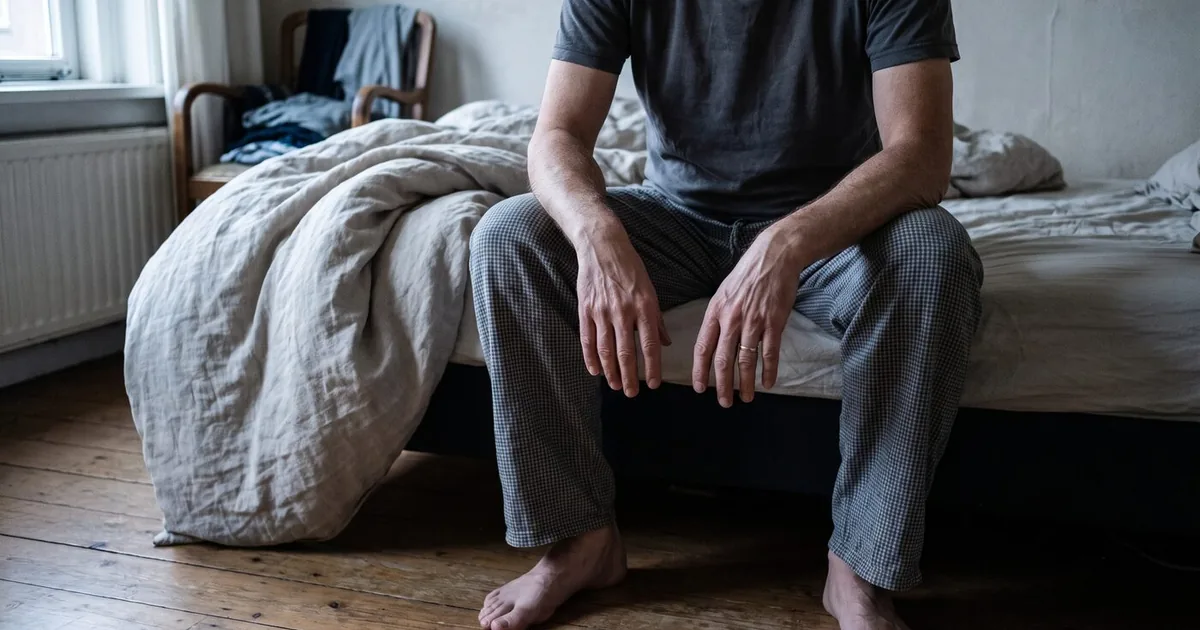
In this article you will read what the causes of extreme fatigue can be, how common it is, what a Dutch GP usually finds, what role iron plays and when to see your GP. This matters, because extreme fatigue rarely has one clear cause, and knowing what is usually found helps you assess your own situation calmly. Many people feel tired now and then, tiredness often passes on its own, and the exact cause is usually not found.4 The BioProfile energy scan measures how much these symptoms bother you and gives you an indication of where you stand today, as the first of the 11 areas the full scan looks at. The scan is not a diagnosis. It is insight, to see where you stand today and to help you make better choices in your diet and lifestyle. The scan does not point to a cause and does not name a condition. Only a doctor can do that.

In short
- About one in five adults feels tired, and about one in ten has tiredness that lasts longer than six months.1
- Among people who see their GP about tiredness, a serious physical illness is found in about 4 in 100, and depression in about 1 in 5.2
- In a Dutch cohort, about half of the people who went to their GP with tiredness still had no explanation in their records after a year.3
- An energy scan shows how much fatigue you are carrying and gives you a starting value. The scan does not point to a cause and is not a diagnosis.
Contents
How common extreme fatigue is
A review that pooled 91 studies covering more than 600,000 people in 32 countries found that about one in five adults in the general population was fatigued, and about one in ten had fatigue that lasted longer than six months.1 About 15 in 100 adults had moderate fatigue and about 6 in 100 had severe fatigue, so moderate fatigue was well over two times as common. Fatigue was slightly more common in women than in men, a pattern the researchers saw in all the groups they looked at.1
What this means for you: being tired is common, and severe tiredness is the smaller group. Six months is the point beyond which researchers call tiredness chronic.
The causes of extreme fatigue at a glance
You can see how many causes extreme fatigue has from the long list Thuisarts gives. Some lie in your life: problems at home, at school or at work, grief, major life events, money worries, worrying, being overstressed or burnt out, and depression. Some lie in your habits: too little exercise, an unhealthy diet, being overweight, smoking, alcohol and drugs. Some lie in your body: infections such as flu or COVID, diabetes, thyroid problems, heart and vascular disease, muscle and joint complaints, and chronic fatigue syndrome, where you are tired for longer than six months. Side effects of medicines are also on the list of causes.4
For you, this means the cause can just as well lie in your days as in your body. It pays to hold the list up against your own past few weeks.
What the GP usually finds
A review of 26 studies of people whose reason for seeing their GP was tiredness found depression in about one in five. A serious physical illness was found in about 4 in 100, anaemia in about 3 in 100 and cancer in fewer than 1 in 100.2 The researchers add that a serious physical illness is rare in patients who complain of tiredness. Because that illness occurs about as often in patients without tiredness, the link may not be causal.2
Put simply: when someone who is tired goes to the GP, a serious illness is the exception. And even when one is found, that illness is just as common in people who are not tired, so it may not be the reason for the fatigue.
A Dutch study followed 571 adults from 147 GP practices for a year after they visited their GP with a new episode of fatigue. Almost half (47 in 100) had one or more explanations recorded in their file that could be linked to the fatigue, most often muscle and joint complaints (19 in 100) or psychological or social problems (about 17 in 100). A clear physical illness was recorded in 8 in 100. The other half received no explanation.3 Almost a quarter of the group reported depressive symptoms in a questionnaire, while depression appeared in only about 1 in 20 GP files.3
What this means for you: tiredness without an explanation is the usual outcome, and it does not mean something was missed. A low mood does often go unnamed, though, so it pays to tell your GP how you feel, as well as how tired you are.
Iron status and anaemia: what you may be lacking
Anaemia means you have too few red blood cells, the cells that carry haemoglobin. Anaemia can make you feel tired and weak, along with shortness of breath when you exert yourself, dizziness, palpitations and headaches. Thuisarts names three causes: too little iron, too little vitamin B12 or folic acid, or another illness. Iron deficiency is most common in women, and that is due to heavy blood loss during menstruation.5
The Voedingscentrum lists getting tired easily as one of the signs of iron deficiency. For adults aged 18 and over, the advice is 11 milligrams of iron a day; for women before the menopause, the advice is 16 milligrams. Women of childbearing age are at greater risk of a deficiency, and young children and vegetarians are advised to pay extra attention to their iron intake.6
For you, this means iron is worth knowing about, but a deficiency explains only a small part of tiredness.2 Only a blood test shows a deficiency, and whether you need one is up to your GP.
How fatigue changes over a year
A second Dutch study followed 642 people who went to their GP with fatigue as their main complaint. At the start, 90 in 100 were severely fatigued; after a year, 46 in 100 still were. Of those who took part for the whole year, 26 in 100 stayed fatigued the entire time, 17 in 100 recovered quickly and 25 in 100 slowly, and 32 in 100 first improved and then became fatigued again.7
Put simply: about half got better within a year, and a dip after a good spell is normal. A setback does not mean you are back at the start.
When to see your GP
Thuisarts advises you to contact your GP if the tiredness lasts longer than a month, or if any of these symptoms appear alongside it: sweating more than usual at night, less appetite, your weight going down without you wanting it to, a change in your stools or blood in your stools, feeling short of breath while doing very little, being very thirsty and needing to pee often, heart palpitations, feeling very low and not wanting to do anything, or feeling very tense or restless.4
What an energy scan measures
The energy scan asks a short series of questions about the past two weeks and turns your answers into an energy score. The scan shows how much fatigue you are carrying, and gives you a starting value. A questionnaire cannot tell the causes apart: low iron, a slow thyroid and a low mood all read the same on it. That is why the scan is not a diagnosis. Repeat the scan after two weeks, and you have two numbers instead of a feeling.
What you can do in those two weeks is look at the habits Thuisarts names, such as exercise, diet, smoking and alcohol,4 and compare how much iron you take in with the advice.6 If your energy mostly drops in the afternoon, read why your energy dips after lunch.
In summary
Tiredness is common: about one in five adults is bothered by it, and about one in ten for longer than six months.1 The causes range from events in your life and habits to infections, anaemia and other illnesses.4 When someone who is tired goes to the GP, a serious illness is rare, depression is more common, and about half get no explanation.2,3 About half feel better within a year.7 See your GP if the tiredness lasts longer than a month or if the signs above come with it.4 The energy scan shows how much tiredness you are carrying. The scan is not a diagnosis.
Frequently asked questions
Which illness causes extreme tiredness?
Usually not a serious one. In a review of 26 GP studies, a serious physical illness was found in about 4 in 100 people who came in tired, anaemia in about 3 in 100 and cancer in fewer than 1 in 100; depression was far more common, in about 1 in 5.2 Thuisarts also names diabetes, thyroid problems, heart and vascular disease and infections such as flu or COVID.4 What is going on in your case is for a doctor to judge.
When is your tiredness abnormal?
Researchers call tiredness chronic when it lasts longer than six months, and about one in ten adults has it.1 Thuisarts advises you to contact your GP if the tiredness lasts longer than a month, or sooner if other complaints come with it.4
What are you short of when you are very tired?
Sometimes iron. Tiring quickly is one of the signs of iron deficiency,6 and too little iron, vitamin B12 or folic acid can cause anaemia, which makes you feel tired and weak.5 In people who see their GP about tiredness, anaemia is found in about 3 in 100.2 Only a blood test shows that.
What can I do about extreme tiredness?
Look at the causes in your own days that Thuisarts names: too little exercise, an unhealthy diet, smoking, alcohol, worries and being overstrained.4 Keep an eye on how much iron you take in; the advice for adults is 11 milligrams a day, and for women before the menopause it is 16 milligrams.6 If it lasts longer than a month, see your GP.4
Is the energy scan a fatigue test?
The scan measures how much fatigue you are carrying, and the cause remains open. Looking for a cause is work for a doctor. The scan is not a diagnosis.
Sources
Every source below was checked on the day this article was published. The numbering follows the text.
- Yoon JH, Park NH, Kang YE, Ahn YC, Lee EJ, Son CG. The demographic features of fatigue in the general population worldwide: a systematic review and meta-analysis. Frontiers in Public Health, 2023. doi.org/10.3389/fpubh.2023.1192121
- Stadje R, Dornieden K, Baum E, et al. The differential diagnosis of tiredness: a systematic review. BMC Family Practice, 2016;17:147. doi.org/10.1186/s12875-016-0545-5
- Nijrolder I, van der Windt D, de Vries H, van der Horst H. Diagnoses during follow-up of patients presenting with fatigue in primary care. CMAJ, 2009;181(10):683-687. doi.org/10.1503/cmaj.090647
- Thuisarts.nl (NHG). I am tired. What could it be? thuisarts.nl
- Thuisarts.nl (NHG). Ik heb bloedarmoede. thuisarts.nl
- Voedingscentrum. IJzer (encyclopedie). voedingscentrum.nl
- Nijrolder I, van der Windt DAWM, van der Horst HE. Prognosis of Fatigue and Functioning in Primary Care: A 1-Year Follow-up Study. The Annals of Family Medicine, 2008;6(6):519. doi.org/10.1370/afm.908
Also read
Measure where you start
Five questions about the past two weeks, around three minutes, and your energy score appears in your dashboard. You can read what the energy scan measures and what the scan is based on on the scan page.
Free, about 3 minutes. An analysis of your answers, never a diagnosis.
BioProfile analyses your health status to guide you and your coach. It does not make a diagnosis, only a doctor can do that. Built on validated health questionnaires; the combined BioProfile score is not itself a validated clinical instrument yet. Your answers stay private (GDPR).