
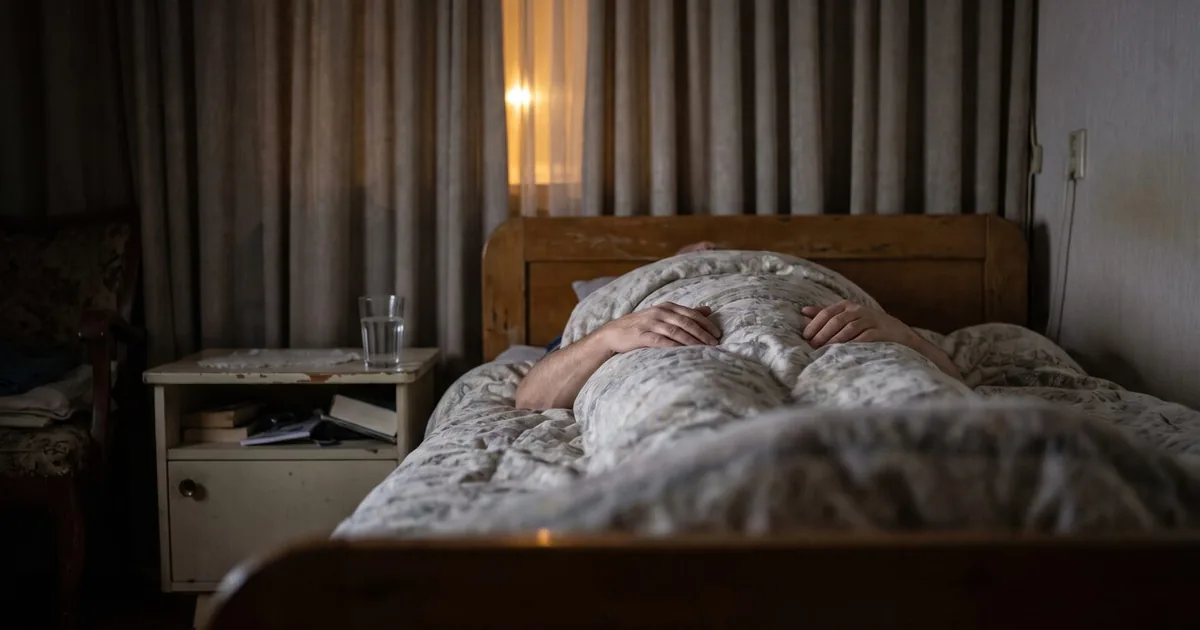
In this article you will read why you might keep jolting awake as you fall asleep, how common it is, what generally goes with it and when to talk to your GP about it. That matters, because a sudden jolt or a bang on the edge of sleep can be frightening. Knowing what it is helps you decide whether it needs attention. You are just drifting off when your body suddenly jerks, you feel as if you are falling, or you hear a loud bang that nobody else heard. The BioProfile sleep scan measures how much your sleep troubles you and shows where you stand today. The scan gives you insight into your sleep and can help you make better lifestyle choices. The scan is not a diagnosis. Looking for a cause is work for a doctor.

In short
- Repeatedly jolting awake as you fall asleep is very common. One article estimates that 60 to 70% of the general population experience these sleep starts.1
- Some people hear a loud bang as they drift off. This is called exploding head syndrome. Nearly one in five students had experienced it at least once, and the researcher calls the episodes relatively harmless in themselves.2
- People who hear these bangs at night tend to report poorer sleep and more anxiety, so it is worth looking at your sleep as a whole.3
- The sleep scan gives you a picture of how you are sleeping today. The scan is not a diagnosis.
Contents
What a sleep start is
The jolt has a name: a sleep start (also called a hypnic jerk), a sudden contraction of the body at the moment you fall asleep.1 One article estimates that 60 to 70% of the general population experience these jolts.1 A case report gives a similar figure of up to 70% of adults at some point in their lives, but that report describes only one patient.4
Put simply: most people know this jolt. If it happens to you now and then, you share that with most adults.
It also helps to know what a normal night looks like. Falling asleep normally takes 10 to 30 minutes, or up to 60 minutes in older people, and waking briefly 3 to 4 times a night is normal.5
Repeatedly jolting awake as you fall asleep: why it happens
Research has not yet established why the jerk happens. What the studies do show is what tends to go together with frequent jerks. Researchers recorded 66 people with parkinsonism for one night with video and sleep measurements, and about one in four of them had sleep starts.1 The authors call the jerks common and underestimated, and write that they can contribute to broken sleep and insomnia.1
That study only looked at people who already had parkinsonism. It shows how often the jolts occur in that group and why researchers see them as something that can interrupt a night’s sleep.
One case report describes a middle-aged patient whose jolts had become stronger, together with chronic sleep deprivation and depression. The author writes that stronger jolts can cause chronic sleep deprivation, which can then lead to depression.4 In this patient, the antidepressant escitalopram improved mood, but the jolts at night got worse.4
One patient cannot show that the same happens in other people. What the report does show is that strong, frequent jolts deserve attention if they are costing you sleep.
For poor sleep in general, Thuisarts names stress and worrying, habits such as using your phone at night and irregular sleep times, caffeine and alcohol, and anxiety or depression. Even caffeine 6 hours before bed makes your sleep worse.5 These are causes of poor sleep in general. The sources here do not say whether they make the jolts more frequent. If you also wake up tired after nights like these, why you wake up tired explains what lies behind it.
A loud bang as you fall asleep
Sometimes it is a sound rather than a jerk. Exploding head syndrome means you hear a sudden, loud noise as you fall asleep or wake up. It is usually painless, but it comes with fear and distress.6 It was first described about 150 years ago, but has received relatively little attention from researchers and doctors.6
When 211 students were interviewed, 18% had experienced it at some point, and almost all of them had had it more than once. Women did not have it more often than men. It occurred in just over a third of the students who had experienced sleep paralysis.2 The episodes came with real fear, but only 2.8% had them so badly that they caused clear distress or got in the way of daily life. The researcher calls the episodes themselves relatively harmless.2
In a second study of 135 young adults, one in five had experienced it at some point. Those who had it reported more anxiety and poorer sleep, and it was more common in people who also had other unusual experiences during sleep. Age, sex, depressive symptoms and whether you are a morning or evening type made no clear difference.3 Three quarters of the whole group slept poorly.3
In a Japanese working population of 1,820 people, with an average age of nearly 46, it was much less common. Fewer than 3 in 100 reported sudden noises or explosions, and just over 1 in 100 met all the criteria. That group scored clearly higher for insomnia, depression, anxiety and fatigue than the people without the syndrome.7
So a bang in your head as you fall asleep is a known experience, and usually painless. It generally goes together with poorer sleep and more anxiety. These studies cannot say which of the two comes first. Nobody knows yet what causes it: a review article lists five main theories, and the question of which one is right is still open.6
How common sleep problems are in the Netherlands
In 2012, a sample of 2,089 Dutch adults aged 18 to 70, chosen to represent the country, filled in a questionnaire about sleep disorders. Of them, 32.1% had a general sleep disorder, 43.2% slept too little and 8.2% had insomnia. A further 6.1% had a parasomnia, meaning unusual events during sleep, and 12.5% had restless legs or limb movements during sleep.8
Put simply: about one in three Dutch adults sleep poorly and more than four in ten do not get enough sleep. If your nights are restless, you are far from the only one.
When to see your GP
Thuisarts recommends making an appointment with your GP if you want to talk about your sleep problems.5 If the sleep advice below has not helped after a few weeks, Thuisarts also recommends seeing your GP.9 Thuisarts names restless legs as a possible sleep disorder: in the evening and at night you keep having to move your legs.5
In short: what matters is whether your sleep is suffering. If that has been the case for weeks, talk to your GP about it.
What the sleep scan measures
The sleep scan asks questions about your sleep and turns your answers into a sleep score in your dashboard, so you can see where you stand today. A questionnaire cannot tell a sleep start apart from exploding head syndrome or restless legs, and it cannot find a cause. The scan is not a diagnosis. What you get is a starting point. If you repeat the scan later, you have two scores to compare instead of a vague feeling.
What you can do yourself
Thuisarts advises no coffee, black or green tea, iced tea, cola or energy drinks in the 6 hours before bed, and no alcohol to help you fall asleep, because alcohol makes your sleep worse.9 Put your phone, tablet or computer away 1 or 2 hours before bed. Go to bed at about the same time every day and get up at about the same time, do not lie in bed for longer than 8 hours, and spend an hour outside every day, especially in the morning.9 In the Dutch sample, people who fell asleep between 22:00 and 24:00 and slept seven to eight hours had the fewest general sleep complaints.8
This advice is about sleep in general. Whether it makes the jolts less frequent has not been tested anywhere in the studies here. You will find more advice in better sleep: tips that really help.
In summary
Repeatedly waking with a start as you fall asleep is usually a sleep start, and most people have one now and then. Hearing a bang as you drift off is called exploding head syndrome. It is frightening but usually painless, and the cause is still unknown. Exploding head syndrome tends to go together with poorer sleep and more anxiety. Thuisarts advises going to your GP if you want to talk about your sleep or if the sleep advice has not helped after a few weeks. The sleep scan shows where your sleep stands today. The scan is not a diagnosis.
Frequently asked questions
Why do I keep waking with a start as I fall asleep?
Usually it is a sleep start, a sudden jerk of the body as you fall asleep. Most people have one now and then.1 Research has not yet established why the jerk happens. One case report describes stronger jerks alongside chronic sleep deprivation and depression.4
What does it mean when you wake with a start in your sleep?
Usually it is your body jerking as sleep begins, and most adults know the feeling.4 What matters is whether your sleep is suffering. If you want to talk about your sleep problems, Thuisarts recommends making an appointment with your GP.5
What causes exploding head syndrome?
Nobody knows yet. A review article lists five main theories and concludes that the question of which one is right is still open.6 The episodes can be frightening, but the researcher who studied students calls them relatively harmless in themselves.2
Is the sleep scan a test for sleep starts?
The sleep scan is not that. The scan shows how much your sleep troubles you in general. The scan cannot tell a jolt apart from a bang in your head or from restless legs. The scan is not a diagnosis.
Sources
Every source below was checked on the day this article was published. The numbering follows the text.
- Chiaro G, Calandra-Buonaura G, Sambati L, Cecere A, Ferri C, Caletti MT, Cortelli P, Provini F. Hypnic jerks are an underestimated sleep motor phenomenon in patients with parkinsonism. A video-polysomnographic and neurophysiological study. Sleep Medicine, 2016;26:37-44. doi.org/10.1016/j.sleep.2016.07.011
- Sharpless BA. Exploding head syndrome is common in college students. Journal of Sleep Research, 2015;24:447-449. doi.org/10.1111/jsr.12292
- Kirwan E, Fortune DG. Exploding head syndrome, chronotype, parasomnias and mental health in young adults. Journal of Sleep Research, 2021;30. doi.org/10.1111/jsr.13044
- Alghamdi SA. Hypnic Jerks, Major Depressive Disorder, and Antidepressant Use: A Possible Relationship. Cureus, 2023. doi.org/10.7759/cureus.47436
- NHG. I sleep badly. What could it be? Thuisarts.nl. thuisarts.nl
- Sharpless BA. Exploding head syndrome. Sleep Medicine Reviews, 2014;18:489-493. doi.org/10.1016/j.smrv.2014.03.001
- Tsovoosed U, Sumi Y, Ozeki Y, Harada A, Kadotani H. Prevalence and impact of exploding head syndrome in a Japanese working population. Sleep, 2025. Group with versus without the syndrome: Athens Insomnia Scale mean 8.86 vs 5.00, PHQ-9 10.8 vs 4.68, GAD-7 8.60 vs 3.69, fatigue 23.3 vs 15.3. doi.org/10.1093/sleep/zsaf007
- Kerkhof GA. Epidemiology of sleep and sleep disorders in The Netherlands. Sleep Medicine, 2017;30:229-239. doi.org/10.1016/j.sleep.2016.09.015
- NHG. I want to sleep better: sleep advice. Thuisarts.nl. thuisarts.nl
Also read
Written by

See where your sleep stands
Answer a few questions about how you have been sleeping lately and your sleep score appears in your dashboard. The scan page explains what the sleep scan measures and what the scan is based on.
Free, about 3 minutes. An analysis of your answers, never a diagnosis.
BioProfile analyses your health status to guide you and your coach. It does not make a diagnosis, only a doctor can do that. Built on validated health questionnaires; the combined BioProfile score is not itself a validated clinical instrument yet. Your answers stay private (GDPR).