
In this article you will find the answer to the question of what worrying is, how to recognise it, how it differs from ordinary thinking, what it does in your body and which steps can help. That matters, because worrying is very common, and the same churning thoughts can hold stress in your body long after the cause has passed.1,2 The BioProfile stress scan shows how much stress you are carrying today. It is insight, so you can see where you stand. The scan is not a diagnosis. The scan does not point to a cause either. Only a doctor can judge that.

In short
- Worrying is thinking about the same problem over and over. Researchers state that worrying about the future and brooding over the past are very common.1
- In many studies, worrying went together with higher blood pressure, a faster heart rate and more of the stress hormone cortisol. A thought can keep the body in stress mode.1,2
- Thuisarts advises giving worrying its own half hour or hour each day and postponing it the rest of the time. In a small study, people with generalised anxiety disorder who postponed their worrying scored clearly lower on worrying than a waiting-list group.3,4
- The stress scan shows how much stress you are carrying today. The scan gives you insight into yourself. The scan is not a diagnosis.
Contents
What is worrying
Worrying is thinking about the same problem over and over without getting any closer to an answer. Researchers group worrying about the future and brooding over the past under one name, perseverative cognition, and state that both are very common.1 A review led by Dutch researchers describes worrying as a common response to stress.2 Almost everyone worries. What matters is how often you do it and how long it lasts.
Sometimes worrying grows into an anxiety disorder. In a large Dutch study of 6,194 adults aged 18 to 75, 28.6 percent had had an anxiety disorder at some point in their lives, and 15.2 percent had had one in the past twelve months.5 About 1 in 7 Dutch adults had an anxiety disorder in the past year. Persistent worrying is common, and you are far from alone in it.
The signs of worrying
Thuisarts lists “thinking a lot and finding it hard to stop” among the symptoms of stress. Tiredness, poor sleep, headaches, neck or back pain, stomach and bowel problems, a low mood and memory problems are on the same list.3 If the worrying is there almost all the time, for example about work, a relationship, children or money, almost every day for six months, and you can no longer manage everyday things such as sleeping, eating, working or doing the housework, Thuisarts calls it generalised anxiety disorder. Muscle tension, poor concentration, sleep problems, tiredness, irritability and difficulty keeping your thoughts under control often come with it.6 In short, worrying shows itself in the body and in the mind.
The difference between thinking things through and worrying
A review of repetitive thinking found that the same kind of thinking can go two ways. It can get in your way, and then it is linked to depression, anxiety and poorer physical health. It can also be helpful: it can help people recover from upsetting events, prepare and plan ahead. Three things made the difference: whether the thoughts were positive or negative, the situation someone was in, and whether the thinking was abstract or concrete.7 Asking yourself “what am I doing tomorrow at nine o’clock?” is thinking things through. Spending hours asking yourself “why does this always happen to me?” is worrying.
A second review brought together 19 studies on how repetitive thinking relates to everyday habits. People who brooded more over the past smoked, drank and used substances slightly more often, and ate less healthily. Reflective thinking and worrying about the future showed no such link, and the same was true for healthy habits.8 The link was small, but it points the same way: brooding over the past is the kind of thinking that costs you something.
Is worrying a form of stress?
Yes, in the sense that worrying keeps stress going. Worrying and brooding can stretch stress out over time, starting before a stressful event and lasting long after it. The review found tentative evidence of more activity in the heart, the hormones and the immune system while people worried.2 A later meta-analysis of 60 studies in healthy people found that blood pressure rose moderately during worrying and brooding. Heart rate went up slightly, there was a little more of the stress hormone cortisol, and the beat-to-beat variation in the heart was slightly lower. For blood pressure, the authors cannot rule out that unpublished studies would have shown a weaker effect.1 Put simply: a worrying thought can put your body into the same state of alarm as the problem itself. You can read what long-term stress can show in your body in chronic stress symptoms.
The habit also tends to stick. In a Dutch study, 1,820 adults filled in a questionnaire on repetitive negative thinking, and the study then followed them for three years. Most of the people who scored high at the start were still scoring high three years later. When the habit grew stronger, the onset of depression or an anxiety disorder became more likely, and when the habit grew weaker, recovery became more likely, although those links were small.9 Worrying is a pattern that can change, and that change usually goes hand in hand with how you feel.
What you can do about worrying
Thuisarts gives a simple exercise. Agree with yourself that you can and may worry for half an hour or one hour a day. If the thoughts come back at other times, tell yourself they can wait until later, or until tomorrow.3 This has been tested in Germany. People with generalised anxiety disorder who postponed their worrying to a set later moment for six days scored clearly lower on worrying than a waiting-list group, and the difference could still be seen four weeks later. No clear effect was found in people with health anxiety.4 Postponing your worrying is a small step you can try today. The study was small and short. You can read about broader steps in what helps with stress.
When to see your GP
Make an appointment with your GP if your stress is not easing even though you want help, or if anxiety, panic attacks or a low mood are getting worse. The same applies if you can no longer work, find it hard to get out of bed or are eating poorly, if you are drinking more alcohol or using more drugs, or if the people around you are seriously worried about you.3 Also contact your GP if you stop doing things because you worry, if your symptoms get worse, or if you regularly use alcohol, drugs or sedatives. If you find yourself thinking about suicide more and more often, that alone is a reason to contact your GP.6
Do you long to be dead, or do you want to end your life? Then get help straight away. On weekdays until 5 in the afternoon, call your GP. After that, at night and at weekends, call the out-of-hours GP service. You can call the 113 helpline day and night, or chat via 113.nl. If your life is in danger right now, call 112.10
What the stress scan measures
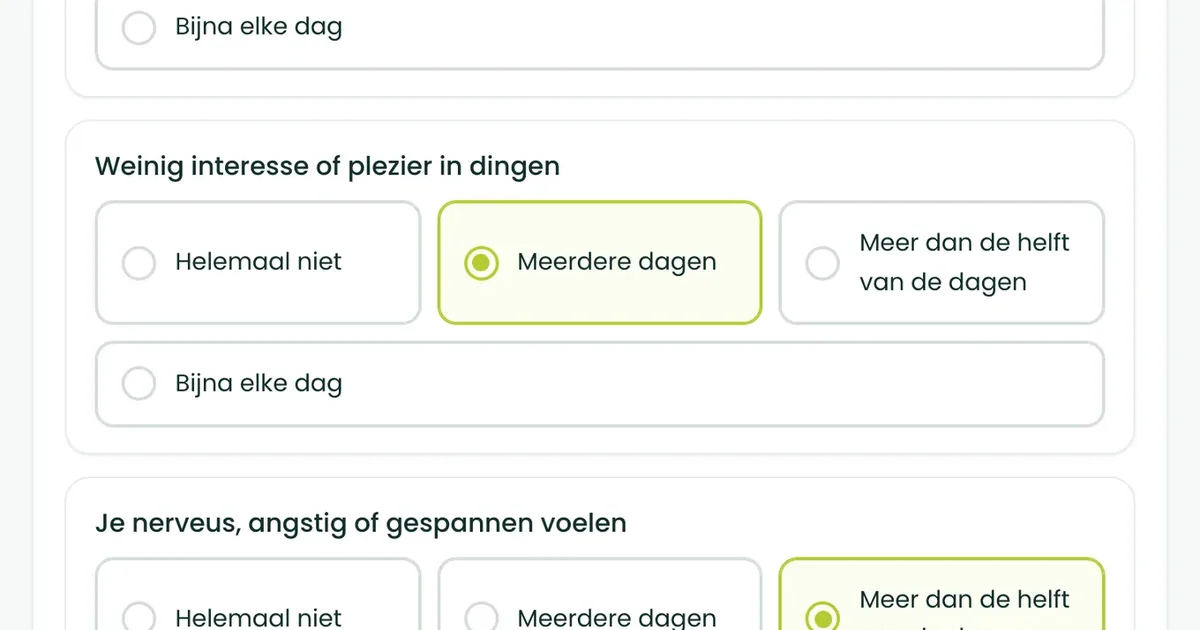
The stress scan asks how stress shows up in your days and turns your answers into a stress score in your dashboard. The scan shows how much stress you are carrying today. A questionnaire cannot tell the difference between ordinary worrying, an anxiety disorder and depression. That question belongs with a doctor. The scan is not a diagnosis. The scan gives you a starting value. Repeat the scan after a few weeks with a set worry time, and you have two numbers to compare instead of a vague feeling.
In summary
Worrying is thinking about the same problem over and over. It is very common, and it shows in both the body and the mind. Thinking concretely about a next step can help you, while brooding abstractly over the past tends to cost you something. Worrying keeps stress going in the body. A set worry time each day is a simple first step. Thuisarts lists clear signs for when to see your GP. The stress scan shows where you stand today.
Frequently asked questions
What are the symptoms of overthinking?
The main sign is a lot of thinking that is hard to stop. It often comes with tiredness, poor sleep, headaches, neck or back pain, stomach complaints, a low mood and memory problems.3 If the worrying is there almost all the time, muscle tension, poor concentration and irritability can come on top of that.6
What is the difference between thinking and worrying?
The same repetitive thinking can help or harm. It is more likely to help when it is concrete and aimed at a next step. It is more likely to harm when it is abstract and negative.7 Brooding over the past also showed a small link with habits such as smoking and drinking. Reflective thinking showed no link.8
What can you do about worrying?
Give worrying its own half hour or hour every day. If the thoughts come back at other times, tell yourself they can wait until later, or until tomorrow.3 In one study, people with generalised anxiety disorder who postponed their worrying in this way scored clearly lower on worrying than a waiting-list group.4
Is worrying a form of stress?
Thuisarts counts worrying among the symptoms of stress,3 and researchers call worrying and brooding a common response to stress. Worrying can keep stress going in the body even when nothing is wrong.2
Can the stress scan tell me whether I have an anxiety disorder?
No, the scan does not do that. The scan shows how much stress you are carrying and gives you a starting point. The scan does not point to a cause and is not a diagnosis. Only a doctor can judge whether ongoing worrying is an anxiety disorder.6
Sources
Every source below was checked on the day this article was published. The numbering follows the text.
- Ottaviani C, Thayer JF, Verkuil B, Lonigro A, Medea B, Couyoumdjian A, Brosschot JF. Physiological concomitants of perseverative cognition: A systematic review and meta-analysis. Psychological Bulletin, 2016;142(3):231-259. doi.org/10.1037/bul0000036
- Brosschot JF, Gerin W, Thayer JF. The perseverative cognition hypothesis: a review of worry, prolonged stress-related physiological activation, and health. Journal of Psychosomatic Research, 2006. doi.org/10.1016/j.jpsychores.2005.06.074
- Thuisarts.nl (NHG). Ik wil beter omgaan met stress [I want to cope better with stress]. thuisarts.nl
- Krzikalla C, Buhlmann U, Schug J, Kopei I, Gerlach AL, Doebler P, Morina N, Andor T. Worry Postponement From the Metacognitive Perspective: A Randomized Waitlist-Controlled Trial. Clinical Psychology in Europe, 2024. doi.org/10.32872/cpe.12741
- Ten Have M, Tuithof M, van Dorsselaer S, Schouten F, Luik AI, de Graaf R. Prevalence and trends of common mental disorders from 2007-2009 to 2019-2022: results from the Netherlands Mental Health Survey and Incidence Studies (NEMESIS). World Psychiatry, 2023. doi.org/10.1002/wps.21087
- Thuisarts.nl (NHG). I have generalised anxiety disorder. thuisarts.nl
- Watkins ER. Constructive and unconstructive repetitive thought. Psychological Bulletin, 2008. doi.org/10.1037/0033-2909.134.2.163
- Clancy F, Prestwich A, Caperon L, O’Connor DB. Perseverative Cognition and Health Behaviors: A Systematic Review and Meta-Analysis. Frontiers in Human Neuroscience, 2016. doi.org/10.3389/fnhum.2016.00534
- Hijne K, Penninx BW, van Hemert AM, Spinhoven P. The association of changes in repetitive negative thinking with changes in depression and anxiety. Journal of Affective Disorders, 2020. doi.org/10.1016/j.jad.2020.07.002
- Thuisarts.nl (NHG). Ik denk aan zelfmoord. thuisarts.nl
Also read
Written by

See where you stand
Answer the questions in the stress scan and your stress score will appear in your dashboard. You can read what the stress scan measures on the scan page.
Free, about 3 minutes. An analysis of your answers, never a diagnosis.
BioProfile analyses your health status to guide you and your coach. It does not make a diagnosis, only a doctor can do that. Built on validated health questionnaires; the combined BioProfile score is not itself a validated clinical instrument yet. Your answers stay private (GDPR).