
In this article you read what a slow metabolism is, which symptoms people mean by it, what your daily energy expenditure depends on and what a free scan tells you about your habits. That matters, because the nutrition advice you keep reading leaves out where the biggest measured differences between people of the same size sit: body composition and daily activity. The BioProfile metabolism scan asks a short series of questions about those habits and gives you an indication of where you stand today, as one of the 11 health areas the full scan assesses. This is not a diagnosis. It is insight into where you stand today. What this scan does not do: point to a cause or make a diagnosis. Only a doctor can do that.
Verified by Justinas Šlikas, PhD
PhD in chemistry from the University of Edinburgh
Checked on 30 September 2026
In short
- The basal metabolic rate does about two thirds of daily energy expenditure, and fat-free mass explained 63 per cent of the difference in basal metabolic rate between 150 adults.1,2
- In 6421 people, total and basal energy expenditure were stable from 20 to 60, with the turning point at 63.0 years.3
- Daily movement contributed two thirds of the rise in daily energy expenditure when volunteers were overfed for 8 weeks.4
- The scan gives you a starting value for your habits in this area. The scan does not point to a cause and it is not a diagnosis.
Contents
What a slow metabolism actually is
Metabolism is not one single button. The basal metabolic rate, the energy your body uses just to keep running, is about two thirds of daily energy expenditure.1 In 150 adults, fat-free mass, so muscles, organs and bones, explained 63 per cent of the differences in basal metabolic rate between people; fat mass explained a further 6 per cent and age 2 per cent, and circulating thyroxine 25 per cent of what was left, only in the male participants. Sex had no significant effect once those three were in the model.2 So the biggest reason one person uses more energy at rest than another of the same size is how much fat-free tissue that person carries.
Slow metabolism symptoms: what people mean by them
Feeling cold quickly, gaining weight, being sluggish or tired, hard stools, dry hair, hair loss and dry skin: those are the complaints Thuisarts names for a thyroid that works too slowly, with too little free T4 alongside a raised TSH in the blood.5 Thuisarts also splits the causes of tiredness into life circumstances, thoughts and feelings, lifestyle such as too little activity and poor sleep, and physical causes including hormonal ones, and adds that when tiredness is the only complaint a blood test almost never turns up a cause.6 A list of symptoms tells you it is worth looking. The list does not say what you have.
How you would know: what is actually measured
A database of 6421 people, from 8 days to 95 years old, from 29 countries and 64 percent female, measured daily energy expenditure with doubly labelled water. Total daily energy expenditure, basal energy expenditure and fat-free mass were stable from 20 to 60, and segmented regression placed the turning point at 63.0 years. After that, daily energy expenditure corrected for body size fell by about 0.7 percent a year, and in people of 90 and older it was about 26 percent below that of middle-aged adults.3 The slowdown that people in their thirties use as an explanation cannot yet be seen in the measurements. With age, fat tissue increases and muscle tissue decreases, and that is why the basal metabolism falls at a higher age.1
What moves your daily energy use
16 volunteers without obesity were given 1000 kilocalories a day above their maintenance needs for 8 weeks. Two thirds of the rise in total daily energy expenditure came from non-exercise activity thermogenesis: fidgeting, holding your posture, walking around. Differences in that daily movement accounted for a 10-fold difference in fat storage between the volunteers.4 So the part of your energy expenditure with the most room in it is the standing, walking and pottering about of an ordinary day.
The Health Council of the Netherlands advises adults to do at least two and a half hours of moderately intensive exercise a week, with muscle and bone strengthening activities alongside it.7 In 2025, 46.1 per cent of people in the Netherlands aged 18 and over met those physical activity guidelines.8 The season moves activity more than the total: in 25 young Dutch adults the physical activity level was 1.87 in summer against 1.76 in winter, while total daily energy expenditure was the same in both seasons.9
Eating far below what you need for a long time works the other way. Of 16 people in a 30-week competition, 14 were measured again after 6 years: the resting metabolic rate was still 704 kcal a day below the starting value, and 41.0 of the 58.3 kg was back.10 So a pace you can keep up beats a steep pace.
When to contact your GP
Call your GP if the tiredness lasts a long time, for example longer than a month. Also call if other symptoms come with it: night sweats, less appetite, your weight dropping without you trying, a change in your stools or blood in them, being short of breath at rest, a lot of thirst and passing a lot of urine, palpitations, or feeling very low or very tense.6 With a thyroid that works too slowly, you contact your GP if the symptoms get worse or come back.5
What the metabolism scan measures
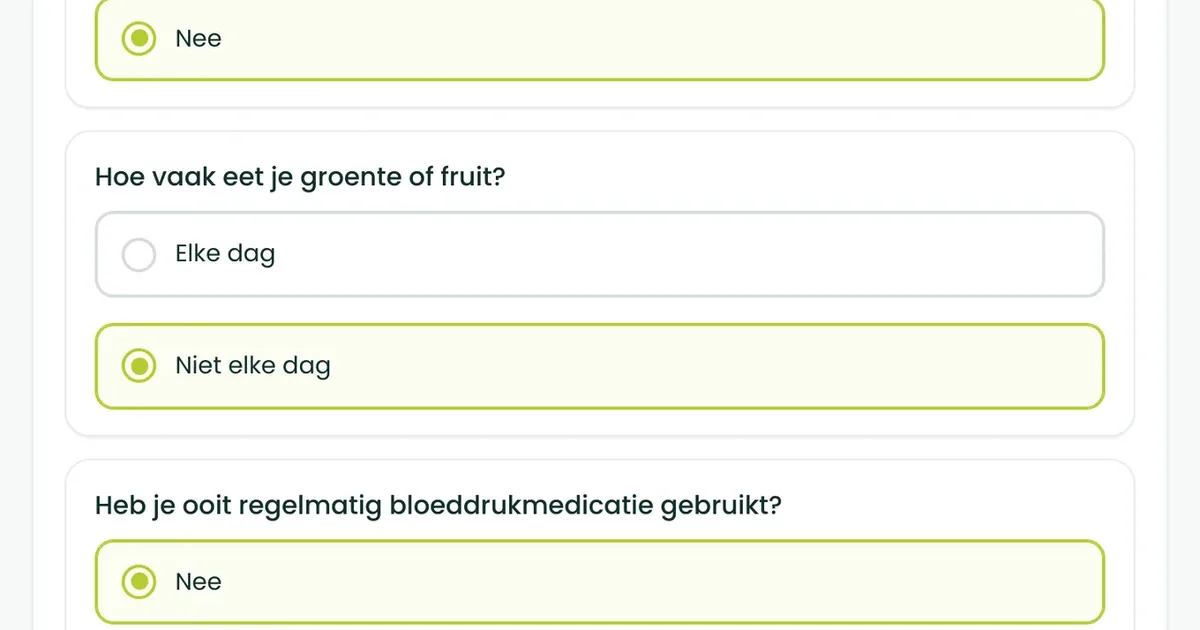
The scan asks about the habits under this area, starting with the two simplest: thirty minutes of movement on most days, and vegetables or fruit every day. Your answers become a score for this area with the reading band the score falls in, and higher is better. A questionnaire does not measure resting energy expenditure; that needs indirect calorimetry or doubly labelled water.10,3 What the scan gives you is a starting value. It is not a diagnosis.
In summary
Most of your daily energy expenditure goes to the basal metabolic rate, and the biggest measured difference between two people of the same size is how much fat-free tissue each one carries.1,2 Daily energy expenditure corrected for body size stayed stable from 20 to about 63.3 The symptoms people call a slow metabolism overlap with a thyroid that works too slowly and with ordinary tiredness, and Thuisarts draws the lines for when to call the GP.5,6 The room to move sits in your daily activity and in the weekly minimum the Gezondheidsraad advises.4,7 The scan gives you a starting value for your own habits. It is not a diagnosis.
Measure where you start
A few short questions about your activity and your food, and your score for this area is in your dashboard. What the metabolism scan measures and what the scan is based on is on the scan page.
Free, about 3 minutes. An analysis of your answers, never a diagnosis. All health scans
Frequently asked questions
How do you know whether you have a slow metabolism?
Not from the scales. Resting energy expenditure is measured with indirect calorimetry and daily energy expenditure with doubly labelled water.10,3 What you can have checked is the thyroid: in the blood there is too little free T4 alongside a raised TSH when the thyroid works too slowly.5
What are the symptoms of a slow metabolism?
The complaints Thuisarts lists with a thyroid that works too slowly are feeling cold quickly, gaining weight, being sluggish or tired, hard stools, dry hair, hair loss and dry skin.5 If tiredness is your only complaint, a blood test almost never turns up a cause.6
What can you do about a slow metabolism?
Start with what has been measured. Daily movement contributed two thirds of the rise in daily energy expenditure in volunteers who were overfed,4 and the Health Council of the Netherlands advises adults to do at least two and a half hours of moderately intensive exercise a week plus muscle and bone strengthening activities.7 In 2025, 46.1 per cent of Dutch adults met those physical activity guidelines.8
How can I speed up a slow metabolism?
Fat-free mass explained 63 per cent of the variation in basal metabolic rate in 150 adults, and that puts strength training next to your weekly exercise.2 Six years after a 30-week competition, resting metabolic rate was still 704 kcal a day below the starting value, so eating far below your needs for a long time is the wrong button.10
Is the metabolism scan a test for a slow metabolism?
The scan scores the habits in this area, starting with thirty minutes of movement on most days and vegetables or fruit every day, and gives you a starting value. The scan does not point to a cause and it is not a diagnosis.
Sources
Every source below was checked on the day this article was published. The numbering follows the text.
- Voedingscentrum. Basaalstofwisseling (encyclopaedia). voedingscentrum.nl
- Johnstone AM, Murison SD, Duncan JS, Rance KA, Speakman JR. Factors influencing variation in basal metabolic rate include fat-free mass, fat mass, age, and circulating thyroxine but not sex, circulating leptin, or triiodothyronine. The American Journal of Clinical Nutrition, 2005;82(5):941-948. doi.org/10.1093/ajcn/82.5.941
- Pontzer H, Yamada Y, Sagayama H, et al. Daily energy expenditure through the human life course. Science, 2021;373(6556):808-812. doi.org/10.1126/science.abe5017
- Levine JA, Eberhardt NL, Jensen MD. Role of nonexercise activity thermogenesis in resistance to fat gain in humans. Science, 1999;283(5399):212-214. doi.org/10.1126/science.283.5399.212
- Thuisarts.nl (NHG). Mijn schildklier werkt te langzaam. Last revised 2 February 2026. thuisarts.nl
- Thuisarts.nl (NHG). I am tired. What could it be? Last revised 18 April 2023. thuisarts.nl
- Gezondheidsraad. Beweegrichtlijnen 2017. Advice, 22 August 2017. gezondheidsraad.nl
- RIVM, VZinfo.nl. Bewegen, Volwassenen. Figures from the Gezondheidsenquete / Leefstijlmonitor CBS in collaboration with RIVM. Page updated 14 July 2026. vzinfo.nl
- Plasqui G, Westerterp KR. Seasonal variation in total energy expenditure and physical activity in Dutch young adults. Obesity Research, 2004;12(4):688-694. doi.org/10.1038/oby.2004.80
- Fothergill E, Guo J, Howard L, et al. Persistent metabolic adaptation 6 years after The Biggest Loser competition. Obesity (Silver Spring), 2016;24(8):1612-1619. doi.org/10.1002/oby.21538
Written by

BioProfile analyses your health status to guide you and your coach. It does not make a diagnosis, only a doctor can do that. Built on validated health questionnaires; the combined BioProfile score is not itself a validated clinical instrument yet. Your answers stay private (GDPR).