
In this article you will find the answer to the question ‘why do women live longer than men’ for the Netherlands: which part of the difference has a biological cause, which part has a cause in habits such as smoking, and why the extra years are not all healthy years. That matters, because people often see the difference as fate, while the studies show that a large part of it changes with how people live. BioProfile’s lifestyle scan gives you a picture of your own daily habits, so you can see where you stand today. It is self-insight, and it can help you make better choices in your diet and lifestyle. The scan is not a diagnosis. The scan does not point to a cause and does not assess your health. Only a doctor can do that.

Verified by Carlos Mendoza Montano
Doctorate in nutritional biochemistry from the University of Arizona
Checked on 12 October 2026
In short
- According to the figures for 2024, women in the Netherlands can expect to live 83.28 years and men 80.53 years, a difference of 2.75 years.1
- Even during famines and epidemics, women lived longer than men, and newborn girls survived better than newborn boys. That points to biological roots.2
- Across 31 European countries together, smoking explained about 3 of the 7 years by which women outlived men in 2014.3
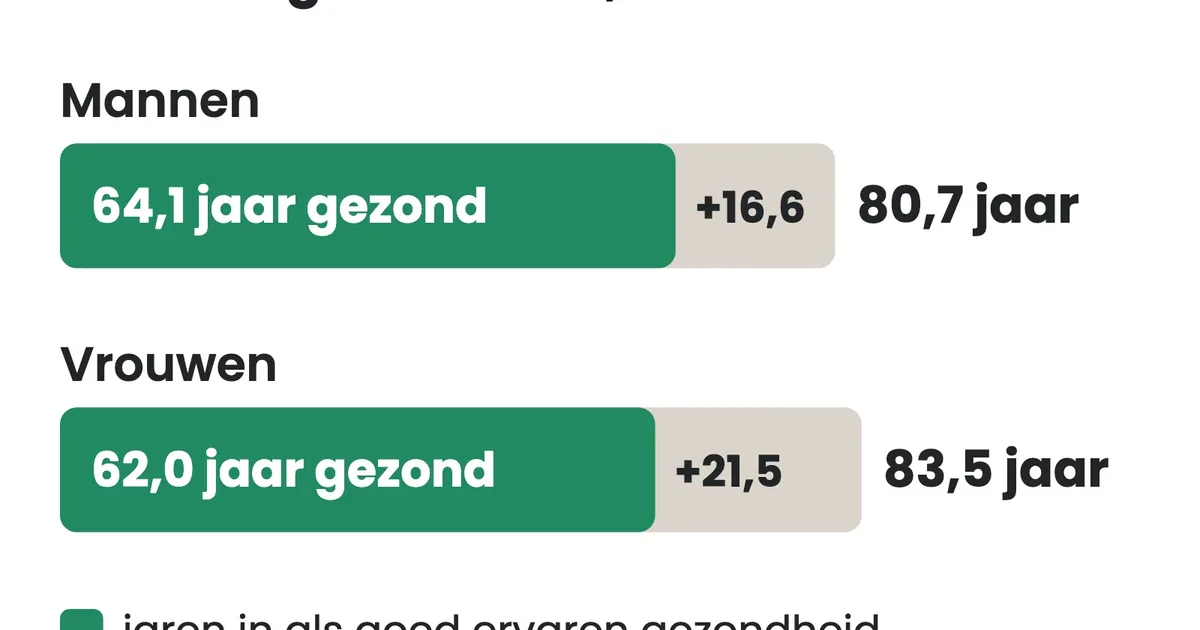
- Women live longer, but men have more years in self-rated good health: in 2023 it was 64.1 years for men, compared with 62.4 for women.4
Contents
How much longer women live in the Netherlands
In 2024, life expectancy at birth in the Netherlands was 83.28 years for women and 80.53 years for men, a difference of 2.75 years. In 2019 the difference was 3.10 years, and in 2023 it was 3.02 years. In 2024, life expectancy for men was slightly higher than before the coronavirus pandemic. For women, it was still slightly lower.1 Life expectancy is expected to rise for everyone: from 81.6 years in 2022 to 86.5 years in 2050. In the RIVM trend scenario, men live 3 to 3.5 years less than women, both in 2022 and in 2050.5
In plain words: based on the death rates measured in 2024, a Dutch girl can expect to live a few years longer than a boy. The difference has become smaller in recent years, but the forecast still assumes it will stay at about three years.
Why women live longer than men: the biology
Humans are the only known species in which one sex lives longer everywhere, and that sex is women.6 History gives a strong hint that this is partly biological. Researchers studied seven populations that went through famines, epidemics and slavery. At almost every age, women died less often than men. In all but one of the enslaved populations, women also lived longer on average. Babies made up most of the gap: newborn girls survived the extreme conditions better than newborn boys. At that age, behaviour and social roles barely differ.2 The authors conclude that the female survival advantage has biological roots, and that its size depends on the environment and on social factors.2
Put simply: even before smoking, work or risk-taking play a part, girls start out with a small head start in survival.
What that biology is exactly remains unclear. One review names possible explanations: hormones, the unequal way sex chromosomes and mitochondria are passed on, immune responses and resistance to oxidative damage. The authors call the evidence for these explanations weak so far.6
So the head start is real, but its exact cause cannot yet be pinned down.
Why men live shorter lives: smoking and causes of death
Biology sets a starting point, and habits largely decide how big the gap becomes. Across 31 European countries together, deaths linked to smoking accounted for about 3 of the 7 years that women outlived men in 2014. In 1995, smoking explained 5.2 of the 9.0 years. Since then the gap has narrowed, along with the share caused by smoking. That recent fall is almost entirely explained by changes over time in how many men and women smoked, and the gap is expected to narrow further.3
Put simply: in Europe in 2014, almost half of the difference between women and men was down to smoking.
In the Netherlands, men still smoke more often. In 2022/2023, 21 per cent of men aged 12 and over smoked at least occasionally, compared with 15 per cent of women. Men also kept to the alcohol guideline less often: 37 per cent did, compared with 54 per cent of women.4
Which causes of death make up the gap? A comparison of ten countries found that cancer, heart disease and external causes such as accidents contributed most to the difference.7 In Australia, according to the figures for 2016-2019, women aged 25 can expect to live 3.79 years longer than men of the same age. Cardiovascular disease accounted for almost a third of that gap, cancers other than lung cancer for about a quarter, and external causes such as accidents and suicide for about a fifth. Education played a part too. Among people with a university education, the gap was 2.28 years. Among people with less than secondary education, it was 4.67 years.8
What this means for you: the gap comes mostly from heart disease, cancer and accidents, and it is smaller among people with more education. So much of it depends on how people live, and less of it is fixed at birth.
Longer, but not healthier
Women live longer, but they do not have more healthy years. According to the figures for 2023, Dutch women can expect 62.4 years in self-rated good health, compared with 64.1 years for men. Years without limitations came to 55.5 for women and 59.4 for men. Women live about 3 years longer, but spend roughly 7 more years with limitations.4 The review article mentioned above calls this a paradox: women live longer, but have more health complaints, especially at an older age.6 You can see part of this in the causes of death. In the Netherlands, the share of deaths from mental disorders and diseases of the nervous system, including dementia and Alzheimer’s disease, is almost twice as large in women as in men.1 Of the 4.9 extra years of life expectancy the RIVM foresees for 2050, about 1.2 years are expected to be lived with some limitation.5
Put simply: many of the extra years women get are years with health complaints. How long you live and how long you live well are two separate questions. How your body’s age can differ from the age in your passport is explained in biological age versus calendar age, and what changes in the body over the years is covered in healthy ageing: what changes over the years.
When to ask for help
Every year in the Netherlands, 6 in 1,000 men and 3 in 1,000 women have a heart attack. Thuisarts lists these signs: a pressing feeling or pain in the chest, together with fear or a sense that something serious is happening, harder breathing, sweating or clammy skin, and nausea. People over 65 more often have no pressure or pain in the chest. Instead, their breathing is difficult and fast, and they have extreme tiredness, dizziness or a restless feeling. Have you had a heart attack before? Then call 112 if you feel restless, sick and sweaty, or if the pressure on your chest does not go away after 3 tablets or puffs under the tongue.9
In plain words: pressure on the chest with sweating or nausea can be a sign of a heart attack. In older people, the signs can be less clear.
What the lifestyle scan shows
The lifestyle scan asks about your daily habits and gives you a picture of where you stand today. That is a baseline. Repeat the scan after a while and you have two results to compare, which tells you more than a feeling can. The scan cannot tell you how long you will live, and it does not point to a cause for a complaint. The scan is not a diagnosis.
In summary
Women in the Netherlands live a few years longer than men.1 Part of that lead is biological and can even be seen in newborns during famines and epidemics.2 A large part comes from habits, with smoking at the top,3 and from heart disease, cancer and accidents.7 Not all the extra years women get are healthy years.4 It helps to know the signs of a heart attack,9 and the lifestyle scan shows where your own habits stand today.
See where your habits stand
The lifestyle scan gives you a picture of your daily habits today and a baseline to compare against later. What the scan measures and what it is based on is set out on the scan page.
Free, about 3 minutes. An analysis of your answers, never a diagnosis. All health scans
Frequently asked questions
Why does a woman live longer than a man?
Partly biology and partly how people live. During famines and epidemics in the past, women still lived longer than men, and newborn girls survived better than newborn boys.2 On top of that, smoking explained about 3 of the 7 years of the gap across 31 European countries together in 2014.3
Why do men live shorter lives?
The cause lies mainly in heart disease, cancer and external causes such as accidents. In a study across ten countries, these made up most of the gap.7 In the Netherlands, men also smoke more often than women and stick to the alcohol guideline less often.4
Why is women’s life expectancy higher than men’s?
Because women die less often than men at almost every age, even during famines and epidemics.2 In 2024, the difference in the Netherlands was 2.75 years.1 The RIVM expects a difference of 3 to 3.5 years to remain in 2050.5
At what age do you age fastest?
The studies in this article do not measure that. They compare how long women and men live. What they do show is that the deaths from heart disease and cancer behind the gap shifted to older ages as death rates fell.7
Does the lifestyle scan tell me how long I will live?
The scan does not do that. The scan gives you insight into your daily habits and a baseline to compare against later. The scan cannot predict how long you will live. The scan is not a diagnosis. A question about your health belongs with a doctor.
Sources
Every source below was checked on the day this article was published. The numbering follows the text.
- Centraal Bureau voor de Statistiek. Trends in sterfte en doodsoorzaken, 2014-2024. Statistische Trends, 19 March 2025. cbs.nl
- Zarulli V, Barthold Jones JA, Oksuzyan A, Lindahl-Jacobsen R, Christensen K, Vaupel JW. Women live longer than men even during severe famines and epidemics. PNAS, 2018. doi.org/10.1073/pnas.1701535115
- Janssen F. Changing contribution of smoking to the sex differences in life expectancy in Europe, 1950-2014. European Journal of Epidemiology, 2020. doi.org/10.1007/s10654-020-00602-x
- Centraal Bureau voor de Statistiek / SCP. Emancipatiemonitor 2024: (Gezond) leven. 2024. longreads.cbs.nl
- RIVM. Volksgezondheid Toekomst Verkenning 2024, Trendscenario: Levensverwachting en sterfte. 2024. volksgezondheidtoekomstverkenning.nl
- Austad SN, Fischer KE. Sex Differences in Lifespan. Cell Metabolism, 2016. doi.org/10.1016/j.cmet.2016.05.019
- Feraldi A, Zarulli V. Patterns in age and cause of death contribution to the sex gap in life expectancy: a comparison among ten countries. Genus, 2022. doi.org/10.1186/s41118-022-00171-9
- Su W, Welsh J, Canudas-Romo V. Causes of death contributions to the sex gaps in life expectancy: evidence by education levels from Australia. BMC Public Health, 2026. doi.org/10.1186/s12889-026-26888-2
- Thuisarts.nl (NHG). Wat gebeurt er als ik een hartaanval heb? thuisarts.nl
Also read
Written by

BioProfile analyses your health status to guide you and your coach. It does not make a diagnosis, only a doctor can do that. Built on validated health questionnaires; the combined BioProfile score is not itself a validated clinical instrument yet. Your answers stay private (GDPR).