
In this article, you can read what research says about small probiotic drinks such as Yakult, for anyone who wonders: is Yakult good for your gut? It covers what the bacteria in the bottle are, what research found for constipation and irritable bowel syndrome, what a daily bottle contains, and when gut symptoms are a reason to see your GP. This matters, because “good for your gut” can mean very different things, and the evidence for an effect differs from one symptom to another.4 BioProfile’s gut scan measures how much your gut symptoms bother you and gives you an indication of where you stand in this area today. This is not a diagnosis. It is insight, to see where you stand today and to help you make better choices in your diet and lifestyle. What this scan does not do: point to a cause or make a diagnosis. Only a doctor can do that.

Verified by Justinas Šlikas, PhD
PhD in chemistry from the University of Edinburgh
Reviewed on 20 October 2026
In short
- In a study of 70 people with chronic constipation, 89 per cent of those who drank a Shirota drink every day said the drink helped, compared with 56 per cent of those who drank a placebo drink that tasted the same.1
- For irritable bowel syndrome, a Dutch study with the Shirota strain found no clear difference from placebo. Which strains help with IBS is still largely unclear.2,3
- For healthy people, there is little evidence of a health benefit, and a bottle contains 8.6 grams of sugars.4,5
- A gut scan measures how much your gut symptoms bother you. The scan does not identify a cause. It is not a diagnosis.
Contents
Is Yakult good for your gut: what the bacteria in the bottle do
Probiotics are live microorganisms that have a positive effect on health when you take in enough of them. That is the WHO definition the Voedingscentrum uses.4 Research on drinks like this tests one particular strain, Lactobacillus casei Shirota, which newer articles call Lacticaseibacillus paracasei Shirota.1,6
For healthy people, there is little evidence that products with live micro-organisms bring a health benefit. For certain conditions, such as irritable bowel syndrome and diarrhoea after taking antibiotics, there are signs of a positive effect. The European food safety authority EFSA approved only one claim for live bacteria in yoghurt or fermented milk: at a level of at least 100 million live micro-organisms per gram, the yoghurt bacteria L. bulgaricus and S. thermophilus improve lactose digestion in people who digest lactose poorly. This does not apply to the Shirota strain.4
Put simply: what the bacteria do depends on the strain and on the symptom. For a gut without symptoms, the evidence is thin.
What the research found in constipation
In a German study, 70 people with chronic constipation drank 65 ml a day for four weeks: either a drink with the Shirota strain or a placebo drink that tasted the same. From week two, the Shirota group reported clearly milder constipation and softer stools than the placebo group. At the end, 89 per cent of the Shirota group said the drink helped, compared with 56 per cent of the placebo group. Wind and a bloated feeling did not change.1
A second study included healthy people who tended to have hard stools. For three weeks, the Shirota group drank fermented milk containing the Shirota strain every day. In that group, the share of people with hard or lumpy stools fell from about three in four to about one in three. In the control group, the share rose, from three in four to just over eight in ten.7
A study in China followed 82 people with depression and constipation for nine weeks. Constipation symptoms fell by just over half in the Shirota group and by about 40 per cent in the placebo group, but that difference was not significant. Shirota was clearly better only for stool-related symptoms. Depression scores improved by about the same amount in both groups, so for mood the drink did no better than placebo.6
What this means for you: if your stools are hard, all three studies saw an improvement with the Shirota strain, but only the German study was clearly better than placebo. Even so, Thuisarts states that it has not been shown that probiotics help with constipation. The advice from Dutch GPs is to drink 1.5 to 2 litres a day and eat plenty of fibre, such as wholegrain products, vegetables, fruit, pulses and nuts.8
Yakult and irritable bowel syndrome
A Dutch study at the Maastricht Universitair Medisch Centrum and the Diaconessenhuis in Leiden gave 80 people with irritable bowel syndrome (IBS) either the Shirota strain or a placebo twice a day for eight weeks. After those eight weeks, the average improvement did not reach the 30 per cent the researchers had set as their goal, either for the symptoms combined or for each symptom separately. By week 16, the probiotic group had improved by about a third and the placebo group by about an eighth. That difference was too small to rule out chance.2
A large review of 53 studies involving 5,545 people with IBS found that some combinations of probiotics, or certain strains, seemed to help with symptoms overall and with abdominal pain. Which ones they are is still largely unclear.3
Put simply: the Shirota strain has not shown a clear benefit for IBS. According to Thuisarts, people with IBS can choose to try probiotics for eight weeks themselves, and the advice is to stop if the symptoms stay the same.9
Is a Yakult every day healthy?
A 65-gram bottle of probiotic drink contains 43 kcal and 9.8 grams of carbohydrates, of which 8.6 grams are sugars, plus 0.8 grams of protein and no fibre. Values can vary by brand.5 Some probiotics contain a lot of sugars, sweeteners or dairy, and these can themselves be a cause of gut symptoms. It is not known whether probiotics have harmful effects when used over a long period.9
So a daily bottle is a small drink containing sugar and bacteria, and its benefit for a healthy gut has not been shown.4 If you drink one, pay attention to how your gut responds.
What a gut scan measures
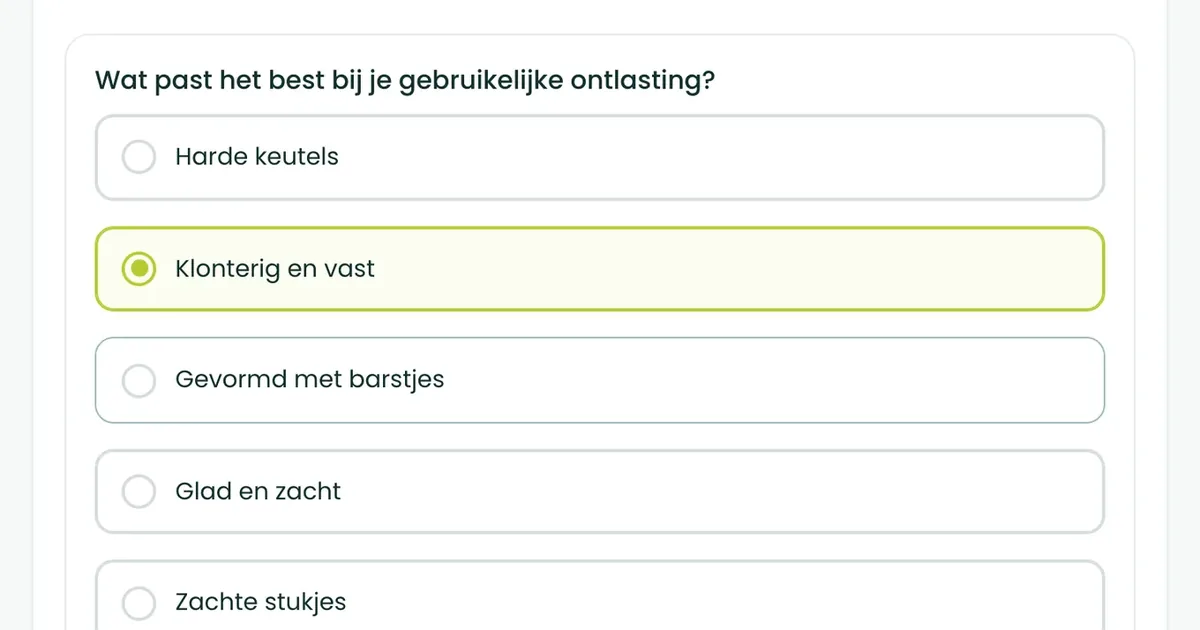
The gut scan asks about the shape of your stools, in seven types, and about abdominal pain or discomfort. You get a picture of how much your gut symptoms weigh on you, plus a baseline you can compare against later. If feeling bloated is your main complaint, bear in mind that the research on constipation found no change in bloating.1 You can read about what lies behind a bloated belly in bloated belly: the causes and what a gut scan measures.
When to see your GP
You have constipation if you poo fewer than three times a week. Contact your GP if you are constipated and have stomach pain that does not go away, feel sick, are vomiting, have pain when you poo, are bleeding from your anus, have a fever, have little appetite, find your weight dropping without trying or have diarrhoea. Also make an appointment if the self-care advice has not helped after two weeks.8
In summary
Drinks such as Yakult use the Shirota strain. In studies, people with hard stools or constipation did better with the strain than with placebo or no drink, but according to Thuisarts the benefit for constipation has not been shown.1,7,8 For IBS, the strain showed no clear benefit.2 For healthy people the evidence is thin, and a bottle contains sugar.4,5 A gut scan shows where you are starting from today. It is not a diagnosis.
Frequently asked questions
Is it healthy to drink Yakult every day?
For healthy people, there is little evidence that a daily drink with live bacteria brings a health benefit.4 A 65 gram bottle contains 43 kcal and 8.6 grams of sugars.5 No one knows yet whether probiotics have harmful effects when used over a long period.9
Can Yakult improve your gut flora?
The studies in this article are about symptoms and stools. They do not answer the question of whether a daily bottle changes your gut flora. The Voedingscentrum concludes that the evidence for a health benefit in healthy people is thin, with signs of a positive effect in certain conditions, such as irritable bowel syndrome and diarrhoea after antibiotics.4
What does Yakult do in your gut?
In studies with the Shirota strain, people with hard stools had hard stools less often after a few weeks than the control group.7,1 The only health claim EFSA approved for live bacteria in yoghurt or fermented milk is that L. bulgaricus and S. thermophilus help people who digest lactose poorly. Shirota is not covered by it.4
Is Yakult really that good?
That depends on the complaint. For constipation, a German study found better results with the Shirota strain than with placebo, but in a Chinese study the overall difference was not significant, and Thuisarts says it has not been shown that probiotics help with constipation.1,6,8 For IBS, the Dutch study found no clear difference from placebo.2
Sources
Every source below was checked on the day this article was published. The numbering follows the text.
- Koebnick C, Wagner I, Leitzmann P, Stern U, Zunft HJ. Probiotic beverage containing Lactobacillus casei Shirota improves gastrointestinal symptoms in patients with chronic constipation. Canadian Journal of Gastroenterology, 2003. doi.org/10.1155/2003/654907
- Thijssen AY, Clemens CH, Vankerckhoven V, Goossens H, Jonkers DM, Masclee AA. Efficacy of Lactobacillus casei Shirota for patients with irritable bowel syndrome. European Journal of Gastroenterology and Hepatology, 2016. doi.org/10.1097/MEG.0000000000000484
- Ford AC, Harris LA, Lacy BE, Quigley EMM, Moayyedi P. Systematic review with meta-analysis: the efficacy of prebiotics, probiotics, synbiotics and antibiotics in irritable bowel syndrome. Alimentary Pharmacology and Therapeutics, 2018. doi.org/10.1111/apt.15001
- Voedingscentrum. Probiotics (encyclopaedia). voedingscentrum.nl
- Voedingscentrum. What is the nutritional value of probiotics? voedingscentrum.nl
- Zhang X, Chen S, Zhang M, Ren F, Ren Y, Li Y, Liu N, Zhang Y, Zhang Q, Wang R. Effects of Fermented Milk Containing Lacticaseibacillus paracasei Strain Shirota on Constipation in Patients with Depression: A Randomized, Double-Blind, Placebo-Controlled Trial. Nutrients, 2021. doi.org/10.3390/nu13072238
- Sakai T, Makino H, Ishikawa E, Oishi K, Kushiro A. Fermented milk containing Lactobacillus casei strain Shirota reduces incidence of hard or lumpy stools in healthy population. International Journal of Food Sciences and Nutrition, 2011. doi.org/10.3109/09637486.2010.542408
- Thuisarts.nl (NHG). I find it hard to poo, what can I do about it? thuisarts.nl
- Thuisarts.nl (NHG). I have irritable bowel syndrome and want to try a treatment. thuisarts.nl
Also read
Written by

Measure where you start
Answer a few questions about your bowel movements and your gut, and your gut score appears in your dashboard. You can read what the gut scan measures and what it is based on on the scan page.
Free, about 3 minutes. An analysis of your answers, never a diagnosis.
BioProfile analyses your health status to guide you and your coach. It does not make a diagnosis, only a doctor can do that. Built on validated health questionnaires; the combined BioProfile score is not itself a validated clinical instrument yet. Your answers stay private (GDPR).