
In this article you will read where a bloated belly comes from, what a gut scan measures and when to go to your GP. That matters, because when you know where the complaint can come from, you know better what you can do yourself. In the morning your trousers fit and by the end of the afternoon they do not. You undo the top button and you wonder what you ate that was wrong. A bloated belly rarely has one cause, and “too much gas” is almost never the explanation. The causes vary: what you eat, how your gut senses stimuli, how quickly the contents pass through and how your abdominal wall and diaphragm react. The BioProfile gut scan measures how much these complaints affect you, and gives you an indication of where you stand today in this area, as the first of the 11 health areas the full scan assesses. This is not a diagnosis. It is insight, to see where you stand today. And to help you make better choices in your food and lifestyle. What this scan does not do: point to a cause or make a diagnosis. Only a doctor can do that; when to go to your GP is set out below.

Verified by Justinas Šlikas, PhD
PhD in chemistry from the University of Edinburgh
Checked on 25 September 2026
In short
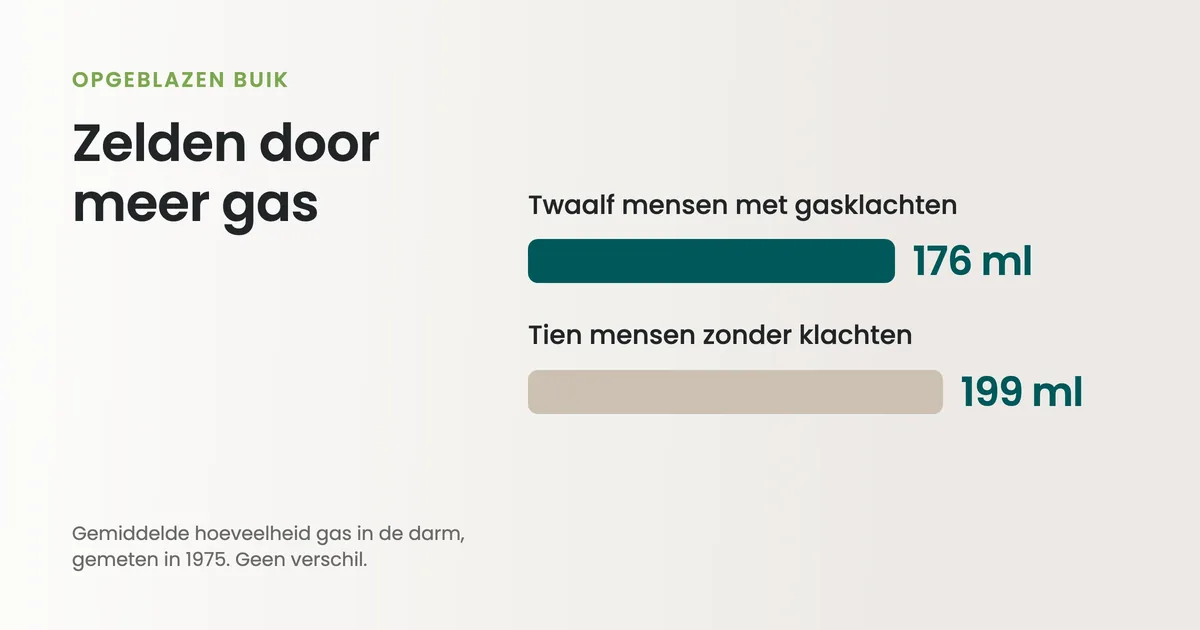
- A bloated belly is rarely caused by more gas: people with chronic gas complaints had about as much gas in the gut as people without complaints.1
- Almost 18 per cent of people have it at least once a week, women about twice as often as men.2
- A gut scan gives you an indication of where you stand today with your symptom load over the past few weeks, and a starting value. It is not a diagnosis, and this scan does not point to a cause.
Contents
How often a bloated belly occurs
In a Rome Foundation study among 51,425 people in 26 countries, almost 18 percent had a bloated belly at least once a week, for three months. Women reported it about twice as often as men, and the complaint became less common with age. Of those who had abdominal pain weekly, more than six in ten also had a bloated belly.2
It rarely stands on its own: in the same study, more than 40 percent of the online participants met the criteria for at least one functional stomach or bowel complaint.3 The best known is irritable bowel syndrome, which about one in 25 people in the Netherlands has.4
Why your belly expands, even without extra gas
The picture of a balloon filling up is usually wrong. Back in 1975, researchers measured how much gas sat in the gut of twelve people with chronic gas complaints: 176 millilitres on average, against 199 millilitres in ten people without complaints. No difference. What did differ: in those who developed pain, the gas took longer to pass, and the same amount hurt more.1
Where the swollen belly does come from was shown by scans. In 56 people whose main complaint was a bloated belly, a CT scan was made at rest and during a severe episode. With a functional bowel complaint the contents of the abdomen barely increased, by 0.3 litres, while the abdominal wall came forward by 14 millimetres: the diaphragm dropped and pushed the contents forward.5 In a follow-up study, twenty people with this complaint and fifteen without were given the same amount of gas in the gut; in the people with complaints the diaphragm contracted instead of relaxing, and their belly expanded more.6
A bloated feeling and a belly that measurably gets bigger are also two different things, and they often occur together.7
What food has to do with it
For some people, food does a lot. In a controlled study, thirty people with irritable bowel syndrome ate a diet low in fermentable carbohydrates for three weeks and an ordinary Australian diet for three weeks. Their symptom score was 22.8 on the first diet and 44.9 on the second, on a scale of 100; in healthy people the diet did nothing.8 A diet like that is work for a dietitian, but it shows that what you eat plays a measurable part.
What a gut scan measures
The gut scan asks six questions about the past few weeks: the form of your stools, belly pain or discomfort, a bloated feeling, how regularly you go, reflux or heartburn, and complaints after certain foods. Each question is given points, the points are added up and converted into a gut score from 0 to 100, with the reading band it falls into. Higher is better.
The questions are modelled on two validated symptom scales. The Bristol Stool Form Scale reads the form of your stools as a signal of how fast your gut works: in 66 volunteers, the form matched the measured transit time more closely than how often they went.9 The Gastrointestinal Symptom Rating Scale rates stomach and gut complaints with fifteen questions, and that set-up is our model.10 The questions about pain and food follow how the Rome IV criteria describe the pattern of complaints, only to describe your pattern and never to establish anything.11 Our questions are written by us, not a copy, so the score is not a validated clinical score. What you get is a structured picture of your symptom load and a starting value.
What a gut scan does not measure
A questionnaire reads the load you describe. It cannot see whether this is irritable bowel syndrome, an intolerance, coeliac disease or something that clears up on its own. That needs a doctor, and sometimes blood or stool tests. So a gut scan does not make a diagnosis. A low score means that looking further makes sense, and nothing more.
Your GP asks questions and examines your abdomen; tests at the hospital are usually not needed. Three things are a reason to make an appointment: blood on or in your stools, your weight going down without you knowing why, and getting bowel complaints for the first time when you are 50 or older.4
What you do with your score
Most people start by cutting things out: first the bread, then the onion, then the milk. A month later you still do not know whether it did anything, because you never wrote down where you started. A score from today is that starting value. Repeat the scan a few weeks later, on the same questions, and you have two numbers instead of a feeling.
If you want to do something in those weeks, write down when your belly swells up and what you ate that day: that is what a GP or dietitian can work with.
Measure where you start
Six questions about the past few weeks, about three minutes, and your gut score is in your dashboard. What the gut scan measures and what it is based on is set out on the scan page.
Free, about 3 minutes. An analysis of your answers, never a diagnosis. All health scans
Frequently asked questions
What is the cause of a bloated belly?
There is no single cause. A bloated belly can come from food you tolerate poorly, an earlier gut infection, a gut that feels stimuli more strongly, slower transit, or a belly wall and diaphragm that respond wrongly to ordinary gas.7 In a functional gut complaint, that last one was often the mechanism.5
Is a bloated belly a sign of irritable bowel syndrome?
It can be part of it. The criteria: abdominal pain that came back at least one day a week on average over the past three months and is linked to at least two of these three: your bowel movements, a change in how often you go to the toilet and a change in how your stool looks; the complaints started at least six months earlier.11 About one in 25 people in the Netherlands has it.4 Whether your complaints fall under it is something only a doctor can say.
When do I go to my GP with a bloated belly?
If there is blood on or in your stools, if your weight goes down and you do not know why, or if you are 50 or older and get bowel complaints for the first time.4
Can a gut scan tell me which food to leave out?
No. The scan asks how often you have complaints after certain foods, as one of six questions. Which food that is, is work for a dietitian or a doctor, with a diary of what you ate and when your belly swelled up.
Sources
Every source below was checked on the day this article was published. The numbering follows the text.
- Lasser RB, Bond JH, Levitt MD. The role of intestinal gas in functional abdominal pain. New England Journal of Medicine, 1975. doi.org/10.1056/NEJM197509112931103
- Ballou S, Singh P, Nee J, et al. Prevalence and associated factors of bloating: results from the Rome Foundation Global Epidemiology Study. Gastroenterology, 2023. doi.org/10.1053/j.gastro.2023.05.049
- Sperber AD, Bangdiwala SI, Drossman DA, et al. Worldwide prevalence and burden of functional gastrointestinal disorders, results of Rome Foundation Global Study. Gastroenterology, 2021. doi.org/10.1053/j.gastro.2020.04.014
- Thuisarts.nl (Nederlands Huisartsen Genootschap). I have irritable bowel syndrome (PDS). thuisarts.nl
- Accarino A, Perez F, Azpiroz F, Quiroga S, Malagelada JR. Abdominal distention results from caudo-ventral redistribution of contents. Gastroenterology, 2009. doi.org/10.1053/j.gastro.2009.01.067
- Villoria A, Azpiroz F, Burri E, Cisternas D, Soldevilla A, Malagelada JR. Abdomino-phrenic dyssynergia in patients with abdominal bloating and distension. American Journal of Gastroenterology, 2011. doi.org/10.1038/ajg.2010.408
- Lacy BE, Cangemi D, Vazquez-Roque M. Management of chronic abdominal distension and bloating. Clinical Gastroenterology and Hepatology, 2021. doi.org/10.1016/j.cgh.2020.03.056
- Halmos EP, Power VA, Shepherd SJ, Gibson PR, Muir JG. A diet low in FODMAPs reduces symptoms of irritable bowel syndrome. Gastroenterology, 2014. doi.org/10.1053/j.gastro.2013.09.046
- Lewis SJ, Heaton KW. Stool form scale as a useful guide to intestinal transit time. Scandinavian Journal of Gastroenterology, 1997. doi.org/10.3109/00365529709011203
- Svedlund J, Sjödin I, Dotevall G. GSRS: a clinical rating scale for gastrointestinal symptoms in patients with irritable bowel syndrome and peptic ulcer disease. Digestive Diseases and Sciences, 1988. doi.org/10.1007/BF01535722
- Lacy BE, Mearin F, Chang L, et al. Bowel disorders. Gastroenterology, 2016. doi.org/10.1053/j.gastro.2016.02.031
Written by

BioProfile analyses your health status to guide you and your coach. It does not make a diagnosis, only a doctor can do that. Built on validated health questionnaires; the combined BioProfile score is not itself a validated clinical instrument yet. Your answers stay private (GDPR).