

In short
- Strong muscles and surgery: in 74 older adults who had heart surgery in Denmark, muscle on CT shrank by 7.1 percent within six weeks of leaving hospital, and the fat between the muscle fibres rose by 14.7 percent, with large differences from person to person.1
- A widely used European test for low muscle strength plus low muscle mass found fewer people than CT did: about one in five against more than one in three, six weeks after leaving hospital.1
- In an earlier study, 10 days of bed rest cost 12 older adults in good health a clear amount of lean mass and leg strength.2
- The Danish analysis shows associations, not cause and effect, in one hospital and mainly in men, and found no consistent link between the scan measurements and walking or standing up from a chair.1
Contents
- What lying still does to your muscles
- You are one of many
- Why muscles shrink when you don’t use them
- What the team from Aarhus found
- Muscle quality: the amount is only half the story
- What the scans showed, and what they didn’t
- In short, and what you can do for strong muscles
- Frequently asked questions
What lying still does to your muscles
In this piece about strong muscles, you read what happens to the muscles after heart surgery later in life, how a CT scan in hospital can show that muscle shrinks within weeks and holds more fat, and why a widely used test can miss part of that change. That matters, because strong leg muscles get you out of a chair, up the stairs and through an ordinary day, and a period of lying still can cost you more of them than you feel.

You come home from hospital and the house looks the same, but the stairs feel steeper. The chair you always sit in seems lower than you remember. You walk to the shop and stop halfway, not really out of breath, just heavy in the legs. People tell you to take it easy, so you do, and the days on the sofa blur into one another. The mirror shows the same face and the scales roughly the same weight, so it is hard to say what has changed. Yet something has changed, and it is happening under the skin.
You are one of many
The group this piece is about is large and growing. In Germany, the number of people aged 65 and over rose from 12 million in 1991 to 19.3 million in 2025, much faster than the population as a whole, Destatis reported in 2026.3 In England and Wales, the share of people aged 65 and over rose from 16.4% to 18.6% between 2011 and 2021, according to the ONS in 2023.4
In the Netherlands, older people have started moving more. CBS reported in 2020 that in 2001, 22 percent of people aged 65 and over met the physical activity guidelines, and in 2019, 40 percent did.5 Activity that makes bones and muscles stronger does drop off with age, though: almost all children aged 4 to 12 did enough of it (99.8 percent), compared with 75 percent of people aged 65 and over, CBS reported in the same year.5 So one in four older Dutch people did not do enough of the kind of activity that keeps muscles strong.
If you would like a first picture of where you stand, the BioProfile lifestyle scan gives you a starting point.
Why muscles shrink when you do not use them
Muscle is not a store that simply stays put. Your body keeps making new muscle protein and breaking down old protein, and using your muscles is one of the signals that keeps the building going. If you lie still for long enough, that building slows down.2
This was clearly shown in 2007. Kortebein and colleagues, including William J. Evans of the University of Arkansas for Medical Sciences, had 12 healthy older adults, with an average age of 67, stay in bed for 10 days. By the end, the participants had clearly lost lean mass and leg strength, and the rate at which their muscles made new protein had dropped.2 Ten days is not long. A hospital stay around major surgery is often a time of lying still, too.
That study had its limits. The participants were in good health, they stayed in bed on purpose, and there were only 12 of them. The study did not show what happens in older adults who are genuinely recovering from major surgery, in the weeks after they go home. The question of muscle quality, how much fat settles between the muscle fibres, is another matter again.
Then there is the question of how too little muscle gets noticed at all. In Europe, a widely used set of criteria from a working group of experts, known as EWGSOP2, speaks of too little muscle when both muscle strength and muscle mass are low.1 Whether that test keeps up with rapid changes after surgery was still an open question for older patients after heart surgery. In the meantime, the GP advice on Thuisarts already asks everyone to make their bones and muscles stronger, for example with exercises, strength training or taking the stairs.6
What the team from Aarhus found

The new piece of the puzzle comes from Denmark. P. Svidt, R. Daugaard, T. Lading and I.S. Modrau, from the Department of Clinical Medicine at Aarhus University and the Department of Cardiothoracic and Vascular Surgery at Aarhus University Hospital, measured the muscles of older patients after heart surgery on CT scans at the start and again six weeks after they left hospital. I.S. Modrau is also affiliated with the Department of Cardiothoracic Surgery at Aalborg University Hospital. The work appeared on 3 October 2026 in The journal of nutrition, health & aging, as a journal article and not as a preprint.1
Put simply, the team saw that in the weeks after coming home the muscle shrank and more fat built up between the muscle fibres, and that the usual European test missed part of that change. Patients whose heart was still pumping well, and patients who had been assigned to early rehabilitation at home, kept slightly more muscle.1 Everything below about this paper is based on the published abstract, the only part of the paper read for this piece.
Why this matters to you: an operation or a stay in hospital is something many people go through later in life, and this shows that the change in muscle can be large, fast and partly invisible to a standard test. It also shows how big the differences between people are. Some kept far more muscle than others. That is why it is worth paying attention to your muscles long before you ever need a hospital bed, and not only afterwards.
Muscle quality: the amount is only half the story
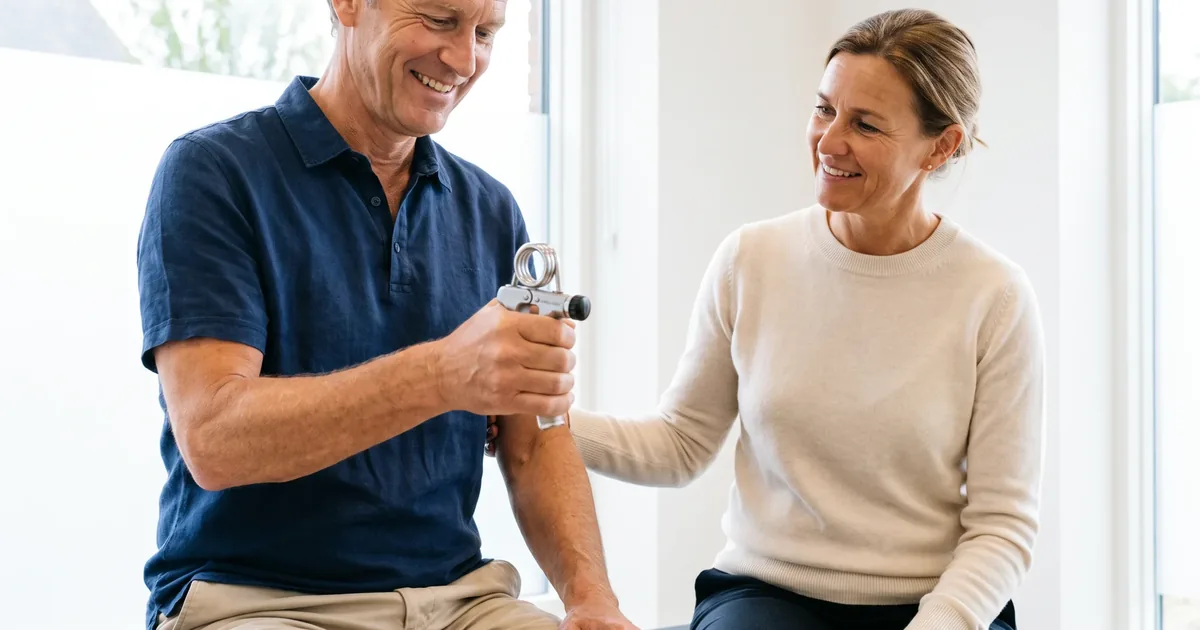
Think of muscle as having two qualities you can see on a CT scan. The first is quantity: how much muscle there is, expressed as a muscle index calculated from the scan. The second is quality: how much fat has settled between the muscle fibres, compared with the area of the muscle itself.1 Most of us only ever think about the first.
Quality is the less familiar idea, so here is a picture. Fat between the fibres looks a bit like the white streaks of fat in a piece of marbled beef. Two pieces can be the same size, while one has far more streaks running through it. In a muscle, more of those streaks means less of the space is taken up by muscle fibres.
Here is a second picture, closer to home. Say that six weeks after leaving hospital, the scales show roughly the same weight. That one number can hide two changes at once: the muscle itself has become smaller, and there is more fat in what is left. The scales cannot tell them apart. A CT scan can see both.
The third piece is what muscles do in everyday life. Alongside the scans, the team asked patients to stand up from a chair as many times as they could in 30 seconds, and gave them a walking test over 10 metres, at the start and six weeks after discharge.1 That lets you compare what the scan sees with what a person can actually do.
Why would muscles change so quickly in the first place? Experts who study muscle and inactivity do not point to age, but to the lying still itself. Luc van Loon, lead researcher of a Maastricht University project on muscle loss during a hospital stay, puts it like this:
Not old age itself, but periods of inactivity during a hospital stay, an operation or an illness can lead to considerable loss of muscle mass and strength within just a few days
Luc van Loon, Professor of Physiology of Exercise and Nutrition, principal investigator, NUTRIM, Maastricht University / Maastricht UMC+7
In plain words: it is not age itself, but periods of inactivity during a hospital stay, an operation or an illness that can lead to a considerable loss of muscle mass and strength within a few days.
William J. Evans, who worked on the 10-day bed rest experiment described above, pointed to what happens inside the muscle:
We found a drastic drop in muscle protein synthesis due to inactivity, and that drop caused the muscle loss.
William J. Evans, director of the Nutrition, Metabolism and Exercise Laboratory, University of Arkansas for Medical Sciences (UAMS)8
Muscle protein synthesis is the building side described above: the body making new muscle protein. When that building slows down and the breakdown carries on, the muscle shrinks.8
What the scans showed, and what they did not
The patients were 100 people aged 65 or over who had heart surgery at a university hospital in Denmark. Their average age was 71.5, and 17% were women. Of the 100, 74 had a CT scan both at the start and six weeks after leaving hospital, so the comparison over time rests on those 74.1 The analysis is part of a larger study of early rehabilitation, registered as NCT06370611, but this part of the work observed and compared; it was not set up to test anything new.1
Over those six weeks, the muscle index on CT fell by 7.1 per cent, and the amount of fat between the muscle fibres, measured relative to the muscle area, rose by 14.7 per cent. The differences between individuals were large.1 Why two people of the same calendar age can be in such different shape is something you can read about in biological age versus calendar age.
The European criteria and the CT measurement told different stories. By the European criteria, the share of patients with low muscle strength plus low muscle mass went from about one in seven (13.5%) to about one in five (21.6%). By CT reference values for low muscle mass, the share was higher at both points: from about one in five (18.9%) to more than one in three (36.5%).1 The authors conclude that CT picked up a decline in muscle that the European criteria did not fully capture.1
Some patients kept more muscle than others. Those whose heart was still pumping well, and those assigned to early rehabilitation at home, kept slightly more muscle. A higher score on a standard surgical risk scale went together with poorer muscle quality.1
What the analysis did not show matters just as much.
First, the scans and the everyday tests did not match up. No consistent link was found between the muscle measurements on CT and how patients did on the sit-to-stand test or the walking test.1 Within six weeks, a smaller, more marbled muscle on the scan did not clearly show up as slower walking or fewer stands from the chair.
Second, this is an observational analysis. The analysis shows which things went together, not what caused what, and the link with early rehabilitation at home was small and lay close to the limit of what could be chance.1
Third, the group was small and specific: one hospital in Denmark, mostly men, and only 74 of the 100 had a scan at both points.
Fourth, the patients were followed for only six weeks after discharge. Whether their muscles recovered after that is not in the summary.
Fifth, the summary does not say what the patients ate, or which muscles the scans looked at. Nutrition is a separate topic here; if you want to know how much energy an ordinary day asks of your body, take a look at how many calories per day.
In short, and what you can do for strong muscles

In short: when older people lie still around a major operation, their muscles can shrink quickly. An earlier study showed this with bed rest in 12 older people in good health.2 In 74 older patients after heart surgery, the team from Aarhus saw that within six weeks of discharge, the muscle on CT shrank by 7.1 percent and held 14.7 percent more fat between the fibres, with large differences between people, and that the usual European test missed part of that change.1 The analysis shows links, not cause and effect, in one Danish hospital and mostly in men, and found no consistent link between the scan measurements and walking or getting up from a chair.1
What you can do with this:
- Keep using your muscles as part of your everyday life, so you have more to fall back on if you ever end up in hospital. The GP advice on Thuisarts asks everyone to make their bones and muscles stronger.6
- If you have an operation planned, ask your care team how you will get moving again afterwards, and whether rehabilitation is part of the plan.
- How your own muscles and bones are doing today is the open question, and that is where the scan below begins. The scan gives you a starting point, and is not a diagnosis.
Frequently asked questions
Can a hospital stay really cost muscle that quickly?
In 12 healthy older adults, 10 days of bed rest led to a clear loss of lean mass and leg strength.2 In older adults after heart surgery, muscle on CT shrank by 7.1 per cent within six weeks of leaving hospital.1
Will I notice if my muscles change after an operation?
Not necessarily. The Danish analysis found no consistent link between the muscle measurements on CT and how patients did on a walking test or a sit-to-stand test.1 The scans picked up a change that the everyday tests did not clearly show within six weeks.
How often should I work on my muscles and bones?
The GP advice on Thuisarts is to make your bones and muscles stronger 2 times a week, for example with exercises, strength training, taking the stairs or going to the gym.6 Of Dutch people aged 65 and over, 75 percent did enough bone and muscle strengthening exercise, CBS reported in 2020.5
When should I call my GP about symptoms during exercise?
Thuisarts advises calling your GP if you become short of breath or find it hard to breathe while moving or exercising, hear a wheezing sound when you breathe, get chest pain, or develop problems with your joints.6
Does the BioProfile scan tell me what is wrong with my muscles?
No. The scan is not a diagnosis. The scan gives you a picture of where you stand today, as a starting point. Finding a cause is work for a doctor.
Sources
Every source below was checked on the day this article was published. The numbering follows the text.
- Svidt P, Daugaard R, Lading T, Modrau IS. Changes in skeletal muscle and physical function after cardiac surgery: a prospective study. The Journal of Nutrition, Health and Aging, 2026. PMID 42828917. doi.org/10.1016/j.jnha.2026.100999
- Kortebein P, Ferrando A, Lombeida J, Wolfe R, Evans WJ. Effect of 10 days of bed rest on skeletal muscle in healthy older adults. JAMA, 2007;297(16):1772-1774. doi.org/10.1001/jama.297.16.1772-b
- Statistisches Bundesamt (Destatis). Bevölkerung ab 65 Jahren. 2026. destatis.de
- Office for National Statistics. Profile of the older population living in England and Wales in 2021 and changes since 2011. 2023. ons.gov.uk
- CBS. Half of Dutch people met the physical activity guidelines in 2019. 2020. cbs.nl
- Thuisarts.nl (NHG). Ik wil gezond bewegen. thuisarts.nl
- Luc van Loon, professor of Exercise Physiology and Nutrition, NUTRIM, Maastricht University. Nieuw onderzoek naar voorkomen van spierverlies bij ziekenhuisopname. Maastricht University, 2026. maastrichtuniversity.nl
- William J. Evans, director of the Nutrition, Metabolism and Exercise Laboratory, University of Arkansas for Medical Sciences. Extended Bed Rest Accelerates Muscle Deterioration in Older Adults, UAMS Researchers Report in JAMA. UAMS News, 2007. news.uams.edu
Quotations from English have been translated by BioProfile.
Also read
See where you stand today
The BioProfile lifestyle scan gives you a first picture of where you stand today, as a starting point. The scan gives insight and is not a diagnosis.
Free, about 3 minutes. An analysis of your answers, never a diagnosis.
BioProfile analyses your health status to guide you and your coach. It does not make a diagnosis, only a doctor can do that. Built on validated health questionnaires; the combined BioProfile score is not itself a validated clinical instrument yet. Your answers stay private (GDPR).