
BioProfile analysis · wellbeing scan
Your result in 3 minutes
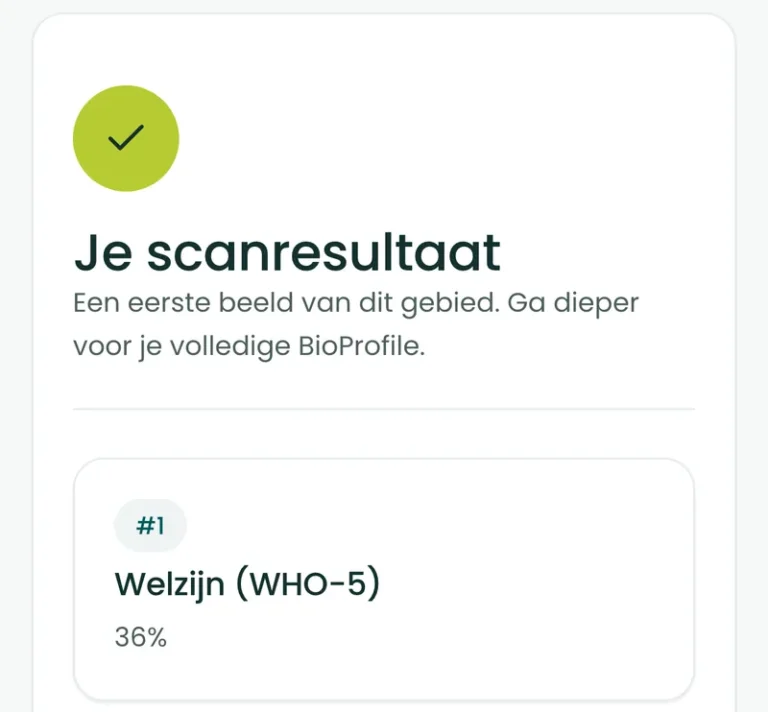
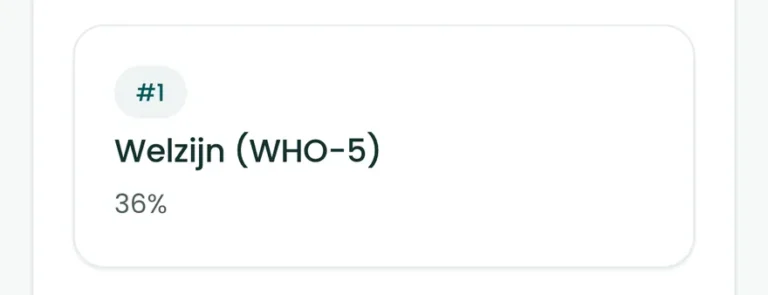
Your wellbeing score over the past two weeks, with the published cut-off value next to it.
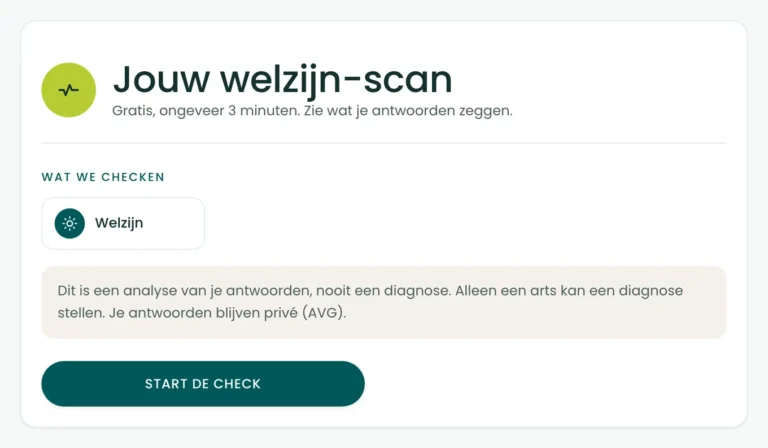
The World Health Organization published five statements about the past two weeks. We ask them word for word, in the official Dutch translation, and convert your answers into a score from 0 to 100. An analysis of your answers, never a diagnosis.
Free
5 questions
About 3 minutes
Score from 0 to 100
You fill in your first name and email address, and then your score is on your screen.
(and the scientifically supported reason why it is precisely these five)
You wake up and the day already feels like work. You do not feel like doing anything, not even the things you were still looking forward to last year. You are not down and you are not restless, you are flat. You sleep your hours, you eat your vegetables, you move enough. And still.
That is the hard thing about wellbeing: there is no thermometer for it. You cannot draw blood for it, you do not see it on an X-ray, and your GP finds nothing. So it stays a feeling. Today goes a little better, tomorrow it does not, and three months from now you still do not know whether you have gone forward or back.
The World Health Organization solved that by measuring it. Five statements about the past two weeks, each with six answers, added up into a score from 0 to 100. Not a diagnosis. But a number. And a number is something you can follow.
An earlier bedtime. A month of running. Two weeks without alcohol. A weekend away. All sensible, and all of them start in the same place: with what you are going to do about it.
So afterwards you never know whether it did anything. You have written down nowhere where you began. Without a starting value, every change is a feeling about a feeling.
We analyse the real cause first
At BioProfile we turn the order around. First measure what is there now, with questions someone else has validated, and only then talk about what you do with it. Analyse, and only then advise.
The wellbeing scan is the first step of that analysis, and the shortest.
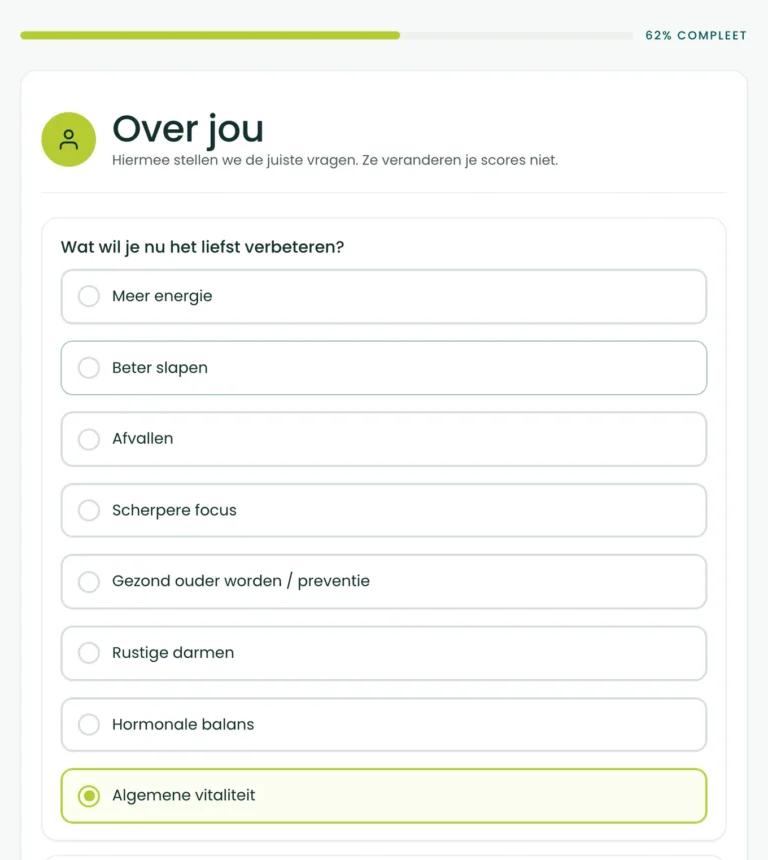
You start with eight short questions about yourself. They do not count towards your score; they make sure we can read the rest properly. One of them you may skip.
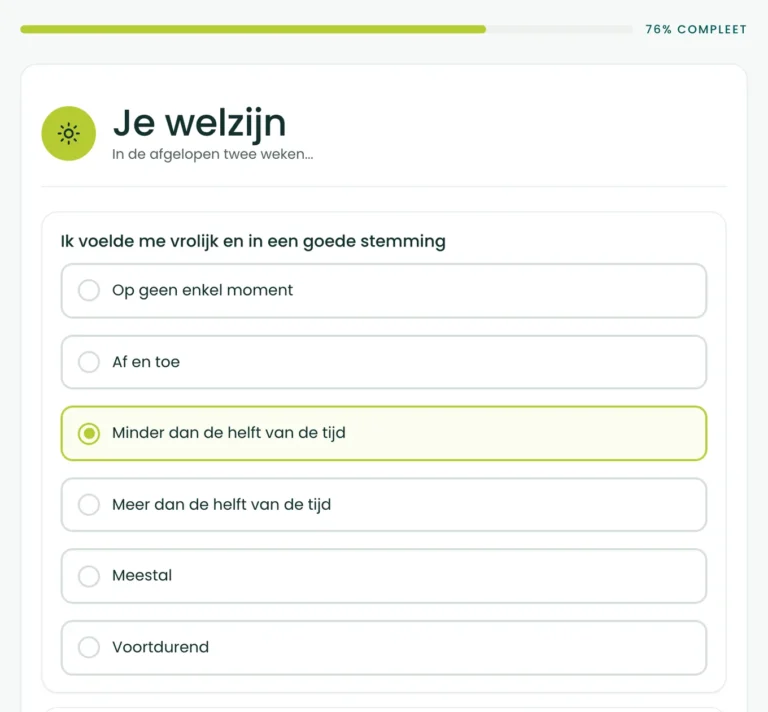
Then come the five statements of the WHO-5, about the past two weeks. For each statement you say how often it applied to you, from ‘at no time’ to ‘all of the time’.
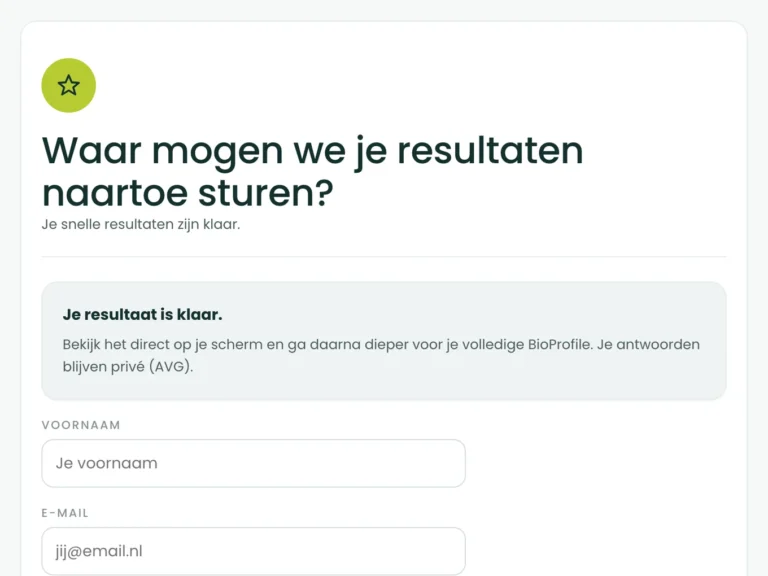
You fill in your first name and email address, and your score is on your screen. Your email holds a login link, so you can find your result again later and extend your scan into your full BioProfile.
Repeat the scan in two weeks and you no longer have a feeling, you have two numbers.
You fill in your first name and email address, and then your score is on your screen.
This scan is about the past two weeks. You get five statements, and for each one you say how often it was true for you.
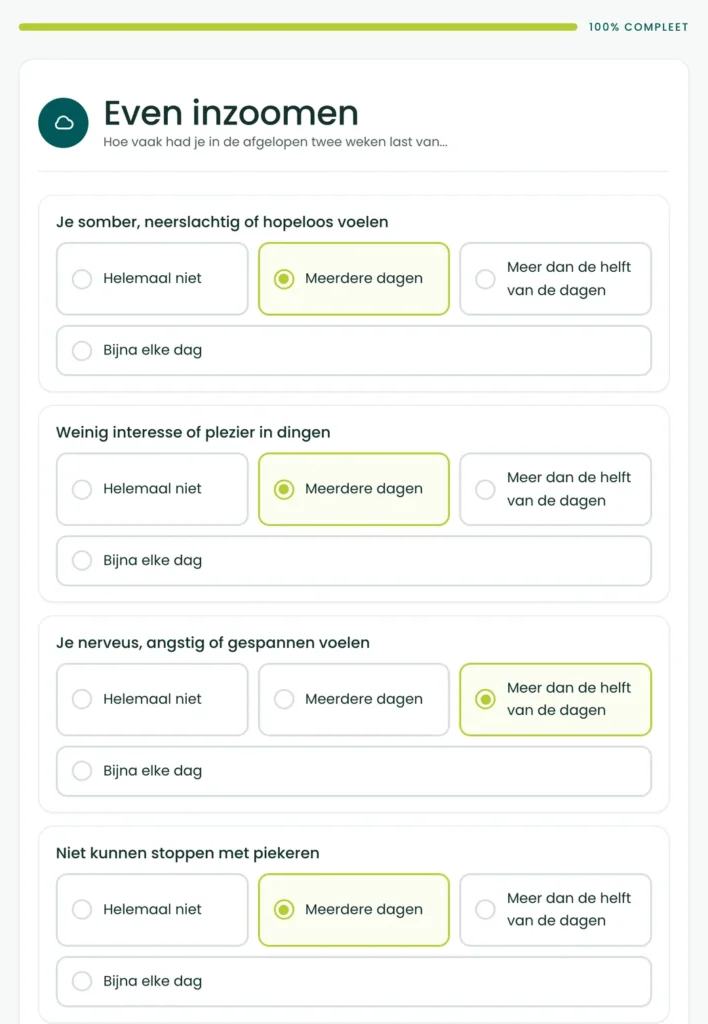
If your score comes out below the published cut-off value, we ask four short follow-up questions about mood and worrying:
Those four do not count towards your score. They only decide whether we point you towards support.
used word for word
The only instrument we use word for word, because it is freely and openly available. Five positively worded questions, a raw score of 0 to 25 converted into a percentage, where 50 per cent or lower reads as low wellbeing and 28 per cent or lower as a signal that deserves follow-up. Validated in 35 countries with an internal consistency between 0.81 and 0.90 and a screening accuracy for low mood of around 0.80 to 0.85.
Used as published, word for word.
Validated for: current mental wellbeing and as a screen for low mood.
Topp and colleagues, systematic review of 67 studies, Psychotherapy and Psychosomatics, 2015.
used word for word
The WHO publishes an official Dutch version of these five questions. We use that official wording and do not translate it ourselves, because a validated instrument loses its validation as soon as someone rewords it.
Used as published, word for word.
Validated for: administering the WHO-5 in Dutch.
World Health Organization, WHO-5 Well-Being Index, Dutch version.
used word for word
Two short publicly available screening questionnaires of two questions each, scored from 0 to 6, where 3 or higher counts as positive. We ask them only if your WHO-5 comes out at 50 percent or lower, and we ask them to know whether we should point you towards support, never to give you a label. Neither is a diagnosis, and neither holds a question about self-harm.
Used as published, word for word.
Validated for: brief screening for low mood and anxiety.
PHQ and GAD instruments placed in the public domain by Pfizer.
These five questions are the only ones in the whole analysis that we use word for word as published. Everything else is worded by us and modelled on a validated instrument. We use these ones verbatim because the instrument is free and openly available, and because that exact wording is what gives the published cut-off values their meaning.
This is the only area on this page whose bands come from the published instrument and not from us, and that is why it is also the only one without the caveat about reading bands. It has been validated in 35 countries as a measure of wellbeing and as a screen for low mood. What it cannot do is establish anything, explain why two weeks were low, or replace a person. A screening is a reason for a conversation, never a conclusion.
WHO-5 Well-Being Index, reproduced word for word under open access. The cut-off values of 50 and 28 per cent are those of the instrument itself.
Your five answers are added up into a raw score of 0 to 25 and converted into a percentage from 0 to 100. Higher is better.
0 to 28
worth following up
29 to 50
low well-being
51 to 100
healthy well-being
Cut-off values of the WHO-5 Well-Being Index: 50 per cent or lower points to low wellbeing, 28 per cent or lower to a signal that deserves follow-up. Topp and colleagues, 2015.
These bands are not ours. For every other area in the BioProfile analysis, a caveat sits in this place, because there we chose the reading bands ourselves. Not here.
This page describes a measuring instrument, so below you can read where that instrument comes from and what has been studied about it. Every claim points to the source it appears in.
For a long time wellbeing was measured by counting what was wrong and turning the result around: few complaints, so things are going well. Bech and colleagues showed in 2003 that those are two different things, and that a scale which asks about the positive gives different information than a scale which asks about complaints.1
That fits a line of research that has been running for decades. In 1999 Diener and colleagues brought together thirty years of research into subjective wellbeing, and in 1989 Ryff described wellbeing as something with several sides, among them meaning and a grip on your own life.2,3 Huppert and So worked that out in European research into a framework for flourishing.4
By now there are dozens of questionnaires for it. In 2016, Linton and colleagues counted ninety-nine of them, and set out the aspects on which they differ.5 That is exactly why it matters which five questions you ask.
The WHO-5 comes from the World Health Organization itself, consists of five positively worded statements about the past two weeks, and is free and publicly available, including an official Dutch translation.6
Topp and colleagues went through sixty-seven studies in 2015 in which the WHO-5 had been used, from general practices to population research.7 Sischka and colleagues checked in 2020, with item response theory, whether the scale measures the same thing in thirty-five countries.8
In short: these five were not chosen because they sound good, but because what they measure, and whether they measure it the same way everywhere, has been checked.
The WHO-5 has a published cut-off value. Krieger and colleagues studied in 2014 how closely the score tracks the severity of low mood symptoms, and whether the scale is suitable as a first sieve.9
A first screen is not the same thing as a result. Coming out below the cut-off value means that looking further makes sense, and nothing beyond that. Only a doctor can make a diagnosis, and that stays that way.10
If your score comes out below the cut-off value, we ask four extra questions: two about mood and two about worrying. These are the PHQ-2 and the GAD-2, both placed in the public domain by Pfizer.11
Kroenke and colleagues described the PHQ-2 in 2003 and the two-question version for anxiety in 2007; Löwe and colleagues studied the combination of those four questions in the general population in 2010.12,13,14
Those four do not count towards your score. They only decide whether we point you towards support on your result screen.
Steptoe, Deaton and Stone brought together in The Lancet what is known about the link between subjective wellbeing, health and growing older.15 Chida and Steptoe summarised prospective research in 2008 on the link between positive wellbeing and mortality.16
That is correlation, not cause, and that is how those studies put it too. What it does say: wellbeing is not the soft part of health that you look at some other time later.
This is what the scan rests on. Now your score.
You fill in your first name and email address, and then your score is on your screen.

This page was written by BioProfile. BioProfile sells health products and this scan is free: no purchase comes with it. The WHO-5 is not ours. It was published by the World Health Organization and is freely available, and that is exactly why we are allowed to use it word for word.
Every source below was checked on the day this page was updated. The numbering follows the text: source 1 is the first one the text points to, and the three instruments the scan runs on sit in between, at the place where they come up.
Five statements, about three minutes, and your score is on your screen. Your answers stay private (GDPR).
You fill in your first name and email address, and then your score is on your screen.
What this does not say. A wellbeing score is not a diagnosis of clinical low mood or of anxiety, and two low weeks are not a condition. What it is good at is noticing, and that is exactly what a screening is for. If you have had thoughts of harming yourself, reach out now: in the Netherlands call 113, in the United Kingdom the Samaritans on 116 123, and if you are in immediate danger call 112.
BioProfile analyses your health status to guide you and your coach. It does not make a diagnosis, only a doctor can do that. Built on validated health questionnaires; the combined BioProfile score is not itself a validated clinical instrument yet. Your answers stay private (GDPR).