
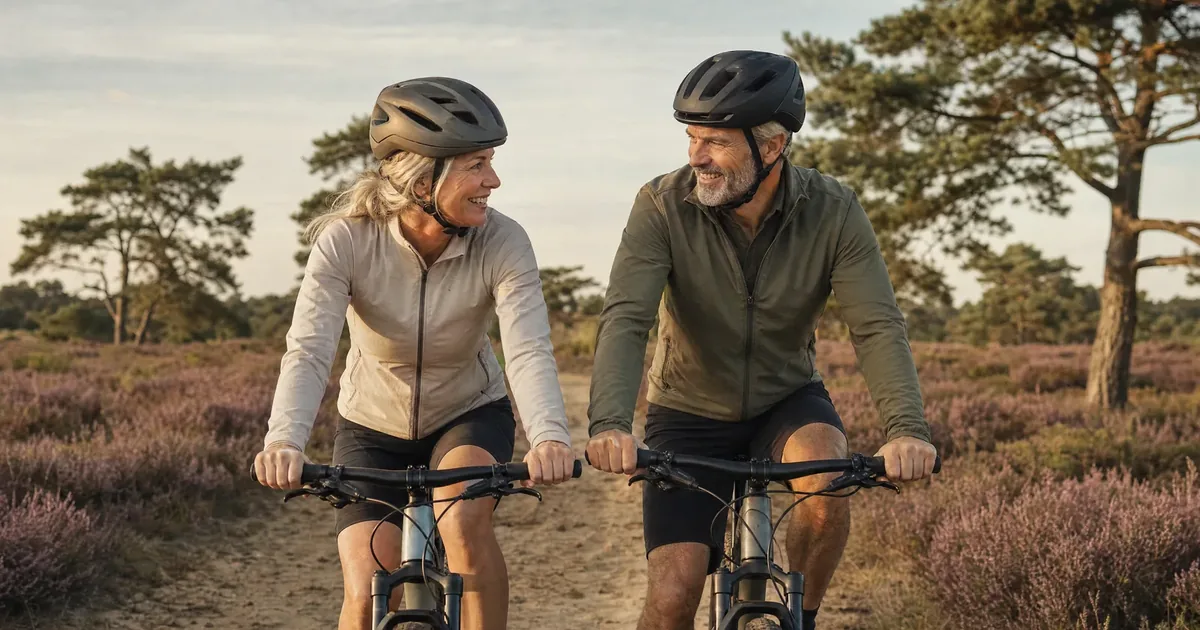
In this article you will read why ‘exercise is good for you’ holds true, how much movement a day the Dutch guidance asks for, what large studies saw in people who move more, and which kinds of movement go together with more years of life. That matters, because the gain is greatest for the people who move the least, and fewer than half of Dutch people met the physical activity guidelines in 2025.4 The BioProfile lifestyle scan gives you an indication of where you stand with your lifestyle today. The scan is not a diagnosis. It is insight, to see where you stand today and to help you make better choices in your diet and lifestyle. The scan does not point to a cause and does not say what is going on in your body. Only a doctor can do that.

In short
- Adults are advised to be active for at least two and a half hours a week, for example 30 minutes on five days. On top of that, the advice is to strengthen your bones and muscles twice a week.1
- The biggest difference in the risk of dying lies between doing nothing and meeting the guideline of two and a half hours a week. Beyond that, each extra hour lowers the risk by less.2
- Light activity counts too. In studies using activity trackers, adults who only did more light activity also had a lower risk of dying over the course of the research.3
- In 2025, 47 per cent of people in the Netherlands aged 4 and over met the physical activity guidelines.4 A lifestyle scan shows where you stand today. It is not a diagnosis.
Contents
Being active is good for you: but why?
The Gezondheidsraad, which advises the Dutch government on health, concludes that enough activity goes together with a lower risk of chronic diseases such as diabetes and cardiovascular disease, of depressive symptoms and, in older people, of broken bones.5
The largest summary to date pooled 94 cohorts with more than 30 million adults. Adults who reached the recommended amount, around 150 minutes of moderate-intensity activity a week, had a clearly lower risk of dying during the studies than adults who did nothing. The difference came close to a third for death from any cause and for death from heart and vascular disease, and it was smaller for death from cancer. If all the adults who moved too little had met the guideline, around one in six early deaths would not have happened.2 For you, this means that going from sitting still to meeting the guideline is the step that counts most.
The same pattern holds for your mood. In 15 cohorts with 191,130 adults, people who did half the recommended amount had about a fifth less risk of depression than people who did nothing, and people who did the full amount about a quarter less.6 Even half the advice already brings something. These studies follow people over a period of years. They show that more movement goes together with a lower risk, and that is a weaker statement than showing that movement alone causes that lower risk.2
How much movement a day is healthy?
For adults, Thuisarts advises at least two and a half hours of movement a week, for example 30 minutes of active movement on five days, sometimes 20 minutes of very active movement, and strengthening your bones and muscles twice a week.1 Children are advised to be active for at least an hour a day and also to do activities that strengthen their muscles and bones.5
Steps give you a second yardstick. In 15 cohorts with 47,471 adults, the risk of death kept falling with more steps up to 6,000 to 8,000 a day in people aged 60 and over, and up to 8,000 to 10,000 a day in younger adults.7 Put simply: a daily walk already takes you a good way along that curve.
Most people in the Netherlands are not there yet. In 2025, 47 per cent of people aged 4 and over met the guidelines: 60 per cent of children aged 4 to 11, 41 per cent of young people, 48 per cent of adults aged 18 to 64 and 41 per cent of people aged 65 and over.4 So if you stay below the advice, you are in the majority and you have the most to gain.
What happens when you move more
One study pooled 36,383 adults who wore an activity tracker, so their movement was not just remembered but also measured. Compared with the least active quarter, the next quarter had about half the risk of dying during the study period, and the most active quarter about a quarter of that risk. Light movement on its own, such as slow walking or chores around the house, was also linked to a clearly lower risk.3 In short: light movement counts too.
Above the advice, the extra gain gets smaller. Most of the difference lay between doing nothing and meeting the advice, and above about twice the advice the differences became small and uncertain.2
A Dutch cohort shows the same thing. In Lifelines, with 142,493 adults in the three northern provinces, healthy people who were active at all had roughly a quarter less risk of a serious heart or blood vessel event, or of death, than inactive people. For these healthy people, moving even more lowered the risk only a little further. In people who already had heart or vascular disease, more activity went together with a steadily lower risk.8 If you already live with a heart condition, every extra step up in activity still showed in the figures.
Which kind of exercise is best for your body
The Rotterdam Study followed people over 55 and compared walking, cycling, housework, sport and gardening. Men who cycled a lot lived 3.7 years longer and women 2.1 years longer, with more of those years free of cardiovascular disease. Women who did a lot of housework lived 2.6 years longer, and men who did a lot of gardening 2.7 years longer.9 The best activity is often the one that is already part of your day. You can read how those years show up in the body in biological age versus calendar age, and what changes as you get older gives the wider picture.
Why long periods of sitting count too
In the activity tracker study, the quarter of adults who sat the most had a risk of dying during the study period more than two and a half times as high as the adults who sat the least.3 If you sit for long stretches, the advice is to get up every half hour and walk around for a moment.1 A short walk between your tasks is part of the advice.
When to see a doctor
Stop and contact your GP if, while moving or exercising, you become short of breath or your chest feels tight, you hear a wheezing sound when you breathe, you get chest pain or your joints start to bother you.1
What the lifestyle scan measures
The lifestyle scan asks about your habits and gives you a score as a starting point. A questionnaire does not look inside your heart, your lungs or your joints. The scan is not a diagnosis. Do the scan again later and you have two numbers to compare instead of a feeling.
In summary
Being active is good for you because enough activity goes together with a lower risk of diabetes, cardiovascular disease, depressive symptoms and broken bones.5 The advice is two and a half hours a week, plus exercises for your bones and muscles twice a week.1 The biggest gain comes from going from nothing to meeting the advice.2 Light activity, cycling and gardening all count.3,9
Measure where you start
Answer the questions about your habits and your lifestyle score appears in your dashboard. What the lifestyle scan measures, and what the scan is based on, is explained on the scan page.
Free, about 3 minutes. An analysis of your answers, never a diagnosis. All health scans
Frequently asked questions
Why is exercise good for you?
Getting enough exercise goes together with a lower risk of diabetes, heart and vascular disease, depressive symptoms and, in older people, broken bones.5 Across 94 cohorts, adults who reached the recommended amount had a clearly lower risk of dying during the studies than adults who did nothing.2
How much movement a day is healthy?
For adults, about 30 minutes of active movement on five days a week, plus exercises for bones and muscles twice a week.1 Children are advised to be active for at least an hour a day.5 Measured in steps, the risk of death kept falling up to 6,000 to 8,000 steps a day in people aged 60 and over, and up to 8,000 to 10,000 in younger adults.7
What happens when you exercise a lot?
The gain keeps coming, but in smaller steps. Above about twice the advice, the differences in risk became small and uncertain.2 For depression the picture was the same: the steepest part was at low levels of activity.6
Which kind of exercise is best for your body?
Activity you can keep up, plus some strength training. In the Rotterdam Study, older adults who cycled a lot lived years longer, and the same was true for women who did a lot of housework and men who did a lot of gardening.9 Exercises that make your bones and muscles stronger are part of the advice.5
When do I stop and call the doctor?
If you become short of breath or tight-chested while moving or exercising, hear a wheezing sound when you breathe, get chest pain or have trouble with your joints.1
Sources
Every source below was checked on the day this article was published. The numbering follows the text.
- Thuisarts.nl (NHG). Ik wil gezond bewegen. thuisarts.nl
- Garcia L, Pearce M, Abbas A, et al. Non-occupational physical activity and risk of cardiovascular disease, cancer and mortality outcomes: a dose-response meta-analysis of large prospective studies. British Journal of Sports Medicine, 2023. doi.org/10.1136/bjsports-2022-105669
- Ekelund U, Tarp J, Steene-Johannessen J, et al. Dose-response associations between accelerometry measured physical activity and sedentary time and all cause mortality: systematic review and harmonised meta-analysis. BMJ, 2019. doi.org/10.1136/bmj.l4570
- RIVM / CBS Gezondheidsenquête en Leefstijlmonitor. Kernindicator Beweegrichtlijnen. Sport en Bewegen in Cijfers. sportenbewegenincijfers.nl
- Gezondheidsraad. Beweegrichtlijnen 2017. Advisory report, 22 August 2017. gezondheidsraad.nl
- Pearce M, Garcia L, Abbas A, et al. Association Between Physical Activity and Risk of Depression: A Systematic Review and Meta-analysis. JAMA Psychiatry, 2022. doi.org/10.1001/jamapsychiatry.2022.0609
- Paluch AE, Bajpai S, Bassett DR, et al. Daily steps and all-cause mortality: a meta-analysis of 15 international cohorts. The Lancet Public Health, 2022. doi.org/10.1016/S2468-2667(21)00302-9
- Bakker EA, Lee DC, Hopman MTE, Oymans EJ, Watson PM, Thompson PD, Thijssen DHJ, Eijsvogels TMH. Dose-response association between moderate to vigorous physical activity and incident morbidity and mortality for individuals with a different cardiovascular health status: A cohort study among 142,493 adults from the Netherlands. PLoS Medicine, 2021. doi.org/10.1371/journal.pmed.1003845
- Dhana K, Koolhaas CM, Berghout MA, Peeters A, Ikram MA, Tiemeier H, Hofman A, Nusselder W, Franco OH. Physical activity types and life expectancy with and without cardiovascular disease: the Rotterdam Study. Journal of Public Health, 2017. doi.org/10.1093/pubmed/fdw110
Also read
Written by

BioProfile analyses your health status to guide you and your coach. It does not make a diagnosis, only a doctor can do that. Built on validated health questionnaires; the combined BioProfile score is not itself a validated clinical instrument yet. Your answers stay private (GDPR).