
BioProfile analysis · lifestyle scan
Your result in 3 minutes

Your habit score for your ordinary week, with the reading band it falls into and, per question, the number that pulled your score up or down. All on your own screen, in your dashboard, and again in a month.
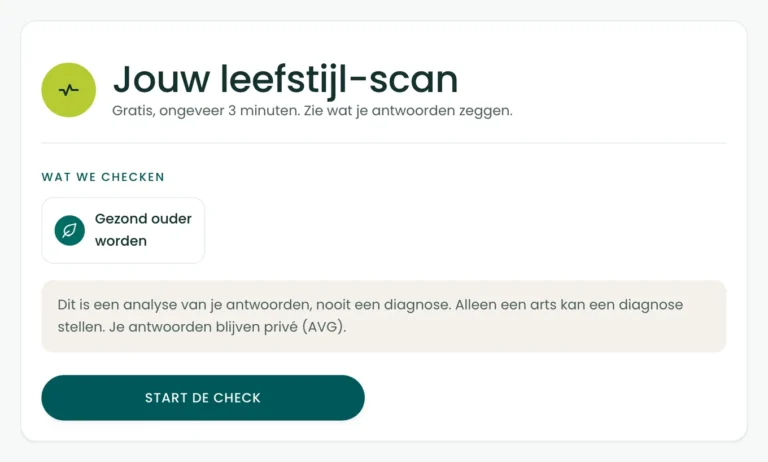
Five questions about your ordinary week, modelled on a validated dietary screener. You get a habit score from 0 to 100 with its reading band. An analysis of what you do, never a biological age.
Free
5 questions
About 3 minutes
Score from 0 to 100
Fill in your first name and email address, and your habit score is in your dashboard.
(and the scientifically supported reason why it is precisely these five)
You eat pretty well. You exercise, mostly. You once did a test that gave you a biological age, and that number was nice or not nice, and after that you did nothing with it, because what were you supposed to do with it. Somewhere you know you are doing well. Somewhere you also know you are not certain.
The difficult thing about ageing well is that it happens slowly and that the yardstick is missing. A blood value changes in months, a risk in years, and a feeling about how you live is exactly that: a feeling. Tests that derive your biological age from a questionnaire fill that gap with a number that is not there. BioProfile says so out loud: any biological age number that comes out of a questionnaire is marketing.
What can be measured is behaviour. Researchers who wanted to know who ages in good health counted habits: what you eat, how you deal with processed food, whether you follow your health and have it checked. Five questions about your ordinary week, added up into a score from 0 to 100. Not an age. A number instead. And a number is something you can set again a month from now.
A supplement against ageing. An expensive test that gives you an age. Intermittent fasting, a cold water bath, a book about blue zones. All understandable, and all of them start in the same place: with what you are going to do about it.
So after half a year you still do not know whether it did anything. You have recorded nowhere which habits you already had when you started, and habits are exactly the behaviour you no longer see because it is ordinary. Without a starting value, every improvement is a feeling about a feeling.
We analyse the real cause first
At BioProfile we turn the order around. First measure what is there now, with questions modelled on a screener that someone else has validated, and only then talk about what you do with it. Analyse first, advise after.
The lifestyle scan is the first step of that analysis, and the only one that adds your habits up instead of subtracting your complaints.
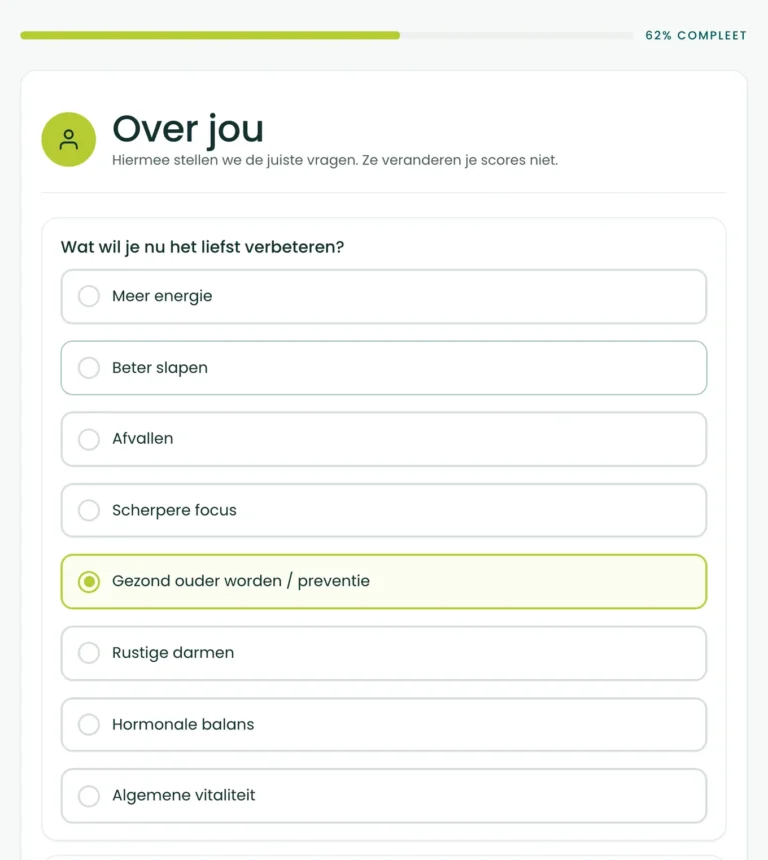
You start with eight short questions about yourself. They do not count towards your score; they make sure we can read the rest properly. One of them you may skip.
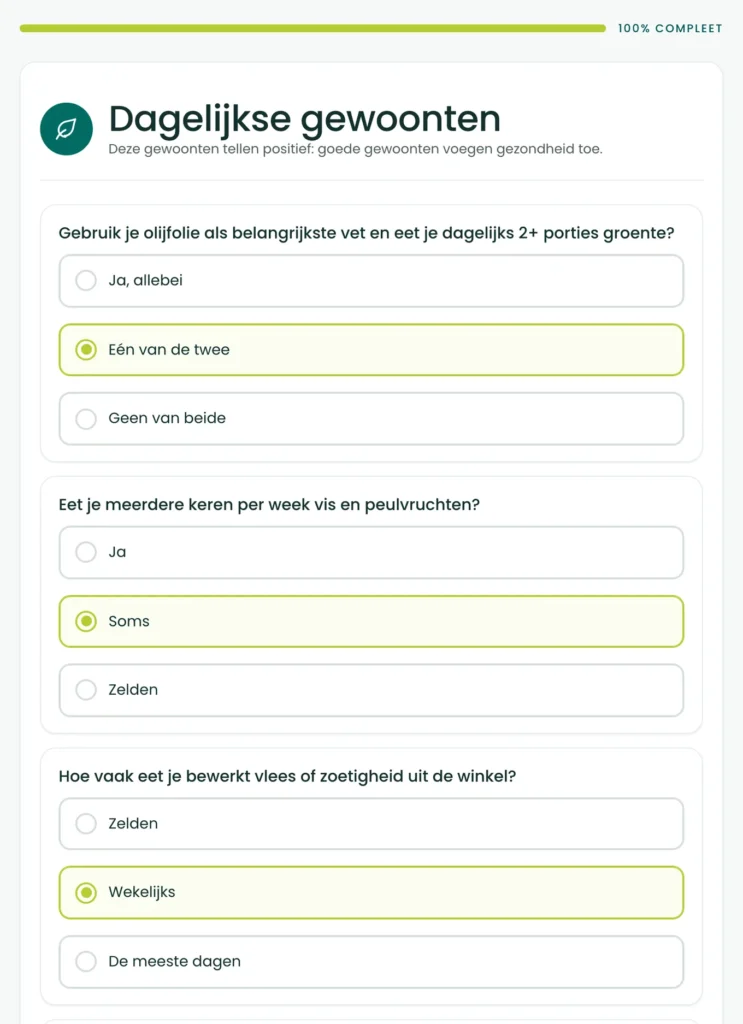
Then come the five habit questions, about your ordinary week: olive oil and daily vegetables, fish and pulses, processed meat and factory sweets, check-ups and screening, and whether you follow your own health. Each question has three answers, from no to yes.
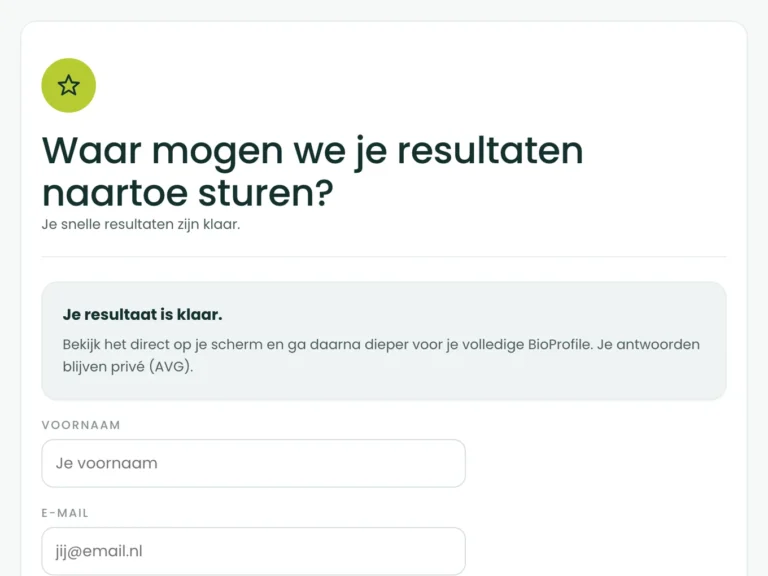
You fill in your first name and email address. You see a first picture straight away, and with a tap on your dashboard your habit score is on your screen, with the reading band alongside it. In your inbox there is a login link, so you can find your result again later and extend your scan into your full BioProfile.
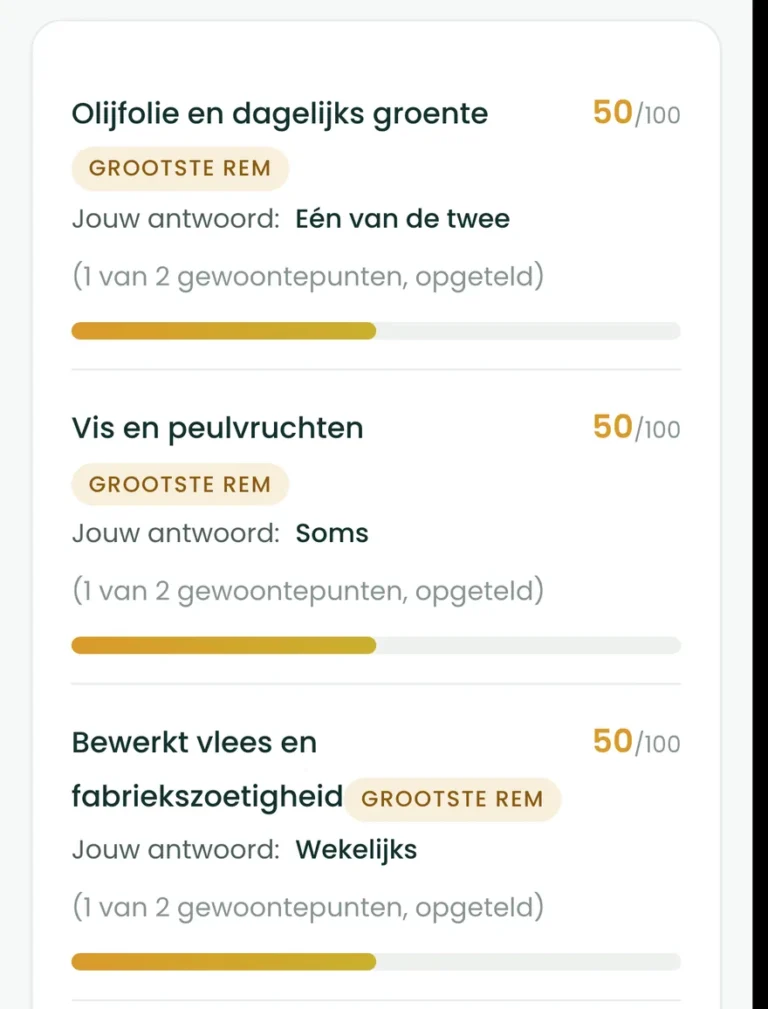
This is what is on your screen after about three minutes:
Repeat the scan in a month and you no longer have a feeling about how you live, but two numbers.
Fill in your first name and email address, and your habit score is in your dashboard.
Five questions about your ordinary week; for each question you choose the answer that comes closest to your habits.
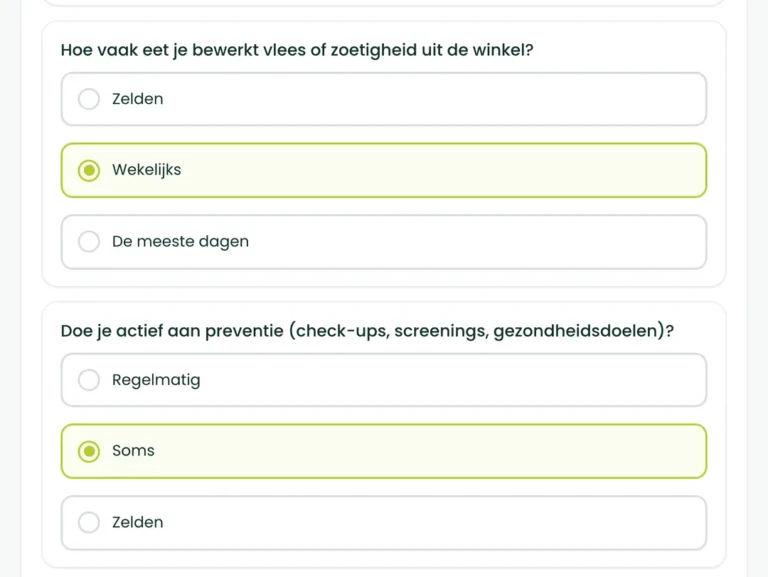
The lifestyle scan itself asks five habit questions on the model of the Mediterranean Diet Adherence Screener: three about food, two about how you handle your own health. The second card, the physical activity questionnaire, is the instrument on which your full BioProfile reads your movement; this scan of five questions does not ask about it itself.
modelled on
A 14-question screener that matches detailed food diaries at around 0.75 and, in follow-up research, is associated with a lower risk of cardiovascular disease, diabetes and mortality, where 9 or 10 and above counts as high adherence and 7 or lower as low. Our habit questions follow that structure, and that is why we score this area positively: good habits add up rather than count against you.
Modelled on, not validated as, this instrument.
Validated for: adherence to a Mediterranean dietary pattern.
modelled on
The standard questionnaire for self-reported physical activity, with a test-retest reliability around 0.80 but a criterion validity of only about 0.30 against an accelerometer. In plain words: people report consistently, but not very accurately. That is exactly why your answer about movement here sets down a direction and never a number we would call measured fitness.
Modelled on, not validated as, this instrument.
Validated for: self-reported level of physical activity.
This is the only area on the page that scores in the reverse direction. Every other score subtracts complaints; this one adds habits up, because the subject here really is behaviour and not how a system functions.
This is the only area in the risk class that can honestly reach average reliability on answers alone, and the reason is simple: the real subject is behaviour, and behaviour is exactly what self-reporting measures well. What it cannot do is give you your biological age, predict how long you will live, or measure whether those habits have already changed something inside. That needs blood values and years.
BioProfile scoring rules, measurement class D behaviour, reliability capped at average as a behaviour score.
Each of the five questions gets 0, 1 or 2 points, from habit absent to habit present. The points are added up and converted into a habit score from 0 to 100. Higher is better, and unlike the other scans this one adds up: every habit you already have is counted in your favour.
0 to 39
few supportive habits
40 to 59
partly in order
60 to 79
solid
80 to 100
strong
Reading bands, not clinical cut-off values. Your questions about healthy ageing are written in our own words and modelled on validated instruments, so no published cut-off value applies to exactly this score. Higher is always healthier.
This scan falls into measurement class D behaviour: the subject is what you do, and that is exactly what a questionnaire measures well, so the reliability of your score stands at average and stays there, even with blood values added. What those values do add is whether your habits have already changed something inside, and that you can have measured in your full BioProfile.
On your results screen that reliability appears as a label next to your score: average reliability, behaviour. That label is not a side remark; it tells you exactly how much weight you can put on the number.
This page describes a measuring instrument, so below you can read where that instrument comes from and what has been studied about it. Every claim points to the source it appears in.
Khaw and colleagues followed 20,244 Britons aged between 45 and 79 for eleven years and counted four habits: not smoking, being active, drinking moderately and five portions of fruit and vegetables. People with none of them were four times as likely to die as people with all four, a difference equivalent to fourteen years of age.1 Van den Brandt found the same pattern in the Netherlands Cohort Study among 120,852 people aged 55 to 69: from the least to the most healthy lifestyle the difference was 15 years for women and 8 years for men.2
Li and colleagues worked it out in 2018 for 123,000 Americans: with five favourable habits, life expectancy at age fifty was 14 years longer for women and 12 years longer for men.3 Loef and Walach pooled fifteen such studies, 531,804 people: four or more healthy habits went together with 66 per cent lower mortality.4 Ford found among 23,153 Germans that only about 9 per cent had all four habits.5
Over ten years of difference, and almost nobody counts their own habits. That is the reason this scan exists.
There is no questionnaire that measures your biological age. What a questionnaire does measure is behaviour, and that turns out to be exactly what counts: in Ford’s German study, people with four healthy habits were 78 percent less likely to develop a major chronic condition than people with none.5 In 2012 Lee and colleagues calculated that too little physical activity causes 9 percent of premature mortality worldwide, well over 5.3 million of the 57 million deaths in 2008.6
And the food on your plate: in 2017 Micha and colleagues attributed 45 percent of American cardiometabolic deaths to what people ate too much or too little of, with too much salt and too few nuts and seeds at the top.7 In 2019 the Global Burden of Disease study arrived at 11 million deaths a year worldwide from diet, with too much salt, too few whole grains and too little fruit as the largest items.8 That is why this scan asks about what you do, and not about how old you feel.
The Mediterranean Diet Adherence Screener counts fourteen questions and in 2011 was set against an extensive food questionnaire among 7,146 participants in the Spanish PREDIMED study: the scores correlated at 0.52, and a higher score went together with a higher HDL cholesterol and a lower BMI, waist circumference and fasting blood sugar.9 Martínez-González found among 7,447 participants that every two extra points went together with a smaller waist relative to height.10 The English version was validated again in 2018, and that is the source the analysis names.11
Our three food questions follow that structure: olive oil and vegetables, fish and pulses, processed meat and factory-made sweets. The other two questions are about how you handle your health. Our own words, not a copy, and the card above says so in as many words. For physical activity, your full BioProfile reads the International Physical Activity Questionnaire, which proved consistent across twelve countries (repeatability around 0.80) and not very accurate (validity around 0.30 against an accelerometer), which is exactly why an activity answer gives a direction and not a number.12,13
A low habit score means that habits which protect you in the research are missing. It does not mean your body is old, and it does not predict how long you will live. Sofi and colleagues showed in 2010 what Mediterranean eating does in cohort research: for every two points of closer adherence, 8 percent lower mortality and 10 percent fewer cardiovascular conditions.14 In 2018 Dinu combined thirteen meta-analyses of cohorts and sixteen of randomised studies, well over 12.8 million people: robust evidence for lower mortality and less of the major chronic conditions.15
And the fifth question, about check-ups and screening, deserves an honest note. In 2019 Krogsbøll and colleagues combined seventeen randomised studies with 251,891 people: general health checks in people without symptoms do not lower mortality.16 So a check does not protect you in itself; what you do with what you learn does. That is why the scan counts it as a habit, and not as protection.
Estruch and colleagues divided 7,447 Spaniards at high risk across three dietary patterns and followed them for almost five years. In 2018, after a reanalysis because some of the participants had not been randomised correctly, the result still stood: 31 percent fewer major cardiovascular events with olive oil and 28 percent fewer with nuts, compared with low-fat advice.17
That is a randomised study, and still not a promise about your body. What it does say: habits move, and what moves you can follow. An age from a questionnaire cannot do that; a habit score taken again a month later can.
This is what the scan rests on. Now for your habit score.
Fill in your first name and email address, and your habit score is in your dashboard.

This page was written by BioProfile. BioProfile sells health products and this scan is free: no purchase comes with it. The Mediterranean Diet Adherence Screener is not ours. That is why we ask our own five questions, modelled on that instrument, and nowhere call them a validated copy of it. And we do not print a biological age, because no questionnaire can give one.
Every source below was checked on the day this page was published. The numbering follows the text: source 1 is the first one the text refers to, and the two instruments the analysis reads on sit in between, at the point where they come up.
Five questions, about three minutes, and your habit score is in your dashboard. Your answers stay private (GDPR).
Fill in your first name and email address, and your habit score is in your dashboard.
What this does not say. This is not a biological age and not a prediction of lifespan. Real biological age asks for epigenetic clocks or biomarker panels, and any biological age number that comes out of a questionnaire is marketing. What this scores is preventive behaviour, which self-reporting can measure honestly, and which is worth measuring precisely because it is the part you decide.
BioProfile analyses your health status to guide you and your coach. It does not make a diagnosis, only a doctor can do that. Built on validated health questionnaires; the combined BioProfile score is not itself a validated clinical instrument yet. Your answers stay private (GDPR).