
In this article you will read which symptoms belong to the menopause, how long they last and what you can measure yourself. That matters, because when you know what belongs to it, you can place your symptoms better. You sleep worse, you are more easily irritated, your period does what it wants and you feel hot at moments when nobody else does. Menopause symptoms begin years before your last period, and the phase you are in is something you recognise not by a number in your blood but by your cycle. The BioProfile hormone scan measures how much these symptoms bother you, and gives you an indication of where you stand today in this area, as the first of the 11 health areas that the full scan assesses. This is not a diagnosis. It is insight, to see where you stand today. And to help you make better choices in your food and lifestyle. What this scan does not do: measure a hormone or make a diagnosis. Only a doctor can do the latter.
In short
- You recognise the menopause from your cycle, not from a blood value: the stage you are in follows from the pattern of your periods.1
- In more than half of women, hot flushes and night sweats last longer than seven years.2
- A hormone scan measures how much menopause symptoms are troubling you and gives you a baseline. It does not measure a hormone and it does not make a diagnosis.
Contents
Which symptoms belong to the menopause
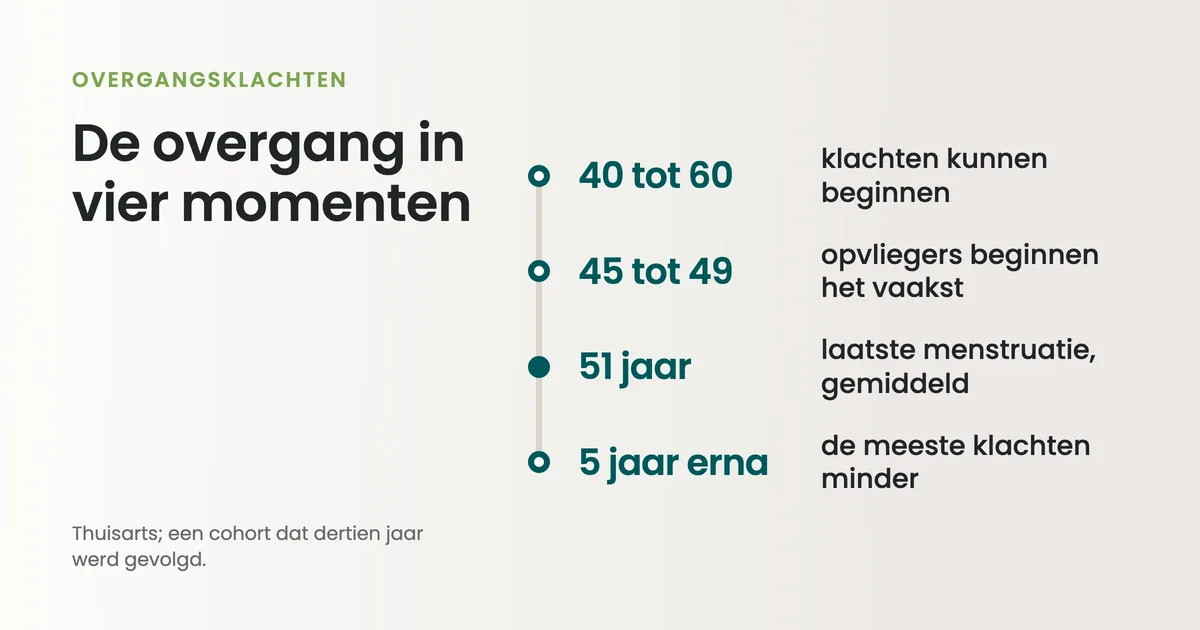
The last period falls on average at 51. Eight in ten women get hot flushes, about three in ten get vaginal symptoms, and most symptoms ease five years after the last period.3 The list that goes around is much longer, from palpitations to headache to fatigue, and there is a difference between what women report and what demonstrably moves with the stage.
Researchers who laid the population studies side by side found only three symptoms that clearly became more common in more than one study as the menopause progressed: hot flushes and night sweats, vaginal dryness and disturbed sleep. A minority of women report severe symptoms.4 Sleep is the symptom that costs the most during the day: 26 per cent of women in the menopause have sleep problems severe enough to get in the way during the day, and many hot flushes at night coincide with a measurable awakening.5
Why you recognise the phase by your cycle, not by a blood test
The system doctors and researchers use, the STRAW stages, reads the stage from your bleeding pattern: the early transition begins when the length of your cycle starts to vary persistently, the late transition when you skip sixty days or more. That system applies regardless of age, background, weight or lifestyle.1 Having blood taken to find out whether you are in the menopause makes no sense, says Thuisarts: that number is not reliable.3 The British guideline says the same with an age limit: in healthy women over 45 with the typical symptoms, the menopause is established from the symptoms and the cycle, without a laboratory test.6
How long menopause symptoms last
Longer than most people think. In the American SWAN study, 3,302 women were followed for up to seventeen years. Among the 1,449 women with frequent hot flushes or night sweats, the median duration of those symptoms was 7.4 years, and among the 881 of them whose last period was established during the study, the symptoms carried on for a median of 4.5 years after that. Those whose symptoms began early, before or at the start of the menopause, were at a median of more than 11.8 years; those whose symptoms only began after the last period, at 3.4 years.2 A second cohort, followed for thirteen years, came to a median of 10.2 years for moderate to severe hot flushes.7
What was linked to more frequent hot flushes, in 3,198 women over six years: above all the phase itself, with the late menopause as the peak, and alongside that smoking, a higher weight and anxiety symptoms at the start of the study.8 A link, not a cause, but they are the things that belong on the table in a conversation with a doctor.
What a hormone scan measures
The hormone scan starts with your life stage. Women in or around the menopause get four questions about the past few weeks: hot flushes or night sweats, vaginal dryness or discomfort, irritability or mood swings, and sleep that is disturbed by hormonal changes. Each question is given points, the points are converted into a hormone score from 0 to 100, with the reading band it falls into. Higher is better.
The questions are modelled on the Menopause Rating Scale, a questionnaire of eleven questions in three groups, physical, psychological and urogenital, which has been tested in nine countries on four continents and was found to measure the same thing everywhere.9 Our four questions follow that construct in our own words; they are not a copy of it, and the score is therefore not a validated clinical score. Women with a regular cycle do not get these questions, because the scale has not been validated for that.
What a hormone scan does not measure
Symptoms, never hormones. The scan can tell you nothing about your oestrogen, your testosterone or your thyroid, and “hormonal imbalance” as a general idea cannot be measured by any questionnaire at all. Only a blood test sees a hormone, and pronounced symptoms are the reason to ask for one. A hormone scan does not make a diagnosis. A low score means that looking further is worthwhile, and nothing more.
Four things are a reason to make an appointment with your GP: very heavy bleeding, symptoms before you turn forty, bleeding more than a year after your last period, and a lot of trouble from hot flushes.3
What you do with your score
A score today is your baseline. Repeat the scan in a few weeks, over the same questions, and you know whether things are better, worse or the same, in a stage that lasts years and in which your memory otherwise tells a different story every week.
Pay attention to your nights in this. Among 52 women measured at home over four full days and nights, the hot flushes they remembered in the morning were linked to worse sleep; the hot flushes that the skin sensor recorded but that they had not noticed barely were.10 So what you notice yourself is exactly what counts for how your day goes, and that is exactly what a questionnaire records.
Measure where you start
Four questions for women in or around the menopause, about three minutes, and your hormone score is in your dashboard. What the hormone scan measures and what it is based on is on the scan page.
Free, about 3 minutes. An analysis of your answers, never a diagnosis. All health scans
Frequently asked questions
At what age do menopause symptoms start?
The last period falls on average at 51, and the symptoms can start when you are between 40 and 60.3 In a cohort followed for thirteen years, moderate to severe hot flushes began most often between 45 and 49.7
What are the first symptoms of the menopause?
A cycle that becomes irregular: the stage is read from that.1 Beyond that, three symptoms in particular change measurably with the stage: hot flushes and night sweats, vaginal dryness and disturbed sleep.4
Can I test whether I am in the menopause?
Not with blood: that number is not reliable, Thuisarts says.3 In women over 45 with the typical symptoms, a doctor establishes it from the symptoms and the cycle, without a laboratory test.6 A questionnaire measures how much they bother you; the phase is something a doctor reads from your cycle.
When do I go to the GP with menopause symptoms?
With very heavy bleeding, with symptoms before you turn forty, with bleeding more than a year after your last period, and if hot flushes are troubling you a lot.3
Sources
Every source below was checked on the day this article was published. The numbering follows the text.
- Harlow SD, Gass M, Hall JE, et al. Executive summary of the Stages of Reproductive Aging Workshop + 10: addressing the unfinished agenda of staging reproductive aging. Menopause, 2012. doi.org/10.1097/gme.0b013e31824d8f40
- Avis NE, Crawford SL, Greendale G, et al. Duration of menopausal vasomotor symptoms over the menopause transition. JAMA Internal Medicine, 2015. doi.org/10.1001/jamainternmed.2014.8063
- Thuisarts.nl (Nederlands Huisartsen Genootschap). Ik ben in de overgang. thuisarts.nl
- Woods NF, Mitchell ES. Symptoms during the perimenopause: prevalence, severity, trajectory, and significance in women’s lives. The American Journal of Medicine, 2005. doi.org/10.1016/j.amjmed.2005.09.031
- Baker FC, de Zambotti M, Colrain IM, Bei B. Sleep problems during the menopausal transition: prevalence, impact, and management challenges. Nature and Science of Sleep, 2018. doi.org/10.2147/NSS.S125807
- National Institute for Health and Care Excellence. Menopause: identification and management. NICE guideline NG23. nice.org.uk
- Freeman EW, Sammel MD, Lin H, Liu Z, Gracia CR. Duration of menopausal hot flushes and associated risk factors. Obstetrics and Gynecology, 2011. doi.org/10.1097/AOG.0b013e318214f0de
- Gold EB, Colvin A, Avis N, et al. Longitudinal analysis of the association between vasomotor symptoms and race/ethnicity across the menopausal transition: Study of Women’s Health Across the Nation. American Journal of Public Health, 2006. doi.org/10.2105/AJPH.2005.066936
- Heinemann K, Ruebig A, Potthoff P, et al. The Menopause Rating Scale (MRS) scale: a methodological review. Health and Quality of Life Outcomes, 2004. doi.org/10.1186/1477-7525-2-45
- Thurston RC, Santoro N, Matthews KA. Are vasomotor symptoms associated with sleep characteristics among symptomatic midlife women? Comparisons of self-report and objective measures. Menopause, 2012. doi.org/10.1097/gme.0b013e3182422973
Written by

BioProfile analyses your health status to guide you and your coach. It does not make a diagnosis, only a doctor can do that. Built on validated health questionnaires; the combined BioProfile score is not itself a validated clinical instrument yet. Your answers stay private (GDPR).