

In short
- Australian university staff who learned transcendental meditation scored clearly lower on perceived stress over six months than colleagues who kept the usual wellbeing provisions.1
- The meditation group also did better on anxiety, low mood, burnout, sleep quality, wellbeing and quality of life, and no adverse effects were reported.1
- Everyone knew which group they were in, the study ran at a single university, and the comparison was not with another activity but with the usual support. So the study does not show how meditation compares with other ways of unwinding.1
- In the Netherlands in 2025, 21 per cent of employees felt mentally fatigued by their work a few times a month or more often.2
Contents
- When the day keeps running in your head
- You are in good company
- Why stress lingers, and where the knowledge stopped
- What researchers in Melbourne tested with transcendental meditation
- Why the comparison group is at the heart of this result
- What the study did and did not show
- Where you could start
- Frequently asked questions
When the day keeps running in your head
You open your work inbox before the coffee is even ready, and the day has started without you. Meetings run into one another, the task you had planned for the morning waits until the afternoon, and the afternoon ends with a list that is longer than when you started. On the way home, your thoughts are still at your desk, far from a quiet moment or anything like transcendental meditation. In the evening you sit on the sofa, tired and restless at the same time, and when you lie down, your mind replays the conversation you wish you had handled differently. The next morning you start again, a little less rested.
Nothing about that day is dramatic. That is exactly why it is easy to carry on for weeks and months without asking yourself what it is costing you, or whether something you do in a quiet moment could make a difference.
You are in good company

Work stress is not something you need to blame yourself for. In the Netherlands, CBS reports that 15 per cent of employees had a stressful job in 2025, with high work pressure and little autonomy in their work.3 In the same year, CBS found that 21 per cent of employees felt mentally exhausted by their work a few times a month or more.2 According to the RIVM’s Monitor Mentale Gezondheid, published in 2026 and based on the Nationale Enquête Arbeidsomstandigheden by CBS and TNO, 20.7 per cent of employees aged 15 to 74 have burnout symptoms.4
This is not a story that stops at the Dutch border. In Germany, Destatis reports that 25 per cent of workers felt exposed to psychological strain in 2020.5 In the United Kingdom, the Office for National Statistics reported in June 2026 that 23.6 per cent of adults experienced a high level of anxiety.6
Where you stand yourself is a different question from where a country stands. The BioProfile stress scan gives you an indication of how much stress you are carrying today. The scan is not a diagnosis but an indication, and it does not point to a cause.
Why stress lingers, and where the knowledge stopped
The CBS definition already points to one source. A job counts as stressful when high work pressure goes together with little room to decide for yourself how you do the work.3 Pressure on its own is part of many jobs; it is the combination with little say over your own work that the statisticians single out. The researchers behind the new study describe ongoing psychological stress as a major public health problem, with consequences for mental health, for quality of life and for how well people function at work.1 You can read what ongoing stress can look like in your own body in our article on the signs of chronic stress.
Meditation has been studied for years as one of the answers. A review of 47 studies by researchers at Johns Hopkins concluded that meditation programmes can bring small to moderate improvements in several negative aspects of psychological stress.7 The picture was mixed, though. For mindfulness programmes, the evidence for less anxiety was moderate, the evidence for less stress and a better quality of life was low, and for sleep the evidence was insufficient.7
Transcendental meditation in particular had been tested at work before. An open study of 80 healthcare workers at Duke, an American academic medical centre, ran during the pandemic. After 3 months of meditation, the main measure of acute psychological distress was not clearly lower than in the control group. The meditation group did, however, do clearly better on emotional exhaustion, anxiety and insomnia.8
That is where the knowledge stopped. According to the authors of the new study, evidence that follows people in a workplace over the long term was limited.1
What researchers in Melbourne tested with Transcendental Meditation
On 23 September 2026, the journal Journal of Affective Disorders published a randomised study from Melbourne, Australia, on Transcendental Meditation among university staff.1 The paper lists seven authors. Khanal MK, Saunders P, Nguyen K and Hallam KT are affiliated with the School of Health and Biomedical Sciences, RMIT University, Melbourne. Karimi L is affiliated with the same RMIT school and with the School of Medicine and Healthcare Management, Caucasus University, Tbilisi, Georgia. Lee K is affiliated with Monash University, Melbourne. De Courten B is also affiliated with the RMIT school, with the Department of Medicine, School of Clinical Sciences at Monash Health, Monash University, Melbourne, and with Monash Health in Clayton.
The design is simple to describe. University staff were divided into two groups by drawing lots. One group learned transcendental meditation in a five-day training course and then practised the method regularly. The other group kept the university’s usual wellbeing provisions. Both groups were followed for six months.1
Why does that matter to you? The name of the method matters less than the setting. The people in this study were not recruited in a clinic. They were colleagues in their own workplace, with the same kind of ordinary day as the one at the start of this piece. What is more, the participants were not compared with doing nothing, but with what many employers already offer: the usual wellbeing support. Something that adds a difference people can feel on top of that, over half a year, is relevant to anyone whose stress starts at work.
Why the comparison group is the heart of this result
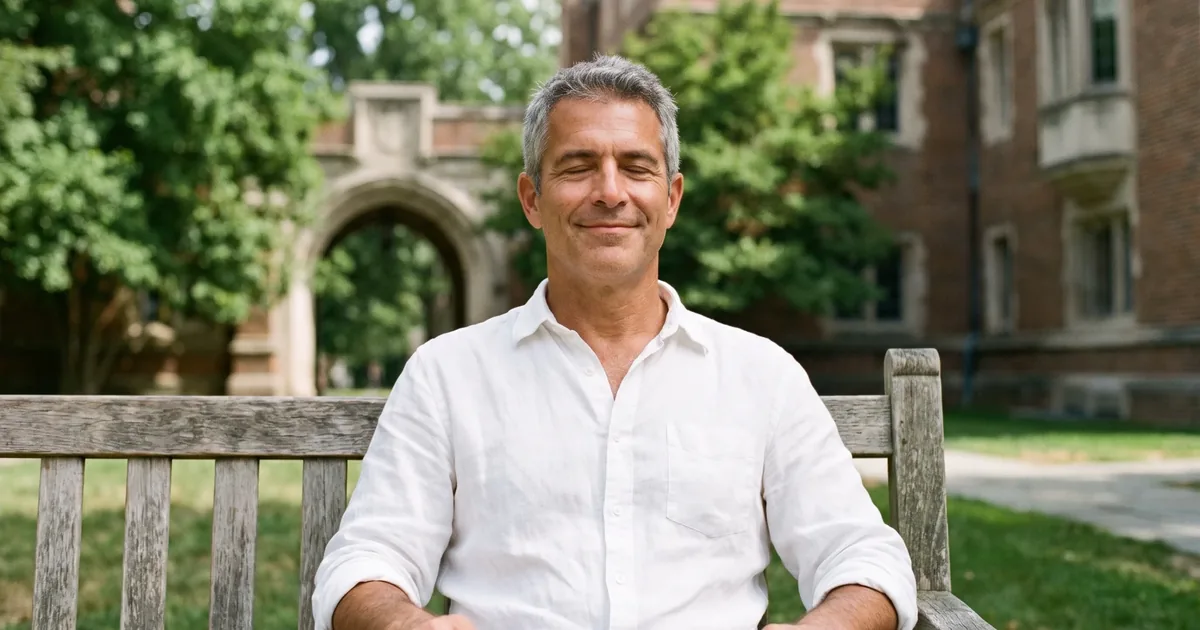
If you feel calmer after starting something new, it is hard to know what made the difference. Stress rises and falls on its own: a busy period ends, a holiday comes along, a project is finished. If you only measure the people who meditate, part of any improvement may simply be the passing of time. The study divided the staff into two groups by drawing lots and followed both groups over the same six months.1 Chance decided who ended up where, so both groups went through the same university, the same calendar and the same busy and quiet weeks. The meditation was the only difference between the groups.
The main measure was perceived stress: how stressful people themselves find their lives. No blood or saliva is involved. It is your own assessment of the strain you are under, and that is also why this measure matters. It is not a number from a lab, but the stress you live with.
Take two colleagues in the same department. One is drawn by lot for the meditation group, spends five days learning the method and keeps practising afterwards. The other carries on with what the university already offered. If the end of the semester makes things easier for both of them, both of their stress scores improve. Only the difference between the two groups tells you something about the meditation. That difference is what the researchers report: over six months, the meditation group scored clearly lower on perceived stress than the control group, a difference the authors call moderate.1
Even a fair comparison has its limits. In this study, everyone knew who was in which group.1 Imagine you have just spent five days learning a method that is meant to make you calmer. When you are later asked how stressed you feel, that knowledge can colour your answer, even with the best of intentions. A colleague in the control group, who was offered nothing new, may answer differently for the same reason. The authors themselves write that studies with an active comparison are needed.1
The same reasoning applies to the finding about practice. In an exploratory analysis, staff who meditated twice a day had better scores on stress, wellbeing, quality of life, low mood and burnout.1 That comparison was not decided by chance. People who manage to meditate twice a day may also be people with a little more room in their day, and the analysis cannot separate the two.
Testing meditation in the place where the stress arises is what links this study to the earlier study of healthcare workers at Duke.8 The senior author of that study described the circumstances like this:
We carried out this research at the height of the pandemic, when being placed in situations of great stress and uncertainty was an everyday reality for our medical colleagues.
Patty J. Lee, professor of medicine, cell biology and pathology; senior author of the study on transcendental meditation among healthcare workers, Duke University School of Medicine9
Two workplaces, two kinds of pressure, and in both cases the question was the same: does a practice that people learn and keep up make a difference in the place where their stress comes from?
What the study did and did not show
Who took part: 129 staff members from one Australian university, 65 in the meditation group and 64 in the control group. Their perceived stress, anxiety symptoms, low mood, burnout at work, poor sleep, wellbeing, health-related quality of life and lost productivity were measured at the start, after 3 months and after 6 months.1
What the study showed: besides lower perceived stress, the meditation group did better on anxiety, low mood, burnout, sleep quality, wellbeing and quality of life.1 The authors conclude that the method is worth considering as a safe workplace strategy for mental health.1
What the method is, as far as the article covers it: a standardised meditation, so that everyone learns the same method.1 In the study, it was not a method staff picked up on their own. The staff learned the method in a five-day course and then practised it regularly. The study did not test whether people who teach themselves the method get the same result.
Is the method risky? No adverse effects were reported in this study.1 That is reassuring for these 129 staff members, but one study at one workplace is a narrow basis for a statement about everyone.
What the study did not show: everyone knew which group they were in, the study ran at one university, and the comparison was not with another activity but with the usual support. The authors write that studies are needed that use an active comparison and follow people for longer.1 Lost productivity was measured, but the abstract gives no result for it. The abstract also does not say how old the staff were, how many men or women took part or what kind of work the staff did. The abstract is the only text of the article we have read, so anything beyond it is not in this piece.
Where you could start

First: look at the shape of your own workload. CBS calls a job stressful when high work pressure comes together with little room to decide how you do the work.3 It can help to notice which of the two weighs more heavily in your week, because work pressure and control call for different conversations: one about how much, the other about how.
Second: if a calm, regular practice appeals to you, keep in mind what this study tested: a method that was taught and then kept up for months, alongside the support people already had.1 The study does not say which method suits you, and says nothing against other ways of finding calm.
What remains open is how much stress you are carrying right now, and whether that changes once you change something. That starts with knowing where you stand today, and the measurement for that follows below.
See where your stress stands today
A short set of questions about how you have been feeling lately, and your stress score appears in your dashboard. You can read what the stress scan measures, and what the scan is based on, on the scan page.
Free, about 3 minutes. An analysis of your answers, never a diagnosis. All health scans
Frequently asked questions
What is Transcendental Meditation?
A standardised form of meditation, so everyone learns the same method. In the Australian study, staff learned the method in a five-day training course and then practised it regularly.1 The study’s summary does not describe the technique itself.
Can you learn transcendental meditation on your own?
The study did not test that. The staff in the meditation group did not teach themselves the method: they took a five-day training course and kept practising afterwards.1 Whether people who teach themselves the method get the same result is an open question.
Is transcendental meditation dangerous?
In this study of 129 university staff, who were followed for six months, no adverse effects were reported.1 That is one study at one workplace, so it is a narrow basis for a statement about everyone.
What is the difference between meditation and Transcendental Meditation?
Meditation is a broad family of practices. A review of 47 studies of meditation programmes found small to moderate improvements in several negative aspects of psychological stress.7 Transcendental meditation is one standardised form within that family, and the new study looked only at that form.1
When should I see my GP about stress?
If stress lingers and you feel overstrained, Thuisarts, the information site of Dutch GPs, says that your GP or the practice nurse can help you get better, and that your GP can refer you to a psychologist if you need more help.10
Sources
Every source below was checked on the day this article was published. The numbering follows the text.
- Khanal MK, Karimi L, Saunders P, Nguyen K, Lee K, Hallam KT, de Courten B. Effects of transcendental meditation on mental health and work productivity among university staff in Australia: A randomised controlled trial. Journal of Affective Disorders, 416, 2026. doi.org/10.1016/j.jad.2026.122555
- CBS. De arbeidsmarkt in cijfers 2025: Arbeidsomstandigheden. Centraal Bureau voor de Statistiek, 2026. longreads.cbs.nl
- CBS. De arbeidsmarkt in cijfers 2025: Arbeidsomstandigheden. Centraal Bureau voor de Statistiek, 2026. longreads.cbs.nl
- RIVM. Burn-out klachten (Monitor Mentale Gezondheid, working people; data: Nationale Enquête Arbeidsomstandigheden, CBS and TNO). Rijksinstituut voor Volksgezondheid en Milieu, 2026. rivm.nl
- Destatis. Gefährdung durch Stress am Arbeitsplatz. Statistisches Bundesamt, 2026. destatis.de
- ONS. Beyond GDP insights, UK measures of National Well-being: June 2026. Office for National Statistics, 2026. ons.gov.uk
- Goyal M, Singh S, Sibinga EM, Gould NF, Rowland-Seymour A, Sharma R, Berger Z, Sleicher D, Maron DD, Shihab HM, Ranasinghe PD, Linn S, Saha S, Bass EB, Haythornthwaite JA. Meditation programs for psychological stress and well-being: a systematic review and meta-analysis. JAMA Internal Medicine, 2014. doi.org/10.1001/jamainternmed.2013.13018
- Joshi SP, Wong AI, Brucker A, Ardito TA, Chow SC, Vaishnavi S, Lee PJ. Efficacy of Transcendental Meditation to Reduce Stress Among Health Care Workers: A Randomized Clinical Trial. JAMA Network Open, 2022. doi.org/10.1001/jamanetworkopen.2022.31917
- Patty J. Lee, Professor of Medicine, Duke University School of Medicine. Study Identifies Meditation as Potential Strategy for Reducing Healthcare Worker Burnout. Duke University School of Medicine, 2022. medschool.duke.edu
- Thuisarts.nl (NHG). Ik ben overspannen. Hoe word ik beter? Thuisarts, 2025. thuisarts.nl
Quotations from English have been translated by BioProfile.
BioProfile analyses your health status to guide you and your coach. It does not make a diagnosis, only a doctor can do that. Built on validated health questionnaires; the combined BioProfile score is not itself a validated clinical instrument yet. Your answers stay private (GDPR).