
In this article you will read what your body notices of low-grade inflammation, what only your blood knows and what you can measure yourself. That matters, because it tells you which symptoms you can follow yourself and what only a blood test shows. You recover more slowly than you used to, you are still tired for weeks after every cold, and you have pain and stiffness without having done anything heavy. Then on the internet you soon come across the words low-grade inflammation, and it sounds like something you can feel. It is not: it is a value in your blood. The recovery scan from BioProfile measures how much these symptoms bother you, and gives you an indication of where you stand today in this area, as the first of the 11 health areas the full scan assesses. This is not a diagnosis. It is insight, to see where you stand today. And to help you make better choices in your diet and lifestyle. What this scan does not do: measure your inflammation or make a diagnosis. Only a doctor can do the latter, and only blood the former.

Verified by Justinas Šlikas, PhD
PhD in chemistry from the University of Edinburgh
Checked on 29 September 2026
In short
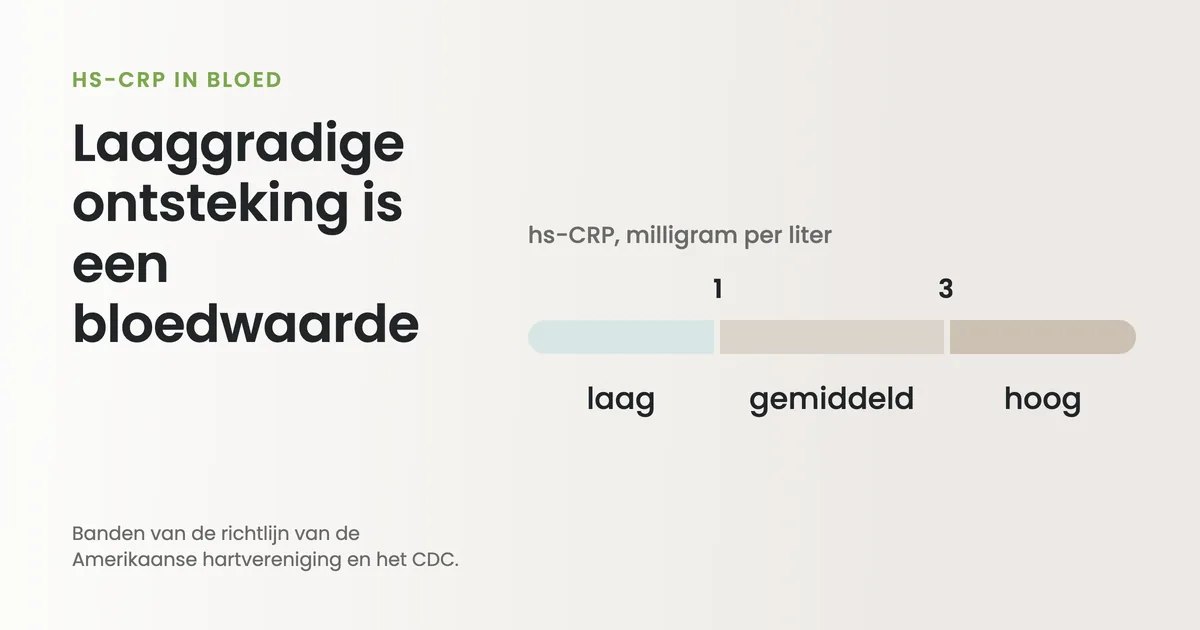
- Low-grade inflammation is a blood measure: high-sensitivity CRP, where under 1 milligram per litre counts as low, 1 to 3 as average and above 3 as high.1
- Sleeping badly, ongoing stress, little exercise and eating too much each go together measurably with higher inflammation values.2
- The recovery scan measures how you recover, how often things hurt and which way your food leans. It is a proxy, not an inflammation score, and it does not make a diagnosis.
Contents
What low-grade inflammation is
A short, fierce inflammation is exactly what you want: without it you survive no wound and no infection. The problem is the other form, a low, ongoing inflammatory activity throughout the whole body that stays for months or years. That form is fuelled by infections, little movement, poor food, harmful substances from the environment and psychological stress, and it plays a part in the major chronic diseases that together cause more than half of all deaths worldwide.2
Two things feed it most often. The first is age: as you grow older a chronic, sterile, low-grade inflammation develops, and the gut microbiome plays a central role in it.3 The second is eating too much: immunity and metabolism have become so interwoven in evolution that an overloaded metabolism pulls the immune system along with it, and the other way round.4 The researchers who described the ageing form therefore call the overfeeding form the same mechanism with a different trigger.3
What your body feels of it
Nothing specific, and that is the difficult part. What your body does report when there is inflammatory activity is sickness behaviour: the substances your immune system makes act on your brain and leave you tired, withdrawn and listless, with less appetite for food. If the activity continues, in sensitive people that can tip over into low mood.5 Exactly that same list belongs with sleeping badly, with stress and with an ordinary busy month, and that is why you cannot read from your symptoms whether something is going on in your blood.
What only your blood knows
The measure is high-sensitivity C-reactive protein, hs-CRP for short. The joint guideline of the American Heart Association and the CDC divides the value into three bands: below 1 milligram per litre low, 1 to 3 average, above 3 high. The value is measured twice, about two weeks apart, and a result above 10 points to an acute cause, such as an infection, which has to be looked for first.1
Why that value matters was shown by a study of 28,263 healthy women after the menopause. Of twelve substances measured, hs-CRP was the strongest predictor of problems with the heart and blood vessels in the three years that followed: the women in the highest quarter had a risk 4.4 times as high as the women in the lowest quarter, even when their cholesterol was low.6
What it is linked to
Sleep is the first. In a meta-analysis of 72 studies with more than 50,000 people, disturbed sleep went together with a higher CRP and a higher interleukin-6; strikingly, a few nights of deliberate sleep shortage in the laboratory did not.7 So it is about the pattern, not about one bad night. Stress is the second: in thirty laboratory studies two inflammatory substances rose measurably after an acute stress task, while the change in CRP was small and not statistically clear.8 Moving is the third, and it works the other way. In 83 controlled studies with 3,769 participants, CRP fell after a period of training, most in the people whose body fat also went down, but also in the people whose weight did not go down.9
What a recovery scan measures
The recovery scan asks three questions about your ordinary weeks: how quickly you recover after exertion or illness, how often you have unexplained pain or stiffness, and how often you have heavily processed food and sugary drinks. The answers are converted into a recovery proxy from 0 to 100, with the reading band it falls in. Higher is better.
The word proxy is there on purpose. The question about food is a tendency and not a measurement: the most important published index in this field scores the inflammation-promoting potential of a dietary pattern, not the inflammation in a person, and it requires a full dietary history.10 The three questions are worded by us, the row is deliberately capped at low reliability on the basis of answers alone, and an hs-CRP value lifts it further than any number of extra questions can.
What a recovery scan does not measure
Nowhere in the literature is there a validated self-report questionnaire for systemic inflammation. So the recovery scan is not an inflammation score, and we do not call it one; it does not give a diagnosis. What it measures are real things about your week: how quickly you recover, how often things hurt and which way your daily food leans. It is not a window on your blood. Pain or stiffness that keeps going, a fever, or your weight going down without a reason are a conversation with a doctor, and that is where you ask for the blood value.
What you do with your score
A score today is your starting value. Repeat the scan in a few weeks, over the same three questions, and you have two numbers instead of a feeling about how you recover. The three things that are linked to the blood value are the three things you can change yourself: the pattern of your nights,7 how much you move,9 and how much you eat.3 If you want to know where your sleep stands, why you wake up tired is the place. And if you want to turn the proxy into a result, ask your GP for an hs-CRP.
Measure where you start
Three questions about how you recover, how often things hurt and which way your food leans, about three minutes, and your recovery proxy is in your dashboard. What the recovery scan measures and what it is based on is on the scan page.
Free, about 3 minutes. An analysis of your answers, never a diagnosis. All health scans
Frequently asked questions
What are the symptoms of low-grade inflammation?
There is no complaint that belongs to it specifically. What your body reports during inflammatory activity is sickness behaviour: tired, withdrawn, less appetite, slow recovery.5 That same list also belongs to sleeping badly and to stress, and that is why only blood can tell the difference.
How do you test for low-grade inflammation?
With a blood test for high-sensitivity CRP, at your GP. The guideline from the American Heart Association and the CDC has the value measured twice, about two weeks apart, and reads a value above 10 milligrams per litre as an acute cause that has to be looked for first.1
What is a low-grade inflammation value?
A CRP that is slightly raised and stays that way: 1 to 3 milligrams per litre is average, above 3 high, and that without an infection or injury to explain it.1
Can a questionnaire measure low-grade inflammation?
No. There is no validated questionnaire for inflammation in the blood. The recovery scan measures three things you can report yourself, recovery, pain and eating pattern, calls that a proxy and makes no diagnosis.
Sources
Every source below was checked on the day this article was published. The numbering follows the text.
- Pearson TA, Mensah GA, Alexander RW, et al. Markers of inflammation and cardiovascular disease: application to clinical and public health practice. A statement for healthcare professionals from the Centers for Disease Control and Prevention and the American Heart Association. Circulation, 2003. doi.org/10.1161/01.CIR.0000052939.59093.45
- Furman D, Campisi J, Verdin E, et al. Chronic inflammation in the etiology of disease across the life span. Nature Medicine, 2019. doi.org/10.1038/s41591-019-0675-0
- Franceschi C, Garagnani P, Parini P, Giuliani C, Santoro A. Inflammaging: a new immune-metabolic viewpoint for age-related diseases. Nature Reviews Endocrinology, 2018. doi.org/10.1038/s41574-018-0059-4
- Hotamisligil GS. Inflammation and metabolic disorders. Nature, 2006. doi.org/10.1038/nature05485
- Dantzer R, O’Connor JC, Freund GG, Johnson RW, Kelley KW. From inflammation to sickness and depression: when the immune system subjugates the brain. Nature Reviews Neuroscience, 2008. doi.org/10.1038/nrn2297
- Ridker PM, Hennekens CH, Buring JE, Rifai N. C-reactive protein and other markers of inflammation in the prediction of cardiovascular disease in women. New England Journal of Medicine, 2000. doi.org/10.1056/NEJM200003233421202
- Irwin MR, Olmstead R, Carroll JE. Sleep disturbance, sleep duration, and inflammation: a systematic review and meta-analysis of cohort studies and experimental sleep deprivation. Biological Psychiatry, 2016. doi.org/10.1016/j.biopsych.2015.05.014
- Steptoe A, Hamer M, Chida Y. The effects of acute psychological stress on circulating inflammatory factors in humans: a review and meta-analysis. Brain, Behavior, and Immunity, 2007. doi.org/10.1016/j.bbi.2007.03.011
- Fedewa MV, Hathaway ED, Ward-Ritacco CL. Effect of exercise training on C reactive protein: a systematic review and meta-analysis of randomised and non-randomised controlled trials. British Journal of Sports Medicine, 2017. doi.org/10.1136/bjsports-2016-095999
- Shivappa N, Steck SE, Hurley TG, Hussey JR, Hébert JR. Designing and developing a literature-derived, population-based dietary inflammatory index. Public Health Nutrition, 2014. doi.org/10.1017/S1368980013002115
Written by

BioProfile analyses your health status to guide you and your coach. It does not make a diagnosis, only a doctor can do that. Built on validated health questionnaires; the combined BioProfile score is not itself a validated clinical instrument yet. Your answers stay private (GDPR).