
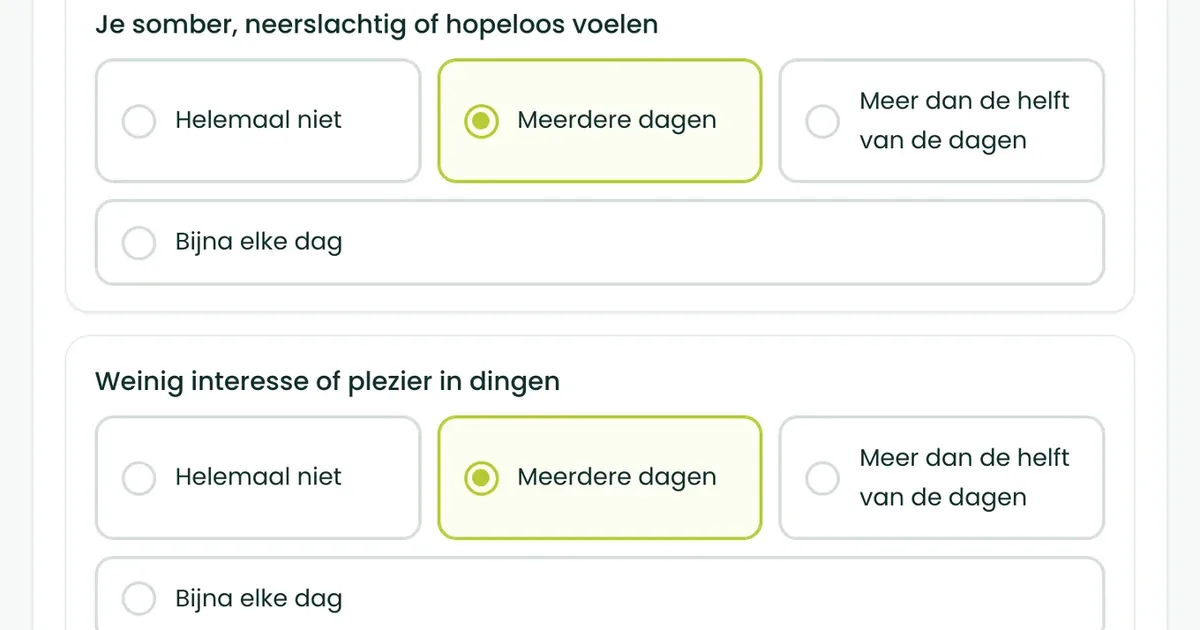
In this article you read what research says about whether a vitamin D deficiency causes mental health symptoms, such as low mood, depression and anxiety. You read what Dutch studies in older people found, what happened when people took extra vitamin D and what Dutch GPs advise. This matters, because low mood is hard to live with, and a vitamin D supplement is quick to reach for. Knowing what vitamin D can and cannot do helps you put your energy where it counts. BioProfile’s lifestyle scan asks about your mood and about worrying, among other things, and gives you an indication of where you stand today. The scan is not a diagnosis. It is self-insight, to see where you stand and to help you make better choices in your diet and lifestyle. The scan does not measure your vitamin D level and does not point to the cause of a symptom. That is work for a doctor.

In short
- Dutch GPs are clear: depression and tiredness are not caused by too little vitamin D.1
- In Dutch older adults, a low mood and a low vitamin D level often go together, but the studies cannot say which comes first.2
- On average, extra vitamin D lowered depressive symptoms a little, but in 18,353 adults aged 50 and over without depression it did not change how often depression developed.3,4
- The lifestyle scan gives you insight into your mood and into worrying. The scan is not a diagnosis.
Contents
Does a vitamin D deficiency cause mental health symptoms?
Thuisarts, the public website of the Nederlands Huisartsen Genootschap, puts it clearly: depression, tiredness, dizziness, dementia and autism are not caused by too little vitamin D.1 Depression is something other than a bad week. It means a low feeling, or much less interest in things and much less enjoyment, almost every day, for longer than two weeks, often with tiredness, difficulty concentrating, or changes in appetite or sleep.5
Even so, the link between vitamin D and mood keeps coming up, because studies do find one. The question is what kind of link it is.
What Dutch studies in older people found
The Longitudinal Aging Study Amsterdam measured the vitamin D in the blood of 1,282 people aged 65 to 95 who were living at home. People with mild depression and people with severe depression had about 14 per cent less vitamin D in their blood than people without depression, and the heavier the symptoms, the lower the vitamin D. The study shows that the two go together. It does not show which comes first.2
A second Dutch study in 2,839 adults aged 65 and over found the same pattern. The quarter with the least vitamin D in their blood scored highest for depressive symptoms, and the other three quarters scored slightly lower. The authors themselves point out that it could also work the other way round: a lower mood can lead to a lower vitamin D level.6
Put simply: older adults with a low mood often have less vitamin D, but these studies cannot tell you that the mood was caused by the vitamin D.
A third Dutch study followed 367 people aged 60 and over who already had depression, for two years. Their vitamin D level at the start made no difference to how the depression developed. Only in the group with a very low level, below 25 nmol/L, was there a trend towards less recovery. People who died during the study had clearly lower levels, and the researchers saw a low level as a sign of weaker physical condition in general.7
What this means for you: a low vitamin D level may say more about the state of your whole body than about your mood alone. How old your body is can differ from what the calendar says, as biological age versus calendar age explains.
What extra vitamin D does for your mood
A review of 31 randomised trials with 24,189 adults, with and without depression, found that extra vitamin D3 lowered depressive symptoms slightly more than a placebo. The researchers rated the certainty of that result as moderate. The drop was larger in people who already had depressive symptoms, and clearer in trials of up to 24 weeks than in longer trials. Extra vitamin D made no clear difference to anxiety.3
A large trial, VITAL-DEP, gave 18,353 adults aged 50 and over without depression either 2,000 IU of vitamin D3 or a placebo every day for about five years. Depression or clear depressive symptoms occurred about equally often in the vitamin D group and the placebo group: 609 times with vitamin D and 625 times with placebo. Mood scores changed in one group just as they did in the other.4
The Dutch D-Vitaal trial gave 155 people aged 60 to 80 with depressive symptoms, a physical limitation and a fairly low vitamin D level either 1,200 IU of vitamin D3 or a placebo every day for a year. After six months, the level in the vitamin D group was about twice as high as in the placebo group, on average 85 versus 43 nmol/L. Even so, after a year the groups did not differ in depressive symptoms, anxiety, thinking or quality of life.8
Put simply: extra vitamin D can lower depressive symptoms a little, especially in people who already have those symptoms. In people without depression, extra vitamin D did not change how often depression developed, and in Dutch older adults with a low mood, a higher level brought no change in mood.
Who needs extra vitamin D, and is a blood test worthwhile?
Your skin makes most of your vitamin D itself when exposed to sunlight. The recommended amount is 10 micrograms a day, or 20 micrograms for people over 70, and 100 micrograms a day is the upper limit for adults.9 You can read what else changes as you get older in what changes over the years.
People with tinted or dark skin need extra vitamin D throughout their lives. People with light skin need extra in certain situations, including if you spend little time outdoors, if you always cover your skin outside, for women aged 50 and over and for adults aged 70 and over. A blood test is almost never needed. If a blood test does show too little vitamin D, the GP will often prescribe extra.1
What this means for you: whether you need extra depends on your skin, your age and how much sun reaches your skin.
When to see your GP
Make an appointment with your GP if depression gets worse, if anxiety starts or grows, if you notice unusual perceptions or thoughts, or if you often think that you no longer want to live. If you have plans to end your life, or if there is a psychotic crisis, call 112, your GP or the out-of-hours GP service straight away. 113 is free to reach, day and night, by phone or through the chat on 113.nl.5
In summary
According to Dutch GPs, depression is not caused by too little vitamin D.1 Dutch studies in older people find that low mood and low vitamin D often go together, but they cannot say which comes first.2,6 In trials, extra vitamin D lowered depressive symptoms a little on average. Extra vitamin D did not change how often depression developed, nor the mood of Dutch older people with depressive symptoms.3,4,8 Whether you need extra vitamin D depends on your skin, your age and the sun, and if low mood persists, see your GP.1,5
See where you stand today
Among other things, the lifestyle scan asks about your mood and about worrying, and your result appears in your dashboard. The scan gives you insight into yourself. The scan is not a diagnosis.
Free, about 3 minutes. An analysis of your answers, never a diagnosis. All health scans
Frequently asked questions
What does vitamin D do to your mood?
A little, on average. In 31 trials, extra vitamin D3 lowered depressive symptoms slightly, and more so in people who already had those symptoms.3 In a trial with 18,353 adults aged 50 and over without depression, extra vitamin D did not change how often depression developed.4
How long does it take to recover from a vitamin D deficiency?
These sources do not give a fixed timeframe that applies to everyone. In the Dutch D-Vitaal trial, 1,200 IU of vitamin D3 a day brought the average level to 85 nmol/L after six months, about twice as high as in the placebo group, but the participants’ mood did not change with it.8 If a blood test shows too little vitamin D, your GP will often prescribe extra.1
Should I have my vitamin D measured?
Almost never, according to Thuisarts. Whether you need extra depends on your skin colour, your age and how much sun reaches your skin.1
Is the scan a test for vitamin D or depression?
No, that is not what the scan is for. The lifestyle scan asks about your mood and about worrying, among other things, and gives you self-insight. The scan does not measure vitamin D. The scan is not a diagnosis. A low feeling, almost every day and for longer than two weeks, can be a sign of depression, and that is something to discuss with your GP.5
Sources
Every source below was checked on the day this article was published. The numbering follows the text.
- Thuisarts.nl (NHG). I may need extra vitamin D. thuisarts.nl
- Hoogendijk WJ, Lips P, Dik MG, Deeg DJ, Beekman AT, Penninx BW. Depression is associated with decreased 25-hydroxyvitamin D and increased parathyroid hormone levels in older adults. Archives of General Psychiatry, 2008. doi.org/10.1001/archpsyc.65.5.508
- Ghaemi S, Zeraattalab-Motlagh S, Jayedi A, Shab-Bidar S. The effect of vitamin D supplementation on depression: a systematic review and dose-response meta-analysis of randomized controlled trials. Psychological Medicine, 2024. doi.org/10.1017/S0033291724001697
- Okereke OI, Reynolds CF III, Mischoulon D, et al. Effect of Long-term Vitamin D3 Supplementation vs Placebo on Risk of Depression or Clinically Relevant Depressive Symptoms and on Change in Mood Scores: A Randomized Clinical Trial (VITAL-DEP). JAMA, 2020. doi.org/10.1001/jama.2020.10224
- Thuisarts.nl (NHG). I have depression, where can I find help? thuisarts.nl
- Brouwer-Brolsma EM, Dhonukshe-Rutten RA, van Wijngaarden JP, et al., de Groot LC. Low vitamin D status is associated with more depressive symptoms in Dutch older adults. European Journal of Nutrition, 2016. doi.org/10.1007/s00394-015-0970-6
- van den Berg KS, Marijnissen RM, van den Brink RH, Naarding P, Comijs HC, Oude Voshaar RC. Vitamin D deficiency, depression course and mortality: Longitudinal results from the Netherlands Study on Depression in Older persons (NESDO). Journal of Psychosomatic Research, 2016. doi.org/10.1016/j.jpsychores.2016.03.004
- de Koning EJ, Lips P, Penninx BWJH, Elders PJM, Heijboer AC, den Heijer M, Bet PM, van Marwijk HWJ, van Schoor NM. The D-Vitaal study, a randomized clinical trial of vitamin D supplementation in older persons with depressive symptoms and poor physical function. The American Journal of Clinical Nutrition, 2019. doi.org/10.1093/ajcn/nqz141
- Voedingscentrum. Vitamin D. voedingscentrum.nl
Also read
Written by

BioProfile analyses your health status to guide you and your coach. It does not make a diagnosis, only a doctor can do that. Built on validated health questionnaires; the combined BioProfile score is not itself a validated clinical instrument yet. Your answers stay private (GDPR).